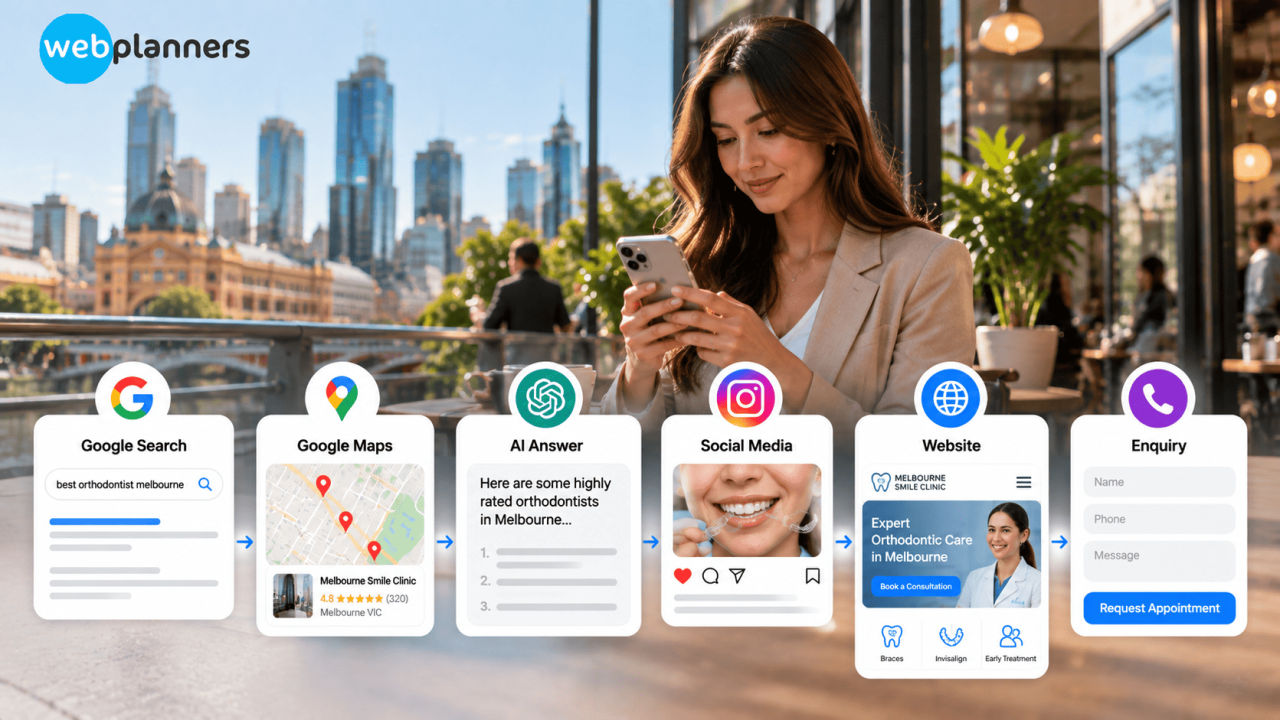
Search is no longer one simple journey from Google to a website.
A customer might search Google, check Maps, ask an AI platform for recommendations, read reviews, watch a video, compare businesses on social media and then visit a website before making a decision.
For businesses, this changes what visibility really means.
A furniture retailer, for example, may be found through Google when someone searches for a dining table, through Instagram when they see a room setup, through Google Maps when they want to visit a showroom, and through an AI platform when they ask which furniture stores are worth considering.
A business can face the same shift. An operations manager looking for warehouse software might search Google first, then ask an AI platform to compare providers, read customer reviews, watch product demonstrations and only then contact a shortlisted company.
The search journey has become fragmented.
In this blog, we’ll look at what that means for businesses and how Google, Maps, AI, social platforms, voice search and websites now work together throughout the customer journey.
Search visibility is no longer about appearing for one keyword or holding one Google position.
Customers can encounter a business through several channels before they make contact. This includes:
- Google organic results and AI-generated search experiences.
- Google Maps and local business listings.
- AI platforms and conversational search.
- Social media and video content.
- Reviews and third-party websites.
- Voice searches and location-based queries.
- The business website itself.
The goal is not to create a completely different strategy for every platform. It is to build a consistent, useful and trustworthy digital presence that works across the places customers actually search.
The Customer Journey Has Become Much More Fragmented
Think about someone looking for a new sofa.
Their first search might be:
“Best modular sofas Melbourne.”
They may then check Maps to see which stores are nearby. They could look at Instagram for styling ideas, read customer reviews and ask ChatGPT something like:
“Which Melbourne furniture stores have good options for small apartments?”
They might eventually visit a retailer's website to compare prices, delivery information, materials and returns.
The customer has moved through several search environments without necessarily thinking about them as separate channels.
Someone researching commercial accounting software might search for providers, read comparison pages, check reviews, ask an AI tool for suitable options and then visit two or three websites before requesting a demonstration.
This means a business can be visible at one stage and absent at another.
Strengthen Your Visibility Across Search Journeys
Google Still Matters, But The Results Page Is Changing
Traditional Google search remains important, but the experience around the results continues to change.
AI-generated answers can provide information directly within search experiences, reducing the need for users to open several individual websites.
That makes the quality and clarity of the information surrounding a business increasingly important.
For example, a Melbourne home renovation company might have a page targeting kitchen renovations. But customers could also search:
- How much does a kitchen renovation cost?
- What should I ask a renovation company?
- How long does a kitchen renovation take?
- Which materials work best for small kitchens?
The business has opportunities to provide useful information throughout that research process, rather than relying on one commercial page.
Understanding how AI search systems select and present information is already becoming part of modern search strategy. How Google’s AI Overviews choose information.
AI Search Can Change The Way People Shortlist Businesses
AI search adds another layer to the customer journey.
Instead of opening several search results and comparing them manually, a customer can ask a detailed question and receive a response that brings together information from multiple sources.
Consider a business selling commercial cleaning equipment.
A potential buyer might ask:
“What commercial cleaning equipment is suitable for a large hospitality venue in Melbourne?”
The response could consider product types, use cases, specifications, reviews and suppliers.
This creates a different visibility challenge for the business.
Its website needs to explain its products clearly. Its expertise needs to be evident. Important information should not be buried in vague marketing language.
This connects with the growing importance of entity-based SEO, where search systems need to understand what a business is, what it offers, where it operates and how its different areas of expertise relate to one another.
Maps, Reviews And Local Search Can Shape The Decision
For businesses that operate locally, the search journey often moves between organic search and local discovery.
Imagine someone looking for a family dentist.
They might find a practice through Google, check its location in Maps, read reviews, look at photos, check opening hours and then visit the website.
The website is only one part of that experience. Consistent business information matters across these touchpoints.
Name, address, phone number, opening hours, service areas, categories and other important details should make sense wherever customers encounter the business.
This also connects with voice search. A customer might ask a phone assistant for a nearby business, opening hours or a specific product or service. The wording may be more conversational than a traditional typed search.
Social Media Can Influence Search Without Being The Final Destination
Social platforms can play a different role in the search journey. A customer may not use Instagram or YouTube to find a business in the first place. They may encounter the brand through content and then search for it elsewhere.
For example, a skincare brand could publish a short video explaining how to use a particular product. Someone sees the video, searches the brand on Google, checks reviews and then visits the website.
For a B2B manufacturer, a product demonstration on LinkedIn or YouTube could trigger a later branded search from a potential buyer.
Social content therefore does not have to produce the final conversion to have value. It can create awareness that leads to another search.
Your Website Becomes The Place Where Everything Comes Together
A fragmented search journey does not make the website less important.
It gives the website a different role.
Someone arriving from Google, Maps, social media or an AI recommendation should be able to quickly understand:
- What the business offers.
- Who the products or services are for.
- What makes the business credible.
- Where it operates.
- What evidence supports its claims.
- What the customer should do next.
The site also needs a strong technical foundation.
Fast loading times, mobile usability, structured data, logical internal links and clear content organisation all help users and search systems understand the business.
This is why internal linking needs to support the customer's next question rather than simply add links between pages.
Consistency Matters More As Search Spreads Across More Places
A business can control its website, but it cannot control every platform where customers may encounter information about it.
That makes consistency important.
Imagine a Melbourne furniture retailer whose website says it specialises in custom dining tables, while an old directory listing describes it only as a general furniture store.
Inconsistent information can create confusion for customers and make it harder for search systems to build a clear understanding of the business.
Structured data can also provide additional context around products, services, organisations and other entities. It forms part of the technical foundation discussed in Webplanners' earlier work on preparing websites for AI search.
Better Search Visibility Starts With Better Information
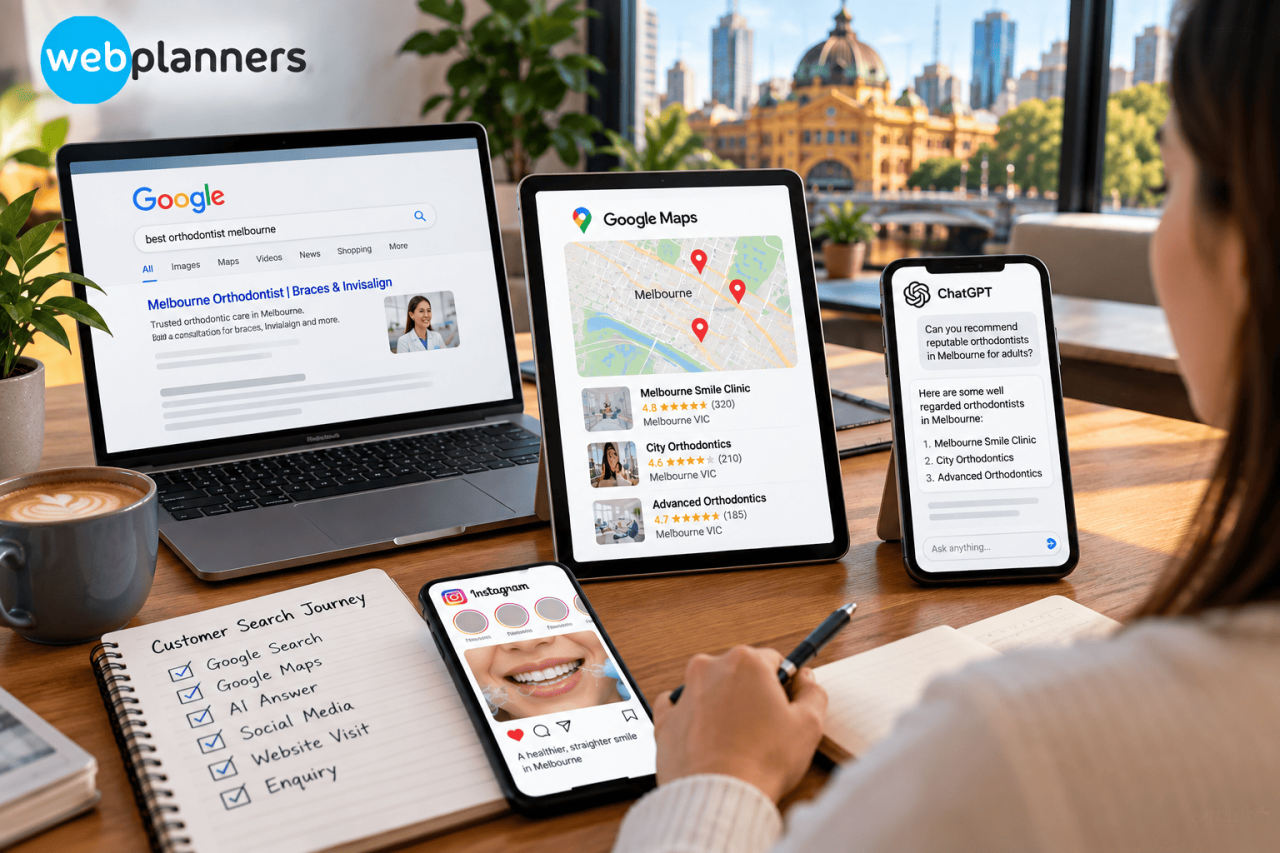
Businesses do not need to create completely separate content for Google, Maps, AI platforms, social media and voice search.
The better approach is to start with genuinely useful information. E-E-A-T principles call for content that demonstrates real experience, expertise, authority and trust, supported by credible information and appropriate evidence.
For example, a commercial property company could publish insights based on actual market observations. An appliance retailer could explain common product issues based on customer questions. A manufacturing company could publish technical information based on its own experience.
That type of content gives customers something more useful than another generic page targeting a keyword.
What Should Businesses Measure Now?
If customers move across several search environments, measuring only organic traffic gives an incomplete picture.
Businesses should also consider:
- Which searches bring qualified visitors?
- How often does the brand appear for important questions?
- Are customers finding the business through local search?
- Which pages assist customers before they enquire?
- Is branded search increasing?
- Which content attracts relevant audiences?
- Are reviews and third-party mentions supporting credibility?
- Where are potential customers dropping out of the journey?
This broader view also helps explain why SEO, AEO and GEO increasingly overlap while serving different search experiences.
Make Your Business Easier To Find Everywhere
Conclusion
The customer may never think about SEO, AI search, Maps or structured data.
They simply want an answer.
They want to know which product is right, which business can solve their problem, whether a company is trustworthy, how much something costs or where they can get it.
Businesses that understand this can build content and digital experiences around the questions customers actually ask.
A furniture buyer, a parent choosing a dentist, a manufacturer comparing suppliers and a business owner researching accounting software may all take different routes.
The common factor is that search now happens across more places.
The question is no longer only “Where do we rank?”
It is also “Where can customers find useful, trustworthy information about us throughout their decision?”
For Melbourne businesses, that broader view is becoming an important part of building sustainable search visibility.
Want to see where your business appears across today's search journey? Talk to Webplanners about assessing your current search visibility.
FAQs
Does A Customer Have To Visit A Website Before Contacting A Business?
No. A customer may call from a Maps listing, message through social media, visit a physical location or contact a business after seeing an AI-generated recommendation. The website still plays an important role, but it may not be the first or final touchpoint.
How Can A B2B Business Show Up During The Research Stage?
Useful educational content can answer the questions buyers ask before contacting sales. This could include product comparisons, implementation considerations, technical explanations, pricing factors, common mistakes and practical buying considerations.
Should Every Business Create Content For AI Search Separately?
Not necessarily. Strong, well-organised information written for real customers can support several search environments. The focus should be on accuracy, clear context, first-hand expertise and useful answers rather than creating multiple versions of the same information for different platforms.