Entity SEO Explained: Why Google and AI Need to Know Exactly Who You Are
A business can have a strong website, useful content and years of experience, yet still leave search systems with a surprisingly unclear picture of who it is.
Think about a customer searching for a business by name. Google needs to distinguish that business from companies with similar names. AI systems face a similar challenge when they answer questions about brands, services, locations and expertise.
This is where entity SEO comes in. Rather than looking at a website as a collection of keywords and pages, entity-based search considers the people, businesses, services, products and places represented across those pages, along with the relationships between them.
That distinction is becoming more important as people use Google, AI Overviews and conversational platforms to research businesses before making a decision.
What Is an Entity in SEO?
An entity is a clearly identifiable person, place, organisation, business, product, service or concept.
For example, consider an online furniture store. It is not simply a collection of keywords such as “sofas Melbourne” or “dining tables Melbourne”. It is a business with:
- A recognisable brand.
- Specific products and categories.
- Physical or delivery locations.
- Product information and pricing.
- Customer reviews.
- Expertise and buying resources.
Search engines can use these signals to build a clearer understanding of what the business represents.
This is why repeating a keyword throughout a page is very different from establishing a recognisable business entity.
Why Entity Clarity Matters
Imagine two websites.
The first relies heavily on phrases such as “best running shoes,” “running shoes Melbourne,” and “women’s running shoes,” but gives little context about the brand, its products, expertise or what makes it relevant to customers.
The second clearly explains:
Who the business is → What it does → Who it serves → Where it operates → Why it is qualified
The second website gives search systems much more context.
Google’s structured data documentation describes structured data as a way to provide explicit clues about the meaning of page content. It can help Google understand entities and relationships, although it does not guarantee rankings or enhanced search appearances.
That same principle matters when AI systems are trying to determine which business a question refers to.
Make Your Business Easier to Understand Online
Entity SEO Goes Beyond Your Business Name
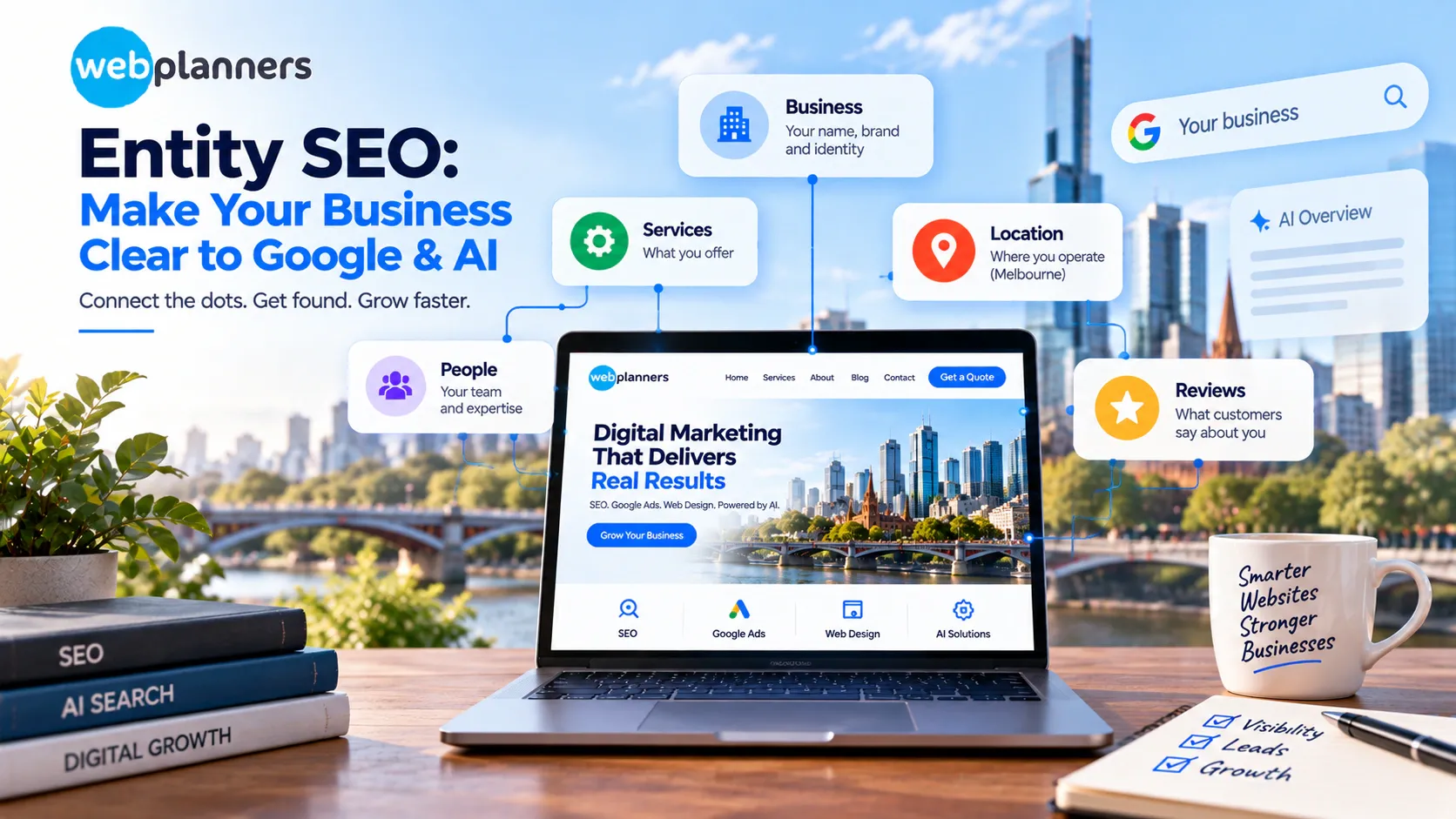
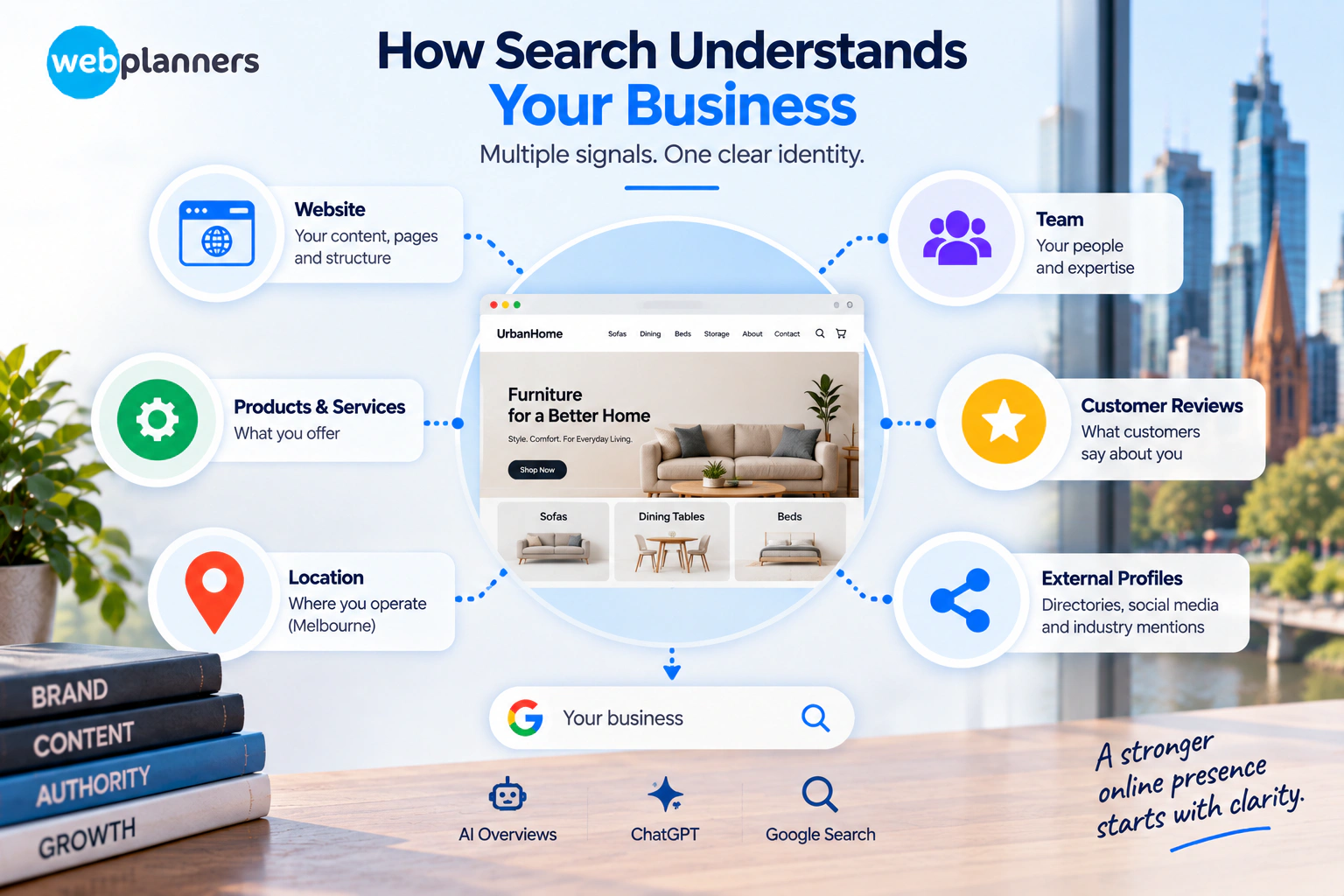
Your brand name is only one part of your entity. Search systems can connect several types of information around a business.
Your business
Make the organisation clearly identifiable through consistent information across important pages and credible external references.
Your services
Each major service should have a clear description rather than being mentioned briefly across dozens of unrelated pages.
For example, if an online furniture store sells sofas, beds and dining tables, each product category should have its own clear context rather than placing every product under one generic page.
Your location
Location can add another layer of meaning.
A business may operate in Melbourne while also serving customers in Sydney, Brisbane or Adelaide. The website should make those relationships clear where they are genuinely relevant.
This is particularly important for businesses relying on local search, where location, service area and customer intent can strongly affect which businesses appear.
Your people and expertise
Authors, founders, specialists and other identifiable professionals can add context around a business’s expertise.
That information should be genuine and supported by appropriate profiles, experience and content.
Your external presence
Your website is not the only source of information about your business.
Business directories, industry publications, professional profiles, reviews and other credible references can contribute to how your organisation is understood across the web.
Consistency matters here. If different sources describe your business in conflicting ways, search systems have more ambiguity to resolve.
Entity SEO and Keywords Are Not the Same Thing
Keywords still matter.
If someone searches for “SEO consultant Melbourne”, that phrase provides useful information about what they want.
But the search system also needs to understand:
Which business provides that service?
Where is it located?
What does the business specialise in?Is this a reliable source?
What other evidence supports those claims?
This is why you can’t just depend on keyword placement in modern SEO.
Our SEO consultants focus on business goals, technical optimisation, content planning and measurable search performance rather than the whole strategy being individual keywords.
How Structured Data Supports Entity Understanding
Structured data can give you more information about what a page is about.
For a business, this could include information on:
- Organisation.
- LocalBusiness
- Services.
- Website.
- Logo.
- Address.
- Contact Information.
- Similar profiles.
The important thing is that structured data should represent information that the page actually supports.
For example a local business page should have the right business name, address, and other relevant details and be consistent.
Schema does not create an entity out of thin air.
It provides structured information about an entity that already needs to be clearly represented.
Your Website Should Tell One Consistent Story
Consider an online furniture store that describes itself differently across its website and external profiles.
The homepage positions it as a furniture retailer. One page focuses on bedroom furniture.
A directory categorises it as a homewares store. Another profile uses a slightly different brand name.
A customer may still understand that these profiles refer to the same store. A search system has a harder job connecting all those signals.
The goal is not to make every mention identical. It is to keep the important business details consistent enough for those relationships to be clear.
This includes checking:
- Business name.
- Website.
- Contact details.
- Locations.
- Main services.
- Team information.
- Business descriptions.
- External profiles.
Entity SEO and Content Are Closely Connected
A business entity becomes clearer when its website provides useful depth around what it actually offers.
Suppose an online furniture store sells sofas.
A single page saying “We sell furniture” gives limited context. A stronger website may contain:
Sofa collection → Sofa buying guide → Material and care information → Customer reviews → Related furniture
Each page adds useful context about the products, the brand and what customers can expect.
This is why relevant, connected content is more valuable than simply publishing large volumes of pages around similar keywords.
Webplanners’ recent research into AI search visibility across Melbourne industries found that clear business identity, useful industry information and relationships between pages all play a role in how businesses are represented in AI-driven search experiences.
What AI Systems Need to Understand About Your Business
When someone asks an AI platform:
“Who provides this service in Melbourne?”
The system needs enough information to make sense of the question and the businesses it may recommend.
It may need to establish:
- What the business does.
- Where it operates.
- What it specialises in.
- Who it serves.
- Whether credible information supports those claims.
- How the business differs from alternatives.
This is where entity clarity can support AEO and generative search visibility.
It also connects with the principles behind ChatGPT optimisation, where business information needs to be clear enough for AI systems to interpret and potentially reference. Webplanners’ ChatGPT optimisation resources place entity information alongside content, authority and structured data as important components.
What About AI Overviews?
AI Overviews make entity clarity even more relevant because a search response can combine information from different sources instead of simply displaying one webpage.
For example, a person might search for:
“Which Melbourne business is suitable for small business SEO?”
The question is not just about finding a page containing the words “small business SEO”.
The system needs to understand which businesses offer the service, where they operate, what they specialise in and what information supports those associations.
Google says AI Overviews and AI Mode use the same foundational SEO practices as Google Search. There is no separate technical requirement or special AI markup that guarantees inclusion.
That makes the fundamentals important: clear content, accessible pages, reliable information and a website structure that makes sense.
Build Relationships Between Your Pages
Entity understanding does not stop at individual pages.
Consider a B2C home services business:
Air conditioning installation → Air conditioning buying guide → Installation project → Air conditioning maintenance
Each page answers a different customer need while remaining connected to the same business and service area.
That relationship can be strengthened through useful internal links.
The same principle applies to a business’s broader content structure. A service page can connect to supporting resources, while relevant case studies can provide evidence of experience.
This approach also gives GEO more useful material to work with because the business is represented through connected, context-rich information rather than isolated pages.
How to Strengthen Your Business Entity
You do not need to create hundreds of pages.
Start with the information that already exists.
Make the business description precise
Explain what the business does, who it serves and where it operates.
Give important services their own context
A major service should not be buried inside generic homepage copy.
Keep business information consistent
Check your website and relevant external profiles for major differences in business name, location and contact information.
Connect related pages
Use internal links where they genuinely help customers understand a subject or move towards the next step.
Support expertise with evidence
Use genuine case studies, experience, credentials, reviews and useful original information where appropriate.
Use structured data carefully
Add relevant schema that accurately describes the page rather than filling every available property.
Strengthen Your Business Entity Across Search
A Simple Entity SEO Audit
You can start with these questions:
| Question | What it reveals |
|---|---|
| Is the business clearly identified? | Brand clarity |
| Are services clearly defined? | Service relevance |
| Are locations accurate? | Local context |
| Are important people identified? | Expertise |
| Is business information consistent? | Entity confidence |
| Are related pages connected? | Topical relationships |
| Does structured data match the page? | Machine-readable context |
| Do credible external sources support the business? | Authority |
If several answers are unclear, the problem may not be a lack of keywords.
It may be a lack of context.
Conclusion
Entity SEO is ultimately about clarity. Search systems have to know more than what words are on a page. They need context around the business, its services, locations, expertise and relationships with other related information.
For a Melbourne business that means creating a consistent digital identity, not just repeating keywords.
Clear service pages, useful supporting content, accurate business information, appropriate structured data and credible external references can all contribute to that picture.
As search becomes more conversational and AI-generated answers become part of the customer journey, being clearly understood matters alongside being well ranked.
If you are not sure how well Google and AI systems understand your business, then reviewing your website content, entity signals and search structure can help you identify where the gaps are.
Get in touch with Webplanners to build a clearer search presence for your business using the help of SEO strategy, structured data and practical AI search considerations.
FAQs
Is entity SEO replacing traditional SEO?
No. Entity-based optimisation adds another layer to SEO. Keywords still help describe what people search for, while entity signals help search systems understand the businesses, services, people and places behind those searches.
Does my business need a Knowledge Panel to have a strong entity?
No. A Knowledge Panel is not a requirement for having a clearly established business entity. Focus first on consistent business information, useful content, structured data where appropriate and credible references.
Can changing my business name affect entity recognition?
Yes. Major changes to your business name, website, location or branding can create inconsistencies if they are not updated across important sources. When changes occur, review the website, structured data and relevant external profiles.
Does schema markup create an entity?
No. Schema can provide structured information about an entity, but it does not replace clear business information, useful content or credible external signals.
How does entity SEO relate to local search?
Location is an important part of many business entities. A local business should make its genuine location, service areas and business information clear. This supports the wider local search strategy rather than replacing it.
Our Recent Blogs

Couldn't be happier with how things have gone since working with Webplanners. The team genuinely cares about getting results and has helped us stay ahead of the competition. Thanks for all the hard work, legends!
Webplanners has been a huge part of our digital growth. Managing multiple websites isn't easy, but they've made the whole process feel effortless. The results have exceeded our expectations.
The team has been great to work with and always keeps us in the loop. We've seen steady improvements over time and the whole process has been straightforward. Very happy with how things are going.