Schema markup is often treated as a technical SEO task that gets added to a website once and then forgotten. That can be a mistake.
Your website contains information about your business, services, locations, products, people and content. Search engines need to understand what those elements represent and how they relate to each other. Structured data provides additional context in a machine-readable format.
This matters as search experiences become more varied. A customer may encounter traditional organic results, local listings, AI Overviews and other answer-led experiences during the same search journey.
So, what should a Melbourne business actually check in 2026?
This schema markup checklist covers the main areas worth reviewing, what commonly goes wrong, and how structured data fits into a broader search strategy.
Start With the Page
Before adding structured data, look at the actual page.
Ask:
- What is this page about?
- What business, service, product or person does it represent?
- What information can visitors see?
- Which entities and relationships are important?
- Does the proposed markup accurately describe the visible content?
Google suggests using structured data to provide explicit clues about the meaning of a page. It can help pages become eligible for certain enhanced search appearances, but correct implementation does not guarantee rankings or a rich result.
The simplest rule is:
Schema should describe the page, not add information that the page does not support.
Make Your Website Easier to Understand
The 2026 Schema Markup Checklist
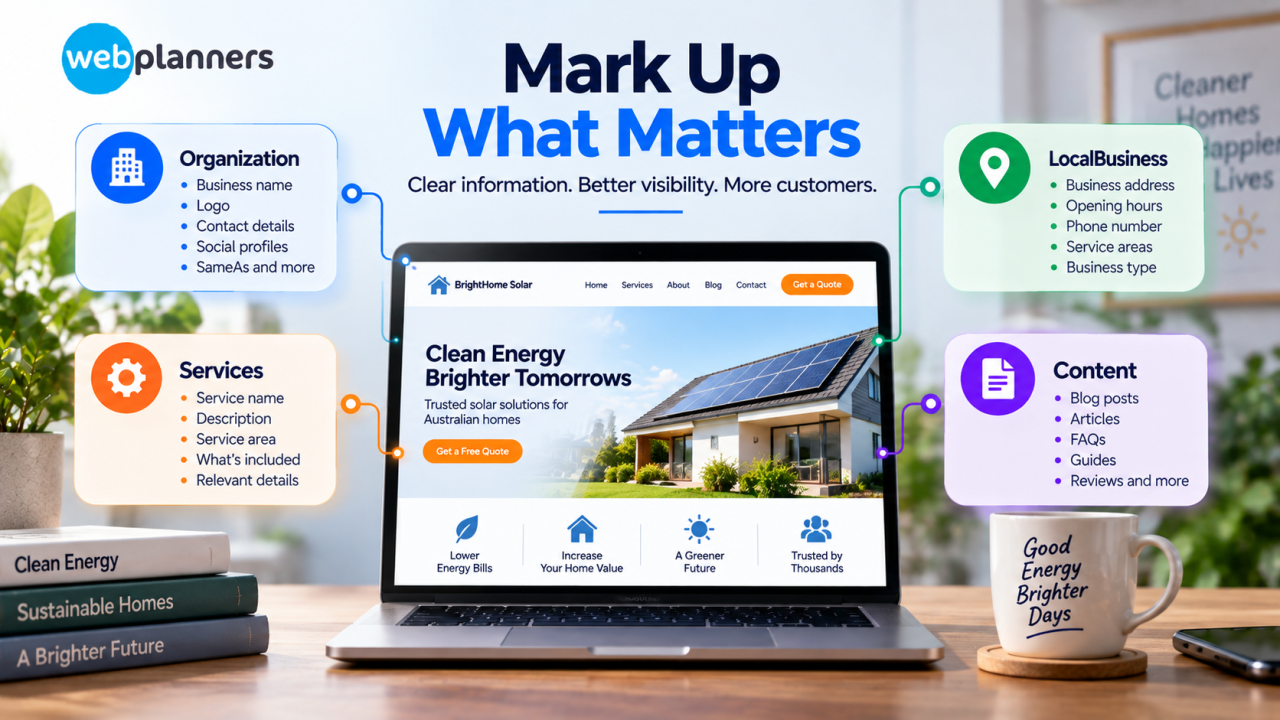
1. Organisation Schema
Start with the business itself.
Organisation structured data can communicate information such as:
- Business name.
- Logo.
- Website.
- Contact information.
- Relevant profiles.
- Other identifying information.
This gives search systems a clearer representation of the organisation behind the website.
For a Melbourne business, consistency is important. Your business name, website, branding and other identifying details should make sense across your website and relevant external sources.
2. LocalBusiness Schema
If customers visit your premises or you operate within defined service areas, local business information deserves particular attention.
Depending on the business, this can include:
- Business name.
- Address.
- Phone number.
- Opening hours.
- Business type.
- Location information.
Google recommends using the most specific applicable LocalBusiness subtype.
That’s in addition to local SEO. Your Google Business Profile, reviews, location pages, business information and local relevance are still important.
For businesses servicing Melbourne suburbs, the site should be a reflection of real service areas and customer relevance rather than repetition of suburb names.
3. Service Schema on Important Service Pages
A service page should make it immediately clear what the business provides, who the service is for and what the customer can expect.
Where applicable, Service structured data can reinforce what that page represents.
For example, a page about air conditioning installation should focus on the installation service, what it includes and who it is intended for, rather than trying to represent every service offered by the business.
The same principle applies to web design, paid advertising and AI-related services.
For anyone comparing an SEO company in Melbourne, the amount of schema on a website is less important than whether the service information is accurate, useful and clearly organised. Webplanners' SEO service structure reflects this separation between different areas of digital marketing.
4. Article and BlogPosting Schema
Business blogs can use suitable Article or BlogPosting structured data.
Relevant information may include:
- Headline.
- Author.
- Image.
- Publication date.
- Modification date.
The information should reflect what is actually presented on the page.
If a genuine author wrote the content, identify that author correctly. If the page has been updated, use the appropriate modification information.
Do not add dates, authors or other properties simply because they are available.
5. BreadcrumbList Schema
Breadcrumbs help users know where a page is on your website.
For example :
Home → SEO → Local SEO → Google Map SEO
This makes a more obvious link between the main service, the supporting topic and the individual page.
Google recommends that breadcrumb markup represent a typical user path rather than simply copying the URL structure.
This becomes particularly useful on larger websites where blogs, services, location pages and supporting resources cover related subjects.
6. Product Schema for Ecommerce
For ecommerce websites, product structured data can communicate information such as:
- Product name.
- Brand.
- Image.
- Price.
- Availability.
- Product identifiers.
- Reviews, where applicable.
This information must be the same as what shoppers see on the page.
If a product is not in stock, the structured data should not show that it is in stock.
What About FAQ Schema?
FAQ schema and FAQ content are two different things.
Customers really need answers, so a business can still be publishing useful FAQs. But the FAQ markup on every page does not automatically create a Google rich result.
The better approach is:
Write FAQs for customers first. Add structured data when it genuinely applies.
This can also support answer-focused content. Clear questions followed by direct answers give readers useful information and make the page easier to interpret.
That is where AEO can naturally fit into a broader content strategy rather than becoming a reason to add unnecessary markup.
Does Schema Have a Role in AI Search?
There is no special piece of "AI schema" that guarantees visibility in ChatGPT, Gemini or Google's AI search experiences.
Google's guidance says the same foundational SEO practices remain relevant for AI Overviews and AI Mode. Pages need to meet Google's normal technical requirements and be eligible to appear in Search.
Google also says there are no additional technical requirements or special schema.org markup required specifically for AI Overviews or AI Mode.
That does not make structured data irrelevant.
It means schema should be treated as one part of a website's information structure.
For example:
Business → Service → Location → Supporting content
When these relationships are clear across the website, search systems have more context about what the business represents.
This is also relevant to GEO, where the wider goal is to make business information clear and useful within generative search experiences.
Make Your Structured Data Match Your Content
One of the most important checks is also one of the easiest to overlook.
If your page says one thing and the schema says another, you have created conflicting signals.
Check:
- Business name.
- Address.
- Phone number.
- Opening hours.
- Service names.
- Product information.
- Author details.
- Images.
- Dates.
- Reviews.
Google's structured data guidelines state that markup should represent visible page content and should not be misleading or irrelevant.
Don't Let Templates Create Bad Schema
Templates can save time, but they can also create problems.
A blog post, service page, location page and product page do not represent the same thing.
For example, if a template automatically adds identical business information to every page, that may be unnecessary. If a page-specific field is populated with incorrect information, the problem becomes more serious.
This is why structured data needs to be reviewed alongside the website architecture rather than treated as an isolated code task.
Webplanners has also documented how AI can assist with schema drafting and internal link mapping, while human review is used before implementation.
Schema and Internal Linking Should Work Together
Structured data is more useful when the wider website has clear relationships between its pages.
Consider a website with:
Solar installation → Solar panels for homes → Solar system costs → Homeowner resources
Those connections should make sense to the visitor.
The same principle applies to:
Solar panel installation → Solar buying guide → Customer project → Battery storage
Internal links help users move between relevant information while giving search engines additional context about the site's structure.
This becomes particularly useful when a website covers several closely related subjects.
Don't Forget the Technical Foundation

Structured data cannot compensate for basic website problems.
Before refining your markup, check that:
- Important pages can be crawled.
- Important pages can be indexed.
- Canonical URLs are appropriate.
- Internal links work correctly.
- Important information is available as text.
- JavaScript is not hiding essential content.
- The website architecture is logical.
- Structured data is present on the intended pages.
Google specifically recommends making important content available in textual form and keeping structured data consistent with visible page content.
This is where technical SEO sits within the wider process rather than as a separate task.
How to Test Your Schema
A schema audit should go beyond checking whether a tool displays a green tick.
Review:
| Check | What to look for |
|---|---|
| Accuracy | Does the markup match the page? |
| Relevance | Is the schema type suitable? |
| Completeness | Are important applicable properties included? |
| Consistency | Does business information match elsewhere? |
| Relationships | Are important entities connected logically? |
| Indexability | Can Google access the page? |
| Validation | Does the markup pass testing? |
| Maintenance | Will it remain accurate after updates? |
Google recommends the Rich Results Test for checking supported structured data and URL Inspection for checking how Google sees a page.
Common Schema Problems to Remove
Marking Up Hidden Information
Structured data should represent information that users can access on the page. Adding hidden or misleading information can make the markup ineligible for rich results.
Using the Wrong Schema Type
A product, service, organisation and blog post represent different things.
Choose the type that most accurately describes the page.
Copying Identical Markup Across Every Page
A website template should not automatically turn every page into the same structured-data object.
Page-specific information should remain page-specific.
Leaving Old Information Behind
Business details change.
When an address, phone number, service, opening hours or other important information changes, check the structured data as well.
Adding Every Possible Property
More schema does not automatically mean better results.
Google recommends providing fewer complete and accurate properties rather than trying to fill every possible field with incomplete or unreliable information.
Build a Stronger Search Foundation
Your Practical Schema Markup Checklist
This is the section worth turning into a visual checklist for the blog:
- Organisation information is accurate.
- LocalBusiness markup is used where relevant.
- The most suitable business subtype is selected.
- Service pages describe their actual services.
- Blog posts use suitable Article or BlogPosting markup.
- Product pages use relevant product structured data.
- Breadcrumbs represent a genuine user path.
- Markup matches visible content.
- Business information is consistent across relevant sources.
- Important pages are indexable.
- Internal links connect related content.
- Structured data has been tested.
- Outdated information has been removed.
- Schema supports the wider website structure.
Conclusion
A useful schema markup checklist is not a list of every property available in Schema.org.
It should answer one practical question:
Does the structured data accurately explain what each important page represents?
For a Melbourne business, that can mean clearly connecting the organisation with its services, products, locations and content while keeping those details consistent.
Schema also works within a wider search strategy. Clear content, strong internal linking, accessible pages, reliable business information and useful expertise all contribute to how a website is understood.
If your website has accumulated structured data through plugins, templates, redesigns or years of content updates, it may be worth checking what is actually being presented to search engines.
At Webplanners, our AI SEO services can review your website's structured data, search foundations and wider visibility strategy, then prioritise the changes that have a practical purpose for your business.
FAQs
Can schema markup improve my Google rankings?
Not directly. Structured data can help Google understand the content of a page and may make pages eligible for certain enhanced search appearances, but it doesn’t guarantee better rankings or a rich result.
Should a local business use both Organisation and LocalBusiness schema?
It can be appropriate when both accurately describe different aspects of the business. The important point is that the markup should reflect genuine information available on the website.
Can schema help get my website into AI Overviews?
There is no guarantee. Google says AI Overviews and AI Mode follow the same foundational SEO practices as Search and do not have any special AI-specific schema requirements.
Is JSON-LD still relevant in 2026?
Yes. Google supports JSON-LD, Microdata and RDFa and recommends the format that is easiest to implement and maintain. JSON-LD is usually the practical choice for many sites.
How often should we review the Schema?
Review if the website or business has had any major changes. It is also a good thing to check during regular website audits so outdated or template-generated markups do not stay unnoticed.