Google Search is changing how people find information. Instead of seeing only a list of traditional results, users can now receive an AI Overview that brings together information from multiple sources and provides a direct response to their query.
That creates an important question for businesses:
How do AI Overviews work, and what makes Google choose one website as a source?
There is no special formula that guarantees inclusion.
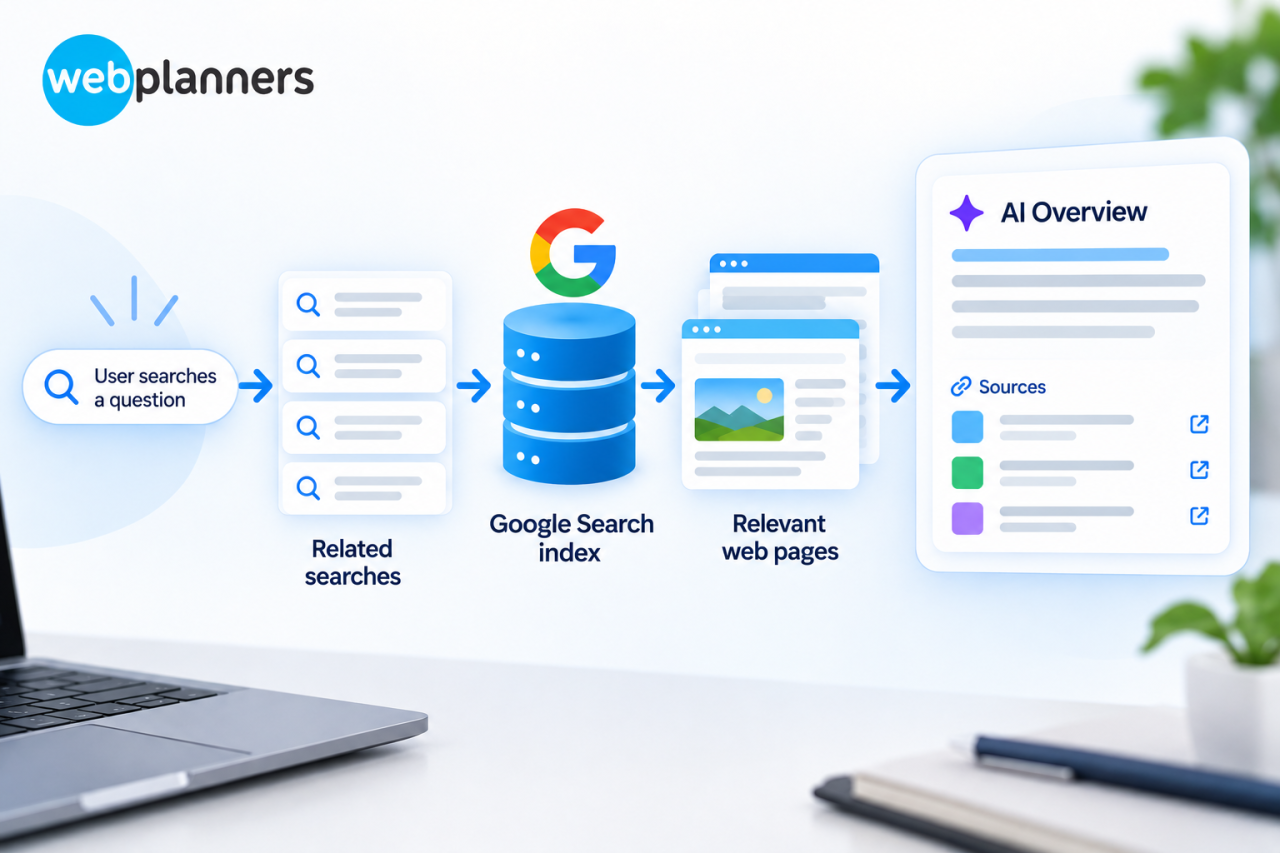
Google's current documentation explains that its generative AI search features use existing Search systems. AI Overviews can retrieve relevant information from Google's Search index and use related searches to gather information before generating a response.
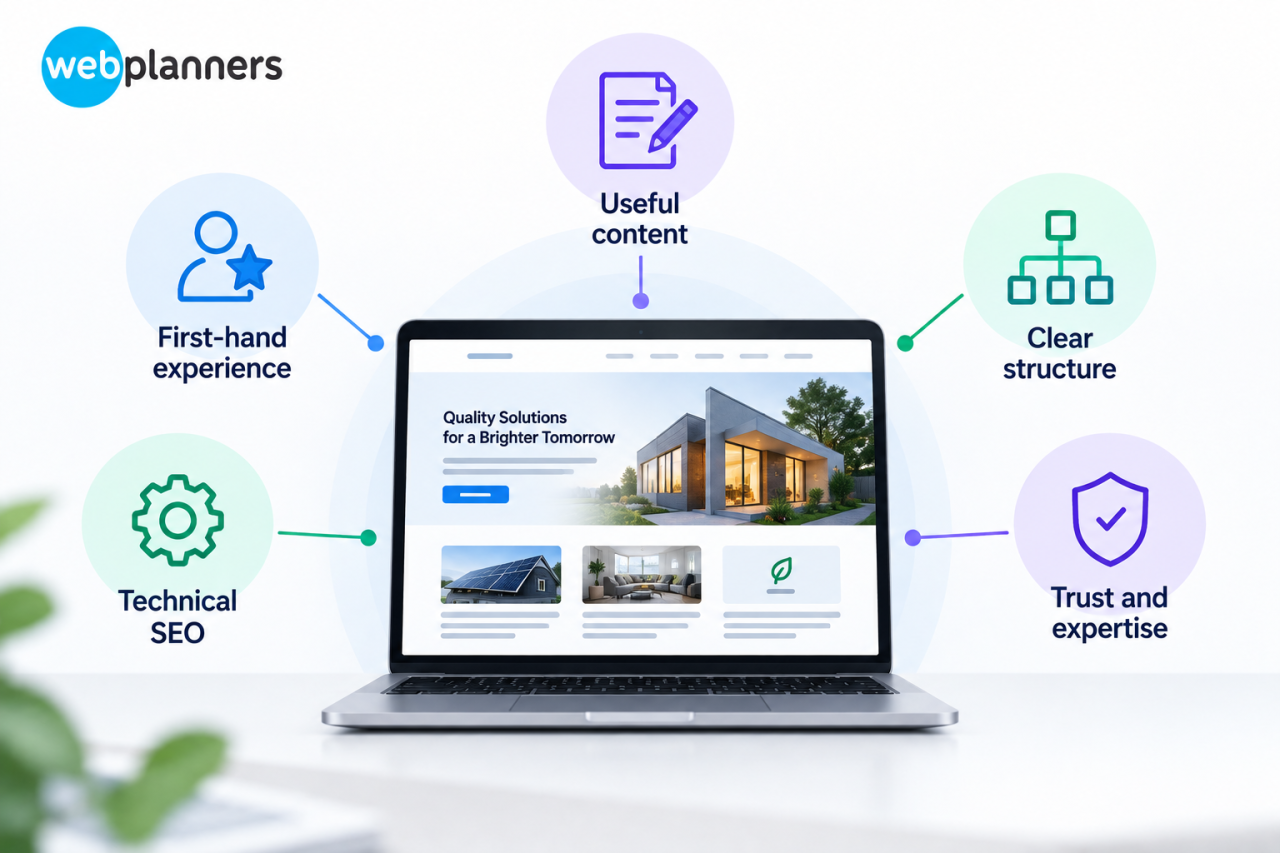
For businesses, this means the fundamentals still matter: useful content, strong SEO foundations, clear information, technical accessibility and genuine expertise.
Keep reading as we will understand how Google’s AI overviews actually choose to show and how to get chosen.
AI Overviews do not simply take the number-one organic result and turn it into an answer.
Google can:
- Understand the meaning behind a query.
- Retrieve relevant pages from its Search index.
- Run related searches to gather information for different parts of a query.
- Generate a response using the information it retrieves.
- Provide links to relevant web sources.
There is no special AI Overview schema that guarantees visibility.
The practical approach is to publish useful information, answer genuine customer questions, demonstrate real expertise and maintain a website that Google can access and understand.
How AI Overviews Work
To understand how AI Overviews work, it helps to look beyond the generated answer itself.
A user might search:
"What's the best type of solar system for a Melbourne home?"
That question can involve several related considerations:
- What size system suits the property?
- What affects solar output?
- What type of system is appropriate?
- What does installation include?
- What does a homeowner need to know before they buy?
Google can use related searches to gather information about these different aspects before producing an AI-generated response.
Google might use related searches to pull information on these different aspects before providing an AI-generated answer.
That’s important because your page doesn’t need to be an exact match of the original query to be relevant.
For example, a page that explains solar system sizing in simple and easy to understand language may contain information that is relevant to one part of the larger question.
That is why modern AI SEO is more than simply adding more variations of the same keyword. It’s all about providing relevant, useful & easy to understand information on your website.
Improve Your Visibility In Google AI Overviews
What Makes a Website More Useful for AI Search?
There is no published formula that says a page needs a specific word count, number of headings or number of links to appear in an AI Overview.
But instead, Google’s current guidance is leaning towards useful, original and people-first content. It also stresses the importance of first hand experience and information that adds something above and beyond what is already widely available.
Answer real customer questions
Start with what your audience actually wants to know.
For example, an air conditioning business could publish a page explaining:
- How to choose a system for different room sizes.
- What affects installation costs.
- When an existing system may need replacing.
- Common problems homeowners experience.
- What to consider before booking an installation.
That is much more useful than repeating "air conditioning Melbourne" throughout the page.
This is also where Answer Engine Optimisation (AEO) can complement traditional SEO. The focus is on making important information clear enough to answer specific questions rather than writing solely around keyword variations.
Add genuine experience
Generic information is easy to reproduce.
Real experience is harder to replicate.
A solar installer, for example, can explain common installation issues, property-specific considerations and mistakes homeowners often make.
That type of information gives readers a reason to trust the business.
It’s also a win for E-E-A-T, particularly experience and expertise, because the content demonstrates knowledge, not just retreading what’s out there.
Does Ranking Number One Mean You Will Appear?
A good organic ranking is still valuable, but it does not mean that page will be chosen as a source for an AI Overview.
AI-generated responses can draw on information retrieved for different parts of a query. As a result, the page that provides the most useful information for one aspect of the search may not be the number-one organic result for the original query.
This does not make traditional SEO less important.
In fact, your content still needs to be accessible to Google's Search systems before it can contribute to Search visibility.
Webplanners discusses this shift in its analysis of AI search visibility, including why a page-one ranking does not tell the whole story about visibility in modern search.
Does AI Summaries Need a Special Schema?
There is no special schema that guarantees inclusion in an AI Overview.
Google’s documentation states that its generative AI search capabilities require no additional technical requirements or special markup. Existing Search requirements continue to apply.
Structured data still helps Google understand what page content qualifies for certain Search features, and how to support those features, but it should reflect information visible on the page.
So don’t look for an “AI Overview schema,” but instead think about whether your website is providing clear, accurate and useful information.
Your Technical SEO Still Matters
AI search does not kill the need for a technically good website.
Google’s guidance now states that pages must be indexed and eligible to appear in Search to be considered for generative AI features.
This makes technical SEO a fundamental component of the foundation.
Make sure that:
- Critical pages can be crawled.
- Key content is available.
- The pages are properly indexed.
- Internal links connect related information.
- The products and services are clearly presented and are relevant.
- The site works well across devices.
- Search engines can read the main content.
- You also have an internal link structure on your site that makes sense.
When related pages are linked naturally, visitors can move between useful information, and search engines get more context about the relationship between those pages.
Does AI Created Content Help You Get Chosen?
Generative AI search results are subject to the same spam policies as traditional Search. Creating large volumes of unoriginal content primarily to manipulate Search can fall under scaled content abuse.
AI can still support research, analysis and content production.
The important part is what happens after that.
Human expertise should add:
- First-hand knowledge.
- Business-specific examples.
- Accurate facts.
- Original observations.
- Useful context.
- Proper review and editing.
That is why the question should not be:
"How much content can we produce with AI?"
Instead ask:
"What useful information can we provide that genuinely helps the customer?"
What Should Businesses Do to Improve Their Chances?
No business can guarantee that Google will cite a particular page.
You can, however, improve the quality of the pages you want to be visible.
Start with these checks:
- Does the page answer a real customer question?
- Are related pages connected with relevant internal links?
- Are services, locations and products clearly explained?
- Does the content help someone make a decision?
A useful test is to read the page as if you knew nothing about the business.
Could you understand what the company does?
Could you find the answer to your question?
Could you see why this business is qualified to provide the information?
If the answer is yes, the page is already doing several things that support strong AI search visibility.
A Simple AI Overview Readiness Check
Before investing in another AI search tool, review your most important pages.
Content
- Does each page have a clear purpose?
- Is the important content available to search engines?
Trust
- Is the business clearly identified?
- Is relevant experience visible?
- Are claims supported?
- Are useful case studies, reviews or evidence available?
Search strategy
- Are important pages already receiving organic visibility?
- Do pages match the intent behind valuable searches?
- Are related topics connected through useful internal links?
- Are you monitoring changes in AI and traditional Search?
This provides a much better starting point than trying to find a secret AI Overview formula.
Strengthen Your Website For AI Search
Conclusion
There’s no single ranking trick that will ensure a spot in Google’s AI Overviews. Relevant information is retrieved from Google’s Search index, and related searches are used to help build a response, so sources selected can vary from query to query.
The best thing you can do is to develop a website that gives useful and credible information, is built on a solid SEO foundation, and clearly demonstrates what your business knows and does. AI search is changing the way people find information, but strong SEO continues to be at the core of search visibility.
Partnering with an experienced SEO company in Melbourne can convert these principles into an actionable search strategy for businesses looking to enhance their visibility across Google and AI-driven search.
Webplanners blend SEO expertise and AI-driven knowledge to help Melbourne businesses improve their search visibility. Get in touch to learn how we can help you generate more qualified traffic.
FAQs
Can I guarantee that my website will be listed in an AI Overview?
No. There is no way to guarantee inclusion in a specific AI Overview. Following Google’s Search guidelines and best practices can support eligibility, but the information that is chosen may differ based on the query.
Do I need a special schema for AI Overviews?
No. Google’s generative AI search features don’t need special AI-specific markup. Structured data can still support eligible Search features, provided that they accurately describe visible page content.
Does ranking first guarantee AI Overview visibility?
No, a strong organic ranking is still valuable, but it’s not a guarantee that a page will be selected as a source for an AI-generated response.
Should I create more content to be featured in AI Overviews?
Don't focus more on quantity. Google says not to make a lot of unoriginal content to manipulate Search. Focus on useful information, real expertise and customer needs.