SEO has changed significantly, but plenty of old advice is still passed around as if it were a rule.
Some businesses still worry about hitting a specific keyword density. Others think ranking number one guarantees leads, that every page needs thousands of words, or that AI search means traditional SEO no longer matters.
Google itself addresses several of these misconceptions in its current SEO documentation, including keyword stuffing, word count, PageRank, duplicate content, heading structure and E-E-A-T. It also states that SEO best practices remain relevant to its generative AI search features.
Keep reading as we'll explore common SEO myths from what actually deserves your attention in 2026.
1. Myth
: SEO is just about putting keywords on a page
Keywords still matter because they help describe what a page is about. But SEO is not a matter of repeating the same phrase until Google gets the message.
Google says its language systems can understand how pages relate to different queries without requiring every exact keyword variation to appear on the page. It also explicitly classifies excessive keyword repetition as keyword stuffing.
A better approach is to understand the topic behind the search.
For example, a page about family car washing might naturally cover the keywords that help establish relevance. The useful information gives the page substance.
2. Myth: Every page needs a specific word count to rank
A page should contain enough information to satisfy its purpose, rather than stretching a simple subject into 2,000 words because an SEO tool recommends it.
A product page for a pair of running shoes does not need to become a lengthy essay. It needs the information a buyer actually needs:
- Materials
- Fit
- Sizes
- Features
- Use cases
- Delivery
- Returns
A detailed comparison page may need substantially more information.
Useful content beats arbitrary word counts.
3. Myth: Ranking number one means your SEO is working perfectly
A page can rank highly for a search that generates plenty of impressions but few enquiries. Another page might receive less traffic but bring customers who are ready to buy.
That means SEO reporting should look beyond position.
Consider:
- Organic conversions.
- Qualified enquiries.
- Revenue.
- Search impressions.
- Click-through rates.
- Relevant landing pages.
- Branded search activity.
This becomes even more important as search results change. Google now includes AI Overviews and AI Mode alongside traditional results, while Search Console provides reporting for generative AI features.
The question is not simply “What position are we in?”
It is “Is organic search bringing the right people to the business?”
4. Myth: SEO is dead because people are using AI
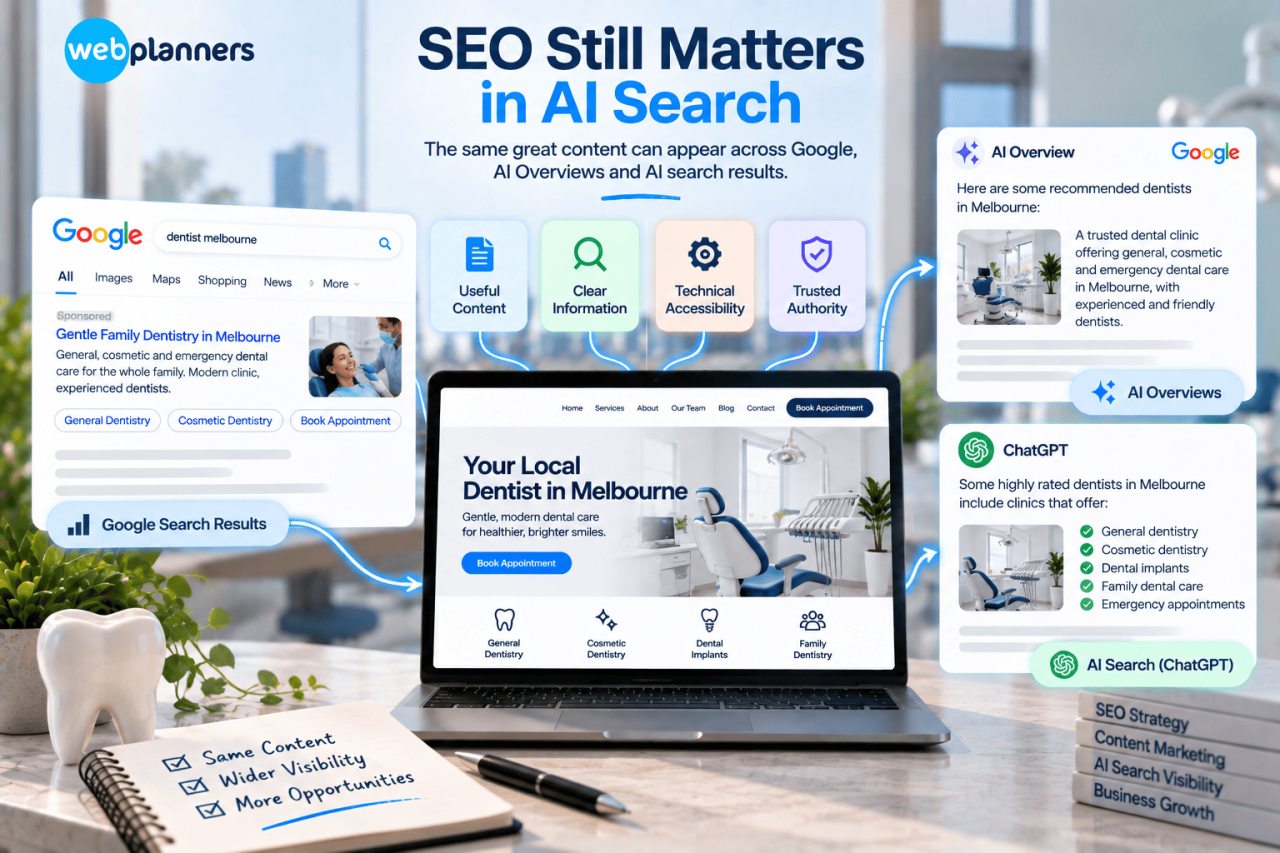
AI search has changed how people can find information. It has not made SEO irrelevant.
Google's current documentation says its generative AI search features are based on its core Search ranking and quality systems, and that SEO best practices remain relevant.
What has changed is the search journey.
A customer might now ask an AI platform:
“Which Melbourne car detailing businesses should I consider for a ceramic coating?”
instead of searching only:
“car detailing Melbourne”
That creates additional opportunities for useful, specific content.
This is where services such as AEO and GEO have entered the conversation. They can be useful ways to think about answer-focused and generative search visibility, but Google itself warns against treating AEO or GEO “hacks” as a shortcut to rankings or AI visibility.
Traditional SEO remains part of the foundation.
5. Myth: Local SEO is only about your Google Business Profile
A Google Business Profile is important for many local businesses, but local visibility does not begin and end there.
Your website can also provide useful local context through:
- Service areas.
- Location-specific services.
- Contact details.
- Local landing pages.
- Relevant customer information.
- Business information.
- Consistent references to where you operate.
For example, a Melbourne car wash targeting customers across several suburbs should make its service areas clear rather than simply repeating “car wash Melbourne” throughout the site.
That is why local SEO services often involve both your Google Business Profile and the wider website.
6. Myth: E-E-A-T is a ranking factor you can simply optimise

This one causes considerable confusion. Google states that E-E-A-T is not itself a ranking factor.
That does not mean experience, expertise, authority and trust are irrelevant.
They influence how useful and trustworthy content appears to users, and Google's people-first guidance specifically asks whether content demonstrates first-hand expertise and whether readers can understand the expertise behind the information.
So instead of adding “E-E-A-T” to a page and calling the job done, show the substance behind your claims.
For a construction business, that could mean:
- Project experience.
- Building methods.
- Material knowledge.
- Before-and-after examples.
- Relevant qualifications.
- Detailed project explanations.
- Genuine customer outcomes.
Evidence is more useful than a label. For businesses that need specialist support, working with an SEO consultant in Melbourne can help turn these fundamentals into a strategy based on the site's actual problems rather than a checklist of fashionable tactics.
Conclusion
Most SEO myths have something in common: they turn a complex system into one simple rule.
“Use this many keywords.”
“Write this many words.”
“Get this many backlinks.”
“Publish every week.”
“AI has replaced SEO.”
Real SEO does not work that neatly.
Google uses many systems to understand and rank content, and its own documentation repeatedly points site owners back towards useful content, technical accessibility, relevant links and a good user experience.
For businesses, that means the strongest strategy is rarely the one with the most tricks.
It is the one that makes the website genuinely useful to the people who matter.
If your website needs a clearer search strategy, Webplanners SEO services can help assess the technical, content and search opportunities across your site, including traditional organic search and newer AI-driven search experiences.
Want to know which SEO myths are holding your website back? Speak with the Webplanners team for a practical review of your current search strategy.
FAQs
How long does it take to see results from SEO changes?
There is no fixed timeframe. Google says some changes can be reflected within hours, while others may take several months, and recommends waiting a few weeks before assessing the effect of many changes.
Should small businesses invest in SEO if most customers come from local searches?
Yes, local search can be an important source of customers, particularly when people are looking for nearby services. The right approach depends on the business, service area, competition and customer behaviour, so local SEO should be tied to actual business goals rather than treated as a standalone checklist.
Can AI-generated content rank on Google?
AI-assisted content can appear in Search, but using AI does not give content a ranking advantage. Google focuses on whether content provides value and warns against scaled production of low-value content intended primarily to manipulate Search.