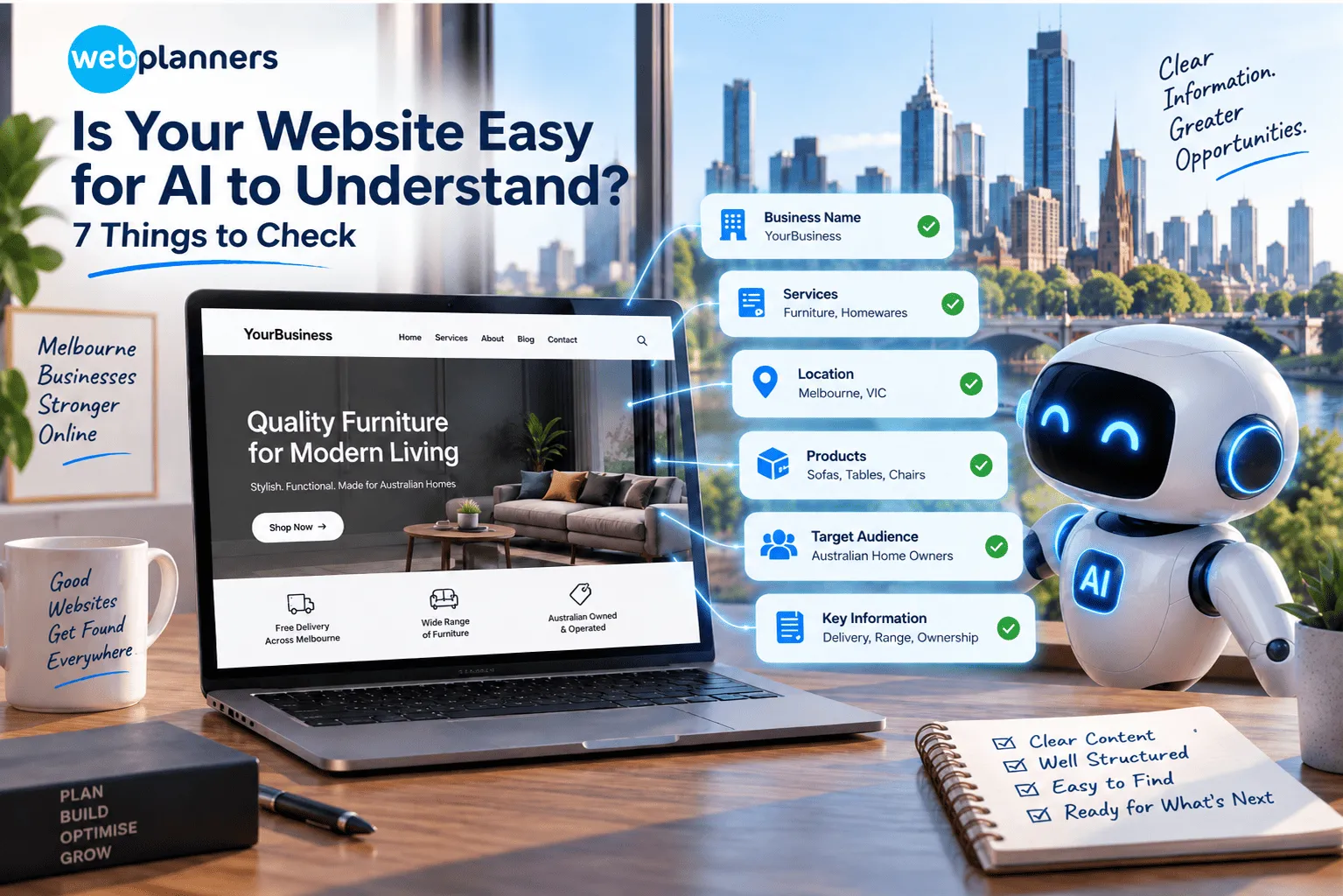
Is Your Website Easy for AI to Understand? 7 Things to Check
A website can look polished, rank for valuable searches and still leave AI systems with an incomplete picture of what the business actually does.
The issue is not about making a website “AI-friendly” by adding a few phrases or creating pages written for machines. It is about whether the important information on your website is visible, specific, consistent and easy to interpret.
Google’s current guidance is clear on one important point: its generative AI features still rely on core Search ranking and quality systems. There is no separate set of magic SEO tricks that guarantees visibility in AI Overviews or AI Mode.
Keep reading, as we’ll look at practical checks you can run on your website to see whether your content is clear enough for AI systems to interpret, connect and use.
An AI system does not see your website in quite the same way a customer does.
A customer can look at a page and quickly understand that you sell premium running shoes, operate in Melbourne and offer same-day delivery. An AI system needs that information to be available in a form it can access and interpret consistently.
Start with these checks:
- Can search systems access the actual page content?
- Is the main purpose of the page obvious?
- Can important information be read without interaction?
- Do your headings reflect real customer questions?
- Are your business entities and relationships clear?
- Are important claims supported by useful evidence?
- Do internal links reinforce the meaning of the page?
These checks are more useful than simply writing for AI.
1. Can Search Systems Access The Actual Page Content?
Start with the simplest question:
If the page loads in a browser, can a search system access the same important information?
Modern websites often rely heavily on JavaScript. That is not automatically a problem, but it can become one when important information only appears after a user interaction or after additional scripts run.
For example, an online retailer may have a product page where the browser shows:
“Organic cotton activewear made in Australia.”
But if the key product description, specifications or availability information is only generated through a client-side application, you need to check how the rendered page is actually seen by search systems.
Google recommends using tools such as URL Inspection to check how it crawls and renders a URL.
Check this:
- View the page source and rendered page.
- Test important URLs in Search Console.
- Check whether key copy appears after rendering.
- Look for content loaded only after clicks or scripts.
- Check that important pages are not blocked from crawling.
This is particularly important for websites built around complex JavaScript frameworks, product filters, interactive tools and dynamic content.
Make Your Website Easier For AI To Understand
2. Is The Main Purpose of The Page Obvious?
An AI system should not have to work through five paragraphs of promotional copy before understanding what a construction business actually does.
Take a construction company targeting Melbourne homeowners.
The first section should make the service immediately clear:
Residential Construction Services in Melbourne
Then quickly explain:
- What types of construction projects the company handles?
- Whether it works on new builds, extensions or renovations?
- Which areas it services?
- Who the service is designed for?
- What makes its approach or experience relevant?
Compare that with a page that begins with:
“Building your dream home is an exciting journey, and choosing the right construction partner is an important decision…”
That opening could appear on almost any builder’s website.
A clear page purpose starts with the basics: a descriptive title, useful headings and specific opening copy.
For a construction website, the same principle applies across project and service pages. A visually impressive site still needs a clear information structure so customers and search systems can quickly understand what the business does.
3. Can Important Information Be Read Without Interaction?
This is one of the most overlooked checks. Businesses often hide useful information inside:
- Tabs
- Accordions
- Sliders
- Pop-ups
- Hover states
- “Read more” controls
- Product filters
- Interactive calculators
These features can be useful for customers. The problem comes when essential information is available only after an interaction that a search system may not experience in the same way.
For example, a furniture retailer might place all product dimensions inside an expandable tab.
A customer can click it.
But if the page’s main content does not clearly expose those dimensions in an accessible way, the information becomes less useful as a source for search.
The same issue can affect:
- Pricing conditions.
- Service areas.
- Product specifications.
- Delivery information.
- Warranty details.
- Eligibility requirements.
- Important product differences.
Interactive design should improve access to information, not become the only place where the information exists.
4. Do Your Headings Reflect What Customers Actually Want to Know?
Headings are not just formatting.
They give both users and search systems clues about how information is organised.
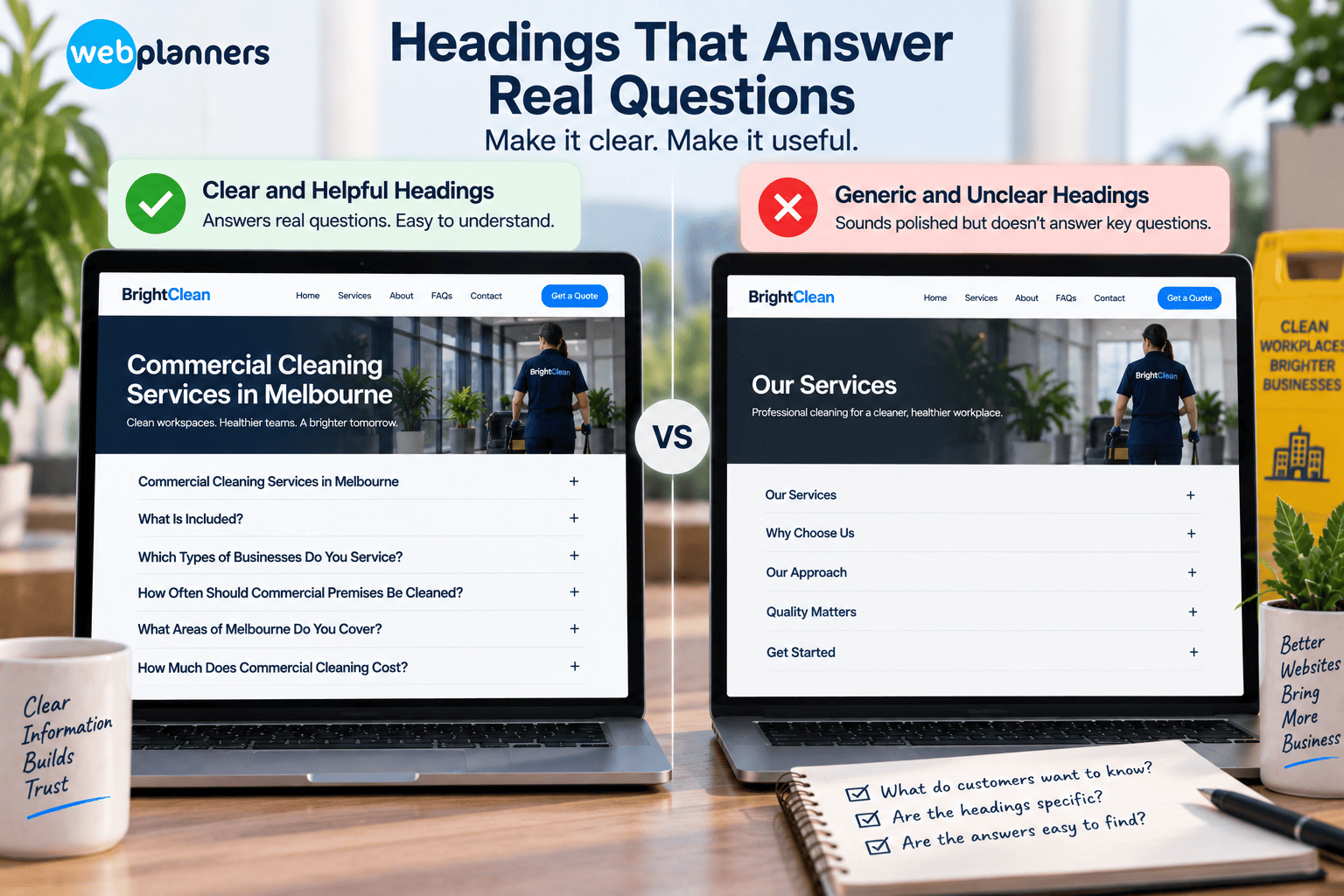
A page about commercial cleaning services could use headings such as:
- Commercial Cleaning Services in Melbourne
- What Is Included?
- Which Types of Businesses Do You Service?
- How Often Should Commercial Premises Be Cleaned?
- What Areas of Melbourne Do You Cover?
- How Much Does Commercial Cleaning Cost?
These headings establish a much clearer information structure than:
- Our Services
- Why Choose Us
- Our Approach
- Quality Matters
- Get Started
The second set sounds polished but communicates very little.
This is where the principles behind Answer Engine Optimisation can be useful without turning every page into a collection of FAQs. The aim is to make genuinely useful answers easy to locate.
5. Are Your Business Entities and Relationships Clear?
AI needs more than isolated words.
It needs context.
Suppose a website mentions:
“Melbourne”
That alone says very little.
But if the website consistently connects:
Business → Service → Location → Audience → Product → Industry
the relationship becomes much clearer.
For example:
Melbourne-based activewear retailer → women’s running clothing → online and Melbourne store → runners and fitness customers → leggings, tops and jackets
That gives far more context than repeating “activewear Melbourne” throughout the page.
Look at your website and ask:
- Is the company name consistent?
- Are products and services named consistently?
- Are locations clearly stated?
- Are related services connected?
- Does the website clearly distinguish brands, products and services?
- Do different pages contradict each other?
This is where Entity SEO becomes relevant, but the practical task is straightforward: make the business and its relationships easy to understand.
6. Are Important Claims Supported by Useful Information?
AI systems have plenty of generic information available to them.
Your website becomes more useful when it contains information that is specific to your business.
Consider these two statements:
“We provide high-quality solar solutions.”
and:
“Our Melbourne residential solar installations use panels rated for Australian conditions, with system sizing based on household energy consumption, roof orientation and available roof space.”
The second gives a much clearer picture.
It contains details that can help a customer understand the service.
Useful supporting information could include:
- Product specifications.
- Testing information.
- First-hand observations.
- Original research.
- Case studies.
- Detailed comparisons.
- Process explanations.
- Real examples.
- Relevant credentials.
- Customer outcomes.
This is not a reason to make every page longer. It is a reason to make important pages more specific.
Improve Your Website’s Search Visibility
7. Do Your Internal Links Explain How Your Content Fits Together?
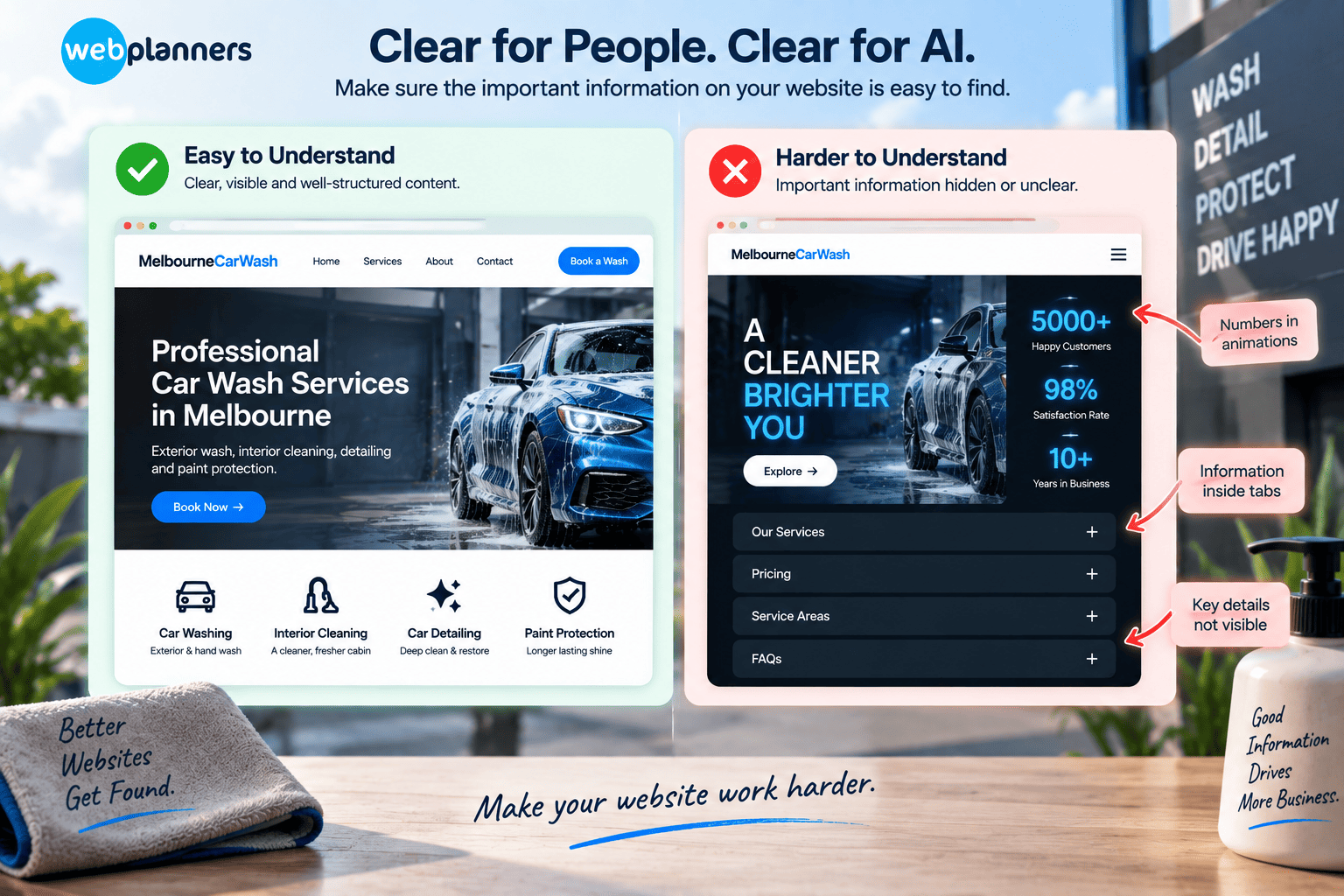
Internal links do more than connect one page to another. They help both customers and search systems understand how different parts of your website relate to each other.
Suppose a Melbourne car wash business has pages covering:
Car Washing → Interior Cleaning → Car Detailing → Ceramic Coating → Paint Protection
A visitor should be able to move naturally between closely related services without being presented with a long list of unrelated links.
The anchor text matters too.
Instead of:
“Click here to learn more.”
Use:
“See how our car detailing services can give your vehicle a deeper clean.”
The anchor gives the visitor context before they click and makes the relationship between the two pages clearer.
Relying on an expert SEO consultant can help you get more organic traffic with internal linking
For this website, the same principle applies to AI search: link where the next page genuinely adds context, not because every page needs three internal links.
Conclusion
An AI-readable website is not a website filled with AI terminology.
It is a website where the important information is accessible, specific, connected and consistent.
Start with your most valuable pages. Check what a customer needs to understand, then check whether that information is actually available to search systems in a clear form.
If you want to assess the wider technical foundation, rely on our trusted AI SEO company in Melbourne. Our team can review how your website handles crawlability, content structure, internal linking and search visibility across key pages.
Want to know how clearly AI can understand your website? Talk to Webplanners for a practical website and AI search assessment.
FAQs
Can a website be technically sound but still difficult for AI to understand?
Yes. Technical accessibility is only one part of the picture. A page can be crawlable while still being vague, inconsistent or lacking the information needed to explain the business, product or service clearly.
Does adding an AI-readable summary to every page help?
No, not automatically. Summary is helpful when it provides a concise explanation of a complicated page but the same generic AI-focussed summary on multiple pages adds little value. The important information should be in the underlying page content.
Should I change my website if AI search traffic is currently low?
Not only AI traffic. First, look at the commercially relevant pages: how your customers find your products or services, and whether the essential information is easily accessible and presented clearly. AI search should be looked at in conjunction with organic traffic, enquiries, sales and other business outcomes.
Our Recent Blogs

Couldn't be happier with how things have gone since working with Webplanners. The team genuinely cares about getting results and has helped us stay ahead of the competition. Thanks for all the hard work, legends!
Webplanners has been a huge part of our digital growth. Managing multiple websites isn't easy, but they've made the whole process feel effortless. The results have exceeded our expectations.
The team has been great to work with and always keeps us in the loop. We've seen steady improvements over time and the whole process has been straightforward. Very happy with how things are going.