When someone searches for a business online, they need more than a page filled with keywords. They want to know:
Can I trust this business? Does it know what it is talking about? Has it actually done this before? Is the information reliable?
These questions sit at the heart of E-E-A-T: Experience, Expertise, Authoritativeness and Trustworthiness.
As search evolves, E-E-A-T is becoming more and more important for businesses investing in SEO. Today, consumers use traditional Google results, AI-powered search and conversational platforms to research businesses, compare services and decide.
But E-E-A-T isn’t a score you can check in Google Search Console.
It is better understood as a framework for evaluating the quality, credibility and reliability of a website and its content.
- Experience: Provide concrete, first-hand experience with the subject.
- Expertise: Provide knowledge that is accurate and useful.
- Authoritativeness: Build recognition for your business, people and subject area.
- Trustworthiness: Provide users with credible, verifiable information.E-E-A-T isn't a technical setting or a numerical Google score.
- Real examples, expert input, original information and transparent business details can strengthen these signals.
- E-E-A-T should form part of the SEO process, rather than being added after the content is written.
What Does E-E-A-T Mean in SEO?
E-E-A-T stands for:
- Experience
- Expertise
- Authoritativeness
- Trustworthiness
Google's Search Quality Evaluator Guidelines use these concepts to help assess the quality of search results.
For a business website, E-E-A-T is about demonstrating that the information comes from a credible source and provides genuine value to the person reading it.
For example, anyone can write:
"Regular dental check-ups are important for your oral health."
A dental clinic can provide considerably more useful information by explaining what patients can expect during a check-up, what the dentists commonly see, when patients should seek additional treatment and what experience the clinic has treating those concerns.
That difference is important. Generic information tells. First-hand expertise demonstrates.
What is E-E-A-T?
1. Experience: Demonstrate What You’ve Done
Experience is first-hand knowledge.
Rather than writing and publishing the same content found on hundreds of other websites, businesses can demonstrate what they’ve actually experienced through the following:
Examples
- Original images
- Screen shots
- Examples of projects
- Customer experience
- Original research
- Practical observation
- Firsthand processes
Example: Car Detailing Business
A car detailing company can create a page explaining how they do paint correction on heavily oxidised cars.
Instead of generic paint correction information it could display:
Before → Treatment process → After
It could describe the condition of the vehicle, what products or techniques were used and what the customer wanted to achieve.
Your real business experience is the kind of content is something generic AI-generated copy can’t easily reproduce.
Strengthen Your Website’s E-E-A-T
2. Expertise: Demonstrate Knowledge
Expertise is about demonstrating that the people behind the content know their stuff.
This is accomplished by:
- Qualified professionals.
- Veteran practitioners.
- Detailed explanations.
- Correct information.
- Expert opinions
- Original perspectives.
- Knowledge of the industry.
Content should be answering the questions customers are actually asking, not just target a keyword.
Example: Dental Clinic
A dental clinic, for example, could describe how they assess patients for implants, what factors affect treatment planning and what questions patients should ask in their consultation rather than just publishing a page that is generic and aimed at “dental implants”.
The information must be based on authentic clinical knowledge and be adequately reviewed.
That’s a more expert presentation than simply replicating the common definitions.
3. Authoritativeness: Build Recognition
Authority is not limited to one page.
This is about recognising the company, its employees and its website as trustworthy sources on their subject.
Relevant signals could be:
- Professional qualifications.
- Author profile.
- Industry Awards.
- Relevant media coverage.
- References to quality.
- Original investigation.
- Good topical coverage.
- Real case studies.
Example: Accounting Firm
An accounting firm could establish authority around small-business tax advice by publishing helpful resources based on its experience working with Australian businesses.
Its website can build a stronger body of relevant information over time rather than publishing disconnected pages trying to rank for individual keywords.
The people behind the information should be clear as well.
What experience do they have? Why should the reader believe them? Who wrote it?
These are important questions.
4. Trustworthiness: Give People Reasons to Believe You
Trust is especially important when a website influences a person’s money, health, safety or other major decisions.
Businesses can offer to build trust:
- Right information.
- Trusted sources.
- Clear business details.
- Transparent claims.
- Genuine reviews.
- Current information.
- Details of contact available.
- Clear ownership/reviewer information.
- Secure website infrastructure.
- Back-end security of the website
Example: Financial Adviser
A financial advice business should clearly describe its business, people and any relevant qualifications. It should also avoid making false promises such as guaranteed investment returns.
It can instead explain its approach, provide relevant evidence and make clear the limitations of its information.
Trust comes from transparency, not bigger claims.
How Do You Improve E-E-A-T for Your Website?
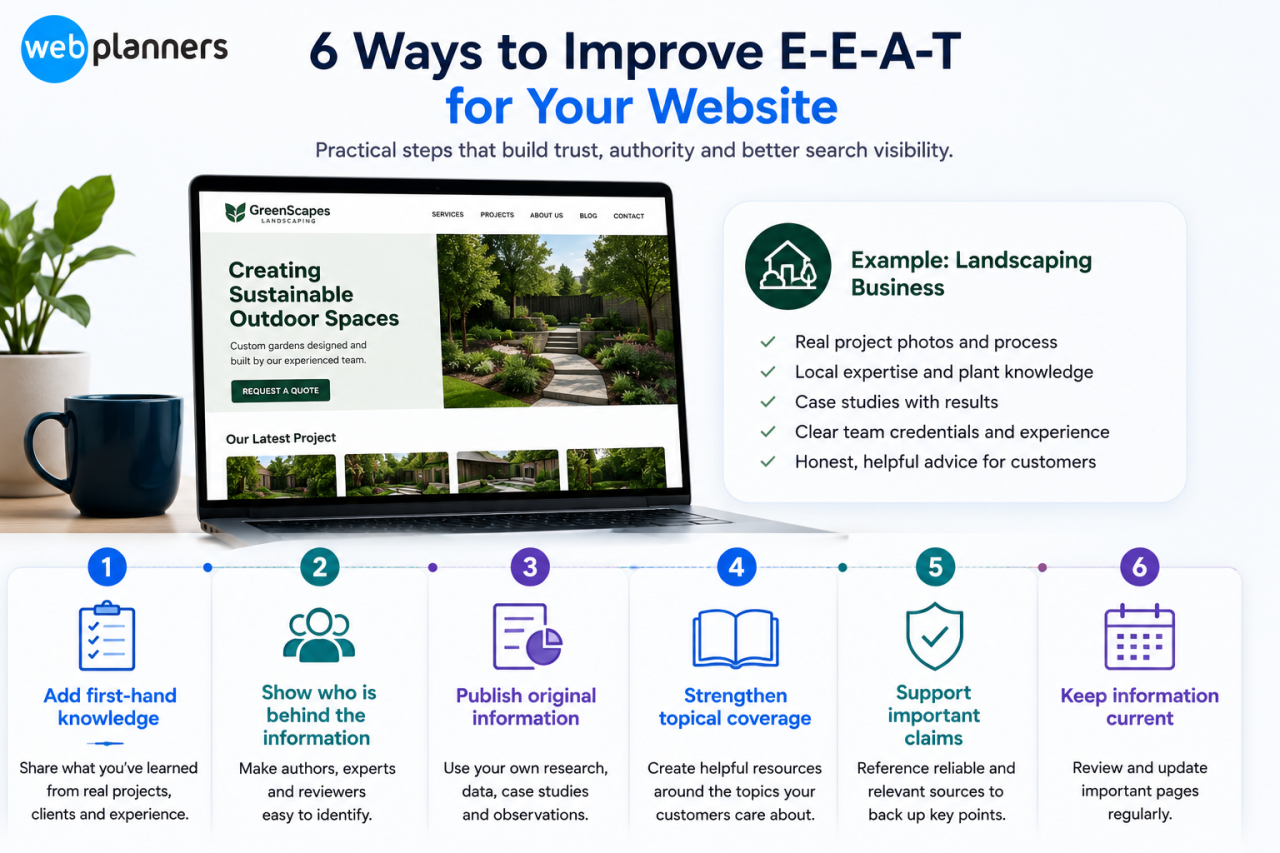
E-E-A-T isn't something you fix by adding four words to your About page.
It should appear throughout the website.
Start by asking:
-
Add first-hand knowledge
What does your business know because it has actually done the work?
-
Show who is behind the information
Make authors, experts and reviewers identifiable where appropriate.
-
Publish original information
Use your own research, data, case studies, processes and observations.
-
Strengthen topical coverage
Build useful resources around the subjects your customers genuinely care about.
-
Support important claims
Reference reliable and relevant sources rather than making unsupported statements.
-
Keep information current
Review important pages when services, regulations, products or business information change.
How Webplanners Builds E-E-A-T Into the SEO Process
For Webplanners, E-E-A-T shouldn't begin when someone starts writing a page. It can begin during onboarding.
Instead of relying only on a standard questionnaire, the team can develop customised questions based on the individual business, its services, customers, industry and search opportunities.
For example, a business might be asked:
- What results have you achieved?
- What experience does your team have?
- What problems do you solve most often?
- What do you do differently from competitors?
- Which services have the strongest demand?
- What mistakes do customers commonly make?
- What information do customers usually misunderstand?
- What questions do customers ask before contacting you?
The answers can then feed into the SEO and content strategy. This gives the team access to information that isn't sitting on competitor websites. It also helps turn business knowledge into useful search content.
The approach aligns with the E-E-A-T principles in Webplanners' own content framework, which recommends first-hand examples, case studies, original research, author credentials, reputable citations and trustworthy information.
E-E-A-T and Modern Search
Search behaviour has changed.
People still use Google to find businesses, products and services, but they also ask longer and more conversational questions through AI-powered search.
That makes the quality of the underlying information increasingly important.
A business that clearly communicates:
- What it does
- Who provides the service
- Where it operates
- What experience it has
- What its customers have achieved
- What makes its approach different
has more useful information available for people and search systems to understand.
This is where AI SEO can overlap with good E-E-A-T practices.
Businesses considering AEO services, GEO services or ChatGPT optimisation should still start with the fundamentals: useful information, clear content, strong website structure and genuine business expertise.
E-E-A-T is not an AI-search shortcut. It is part of building a website worth trusting.
What Does E-E-A-T Look Like in Practice?
Consider a car washing and detailing business.
A generic page might say:
"Professional car detailing keeps your vehicle clean and protects its appearance."
A stronger page could explain:
- Which paint problems the team regularly encounters.
- How different vehicle finishes are treated.
- Which cleaning methods are suitable for different surfaces.
- Before-and-after examples from actual jobs.
- Common mistakes customers make.
- How long different treatments typically take.
- What customers should expect during the service.
The second version contains business-specific knowledge and first-hand experience.
That is the type of information that gives a website a stronger reason to exist than simply publishing another generic page about "car detailing".
Can AI Generated Content Replace E-E-A-T?
AI can assist with research, analysis and content workflows.
It cannot create genuine business experience that doesn't exist.
If an AI tool writes a paragraph about dental treatment, it hasn't treated a patient.
If it writes about car detailing, it hasn't inspected a vehicle.
If it writes about accounting, it hasn't advised a business.
The business still needs to contribute real knowledge, experience, evidence and expertise.
This is why an effective AI SEO workflow should combine technology with human input.
AI can help process information efficiently. People provide the context, validate the information and make the decisions.
How Can You Check Your Website's E-E-A-T?
There isn't an E-E-A-T score to enter into a tool and receive a pass or fail result.
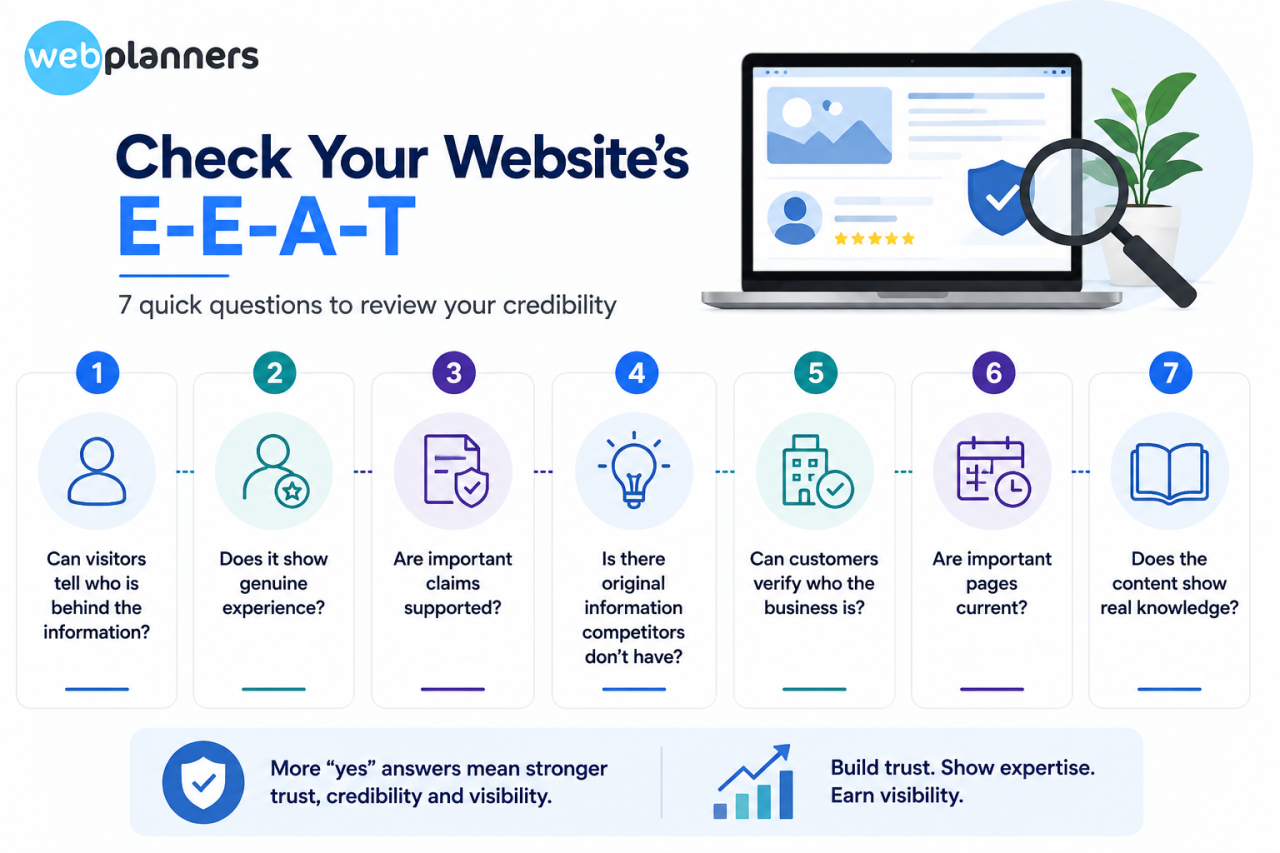
Instead, review your website with questions such as:
- Can visitors tell who is behind the information?
- Does the website show genuine experience?
- Are important claims supported?
- Is there original information competitors don't have?
- Can customers verify who the business is?
- Are important pages current?
- Does the content demonstrate knowledge rather than repeat generic information?
If several answers are no, there may be opportunities to strengthen your website's credibility.
Turn Real Business Experience Into SEO Value
Conclusion
E-E-A-T is not about adding a badge, writing a longer About page or repeating that your business is "trusted".
It comes from showing the evidence.
- Real experience.
- Relevant expertise.
- Recognised authority.
- Reliable information.
For businesses investing in SEO, these qualities can also make content more useful across changing search experiences.
At Webplanners, that process can begin before the first page is written, by gathering business-specific knowledge through customised onboarding questions and using those insights to inform SEO, content and AI-search strategies.
If you're looking for an SEO company in Melbourne that combines SEO strategy with AI-assisted workflows and human expertise, Webplanners can assess where your website has opportunities to strengthen its search presence.
Your business already has experience and knowledge. The opportunity is to make that expertise visible. Get in touch with us to know how we can help your business.
FAQs
Does E-E-A-T apply to local businesses?
Yes. Local businesses can demonstrate E-E-A-T through genuine customer experiences, local knowledge, team expertise, project examples, reviews and useful service information. This can work alongside a broader local SEO strategy.
How can a new business demonstrate Experience without years of history?
A new business can still show the experience of its founders, practitioners or team members. Relevant professional backgrounds, previous work, qualifications, processes and first-hand knowledge can all help communicate experience.
Does E-E-A-T matter for AI search?
E-E-A-T can support the broader qualities that make information useful and credible for both people and search systems. However, businesses should avoid treating it as a formula for appearing in AI-generated answers.
Can backlinks improve E-E-A-T?
Relevant references and links from reputable websites can contribute to a site's wider authority, but backlinks alone don't create experience, expertise or trust. The underlying quality of the business and its information still matters.