- Most small and mid-sized businesses can expect to invest around $1,500-$5,000+ per month in ongoing SEO.
- Smaller local campaigns may start around $1,000-$1,500 per month.
- A growth-focused campaign commonly sits around $1,500-$3,000 per month.
- More competitive markets can require $3,000-$5,000+ per month.
- Larger or technically complex campaigns can move beyond $5,000 per month.
- SEO pricing depends on competition, website condition, services, locations, content requirements and business goals.
- The monthly retainer matters, but what is included matters more.
- Ask whether new pages, content improvements, technical work and local SEO are included or charged separately.
- AEO, GEO and AI search can form part of modern SEO, but a separate "AI SEO premium" should have a clear reason behind it.
- Webplanners takes a results-first approach, focusing the SEO budget on the work the website actually needs.
When comparing SEO services in Melbourne, you will find the price varies significantly from one provider to the next.
For most small and mid-sized businesses, a realistic ongoing SEO investment in 2026 is in the neighbourhood of $1,500 to $5,000+ per month. More competitive industries and larger websites and broader campaigns may need more while smaller local campaigns may have more on the lower end of the scale.
That range is consistent with several current 2026 Australian and Melbourne pricing guides, although there is no official Melbourne-wide average.
But there is a more important question than the monthly number:
What are you actually getting for the money?
Two SEO companies can quote the same monthly fee and deliver very different amounts of strategy, content, technical work and optimisation.
This guide explains what SEO costs in Melbourne, what affects the price, what you should expect from an SEO package, and how Webplanners approaches pricing differently.
How Much Does SEO Cost in Melbourne in 2026?
There is no single fixed price for search engine optimisation.
Current Australian pricing guides place many small-business campaigns around $1,500-$3,000 per month, while competitive campaigns can move towards $5,000 or more. Melbourne-specific sources show a similar pattern.
A useful benchmark is:
| Campaign type | Typical monthly SEO investment |
|---|---|
| Small local business | $1,000-$1,500 |
| Growing business | $1,500-$3,000 |
| Competitive market | $3,000-$5,000+ |
| Larger or complex campaign | $5,000+ |
These figures are indicative market ranges, not fixed Webplanners prices.
A single-location business targeting a few local searches does not need the same level of work as a business competing across Melbourne for dozens of high-value commercial terms.
The cost of SEO should reflect the work required to compete.
What Are You Actually Paying for With SEO?
SEO is not simply paying someone to add keywords to your website.
A proper campaign can involve:
- Technical SEO.
- Keyword and competitor research.
- Search intent analysis.
- Content creation and optimisation.
- New service pages.
- Location pages.
- Internal linking.
- Local SEO.
- Google Business Profile optimisation.
- Authority building.
- Conversion improvements.
- Performance analysis.
- Ongoing strategy and reporting.
This is why two providers can quote $2,500 per month and deliver very different levels of value.
One may include most of the work above.
Another may charge a monthly retainer for a limited scope and then quote separately whenever your website needs something outside that scope.
The monthly fee tells you what you pay. The scope tells you what you get.
Traditional SEO Agency vs Webplanners: A Different Approach to Pricing
This is one of the most important things to look at when comparing an SEO company in Melbourne.
SEO providers can structure their services in very different ways.
Some models treat each requirement as a separate deliverable. A new page can become an additional charge. A technical fix can become another project. Additional local work can create another line item.
Webplanners takes a different approach. The focus is on the work required to move the campaign forward, rather than charging separately for every website requirement that appears.
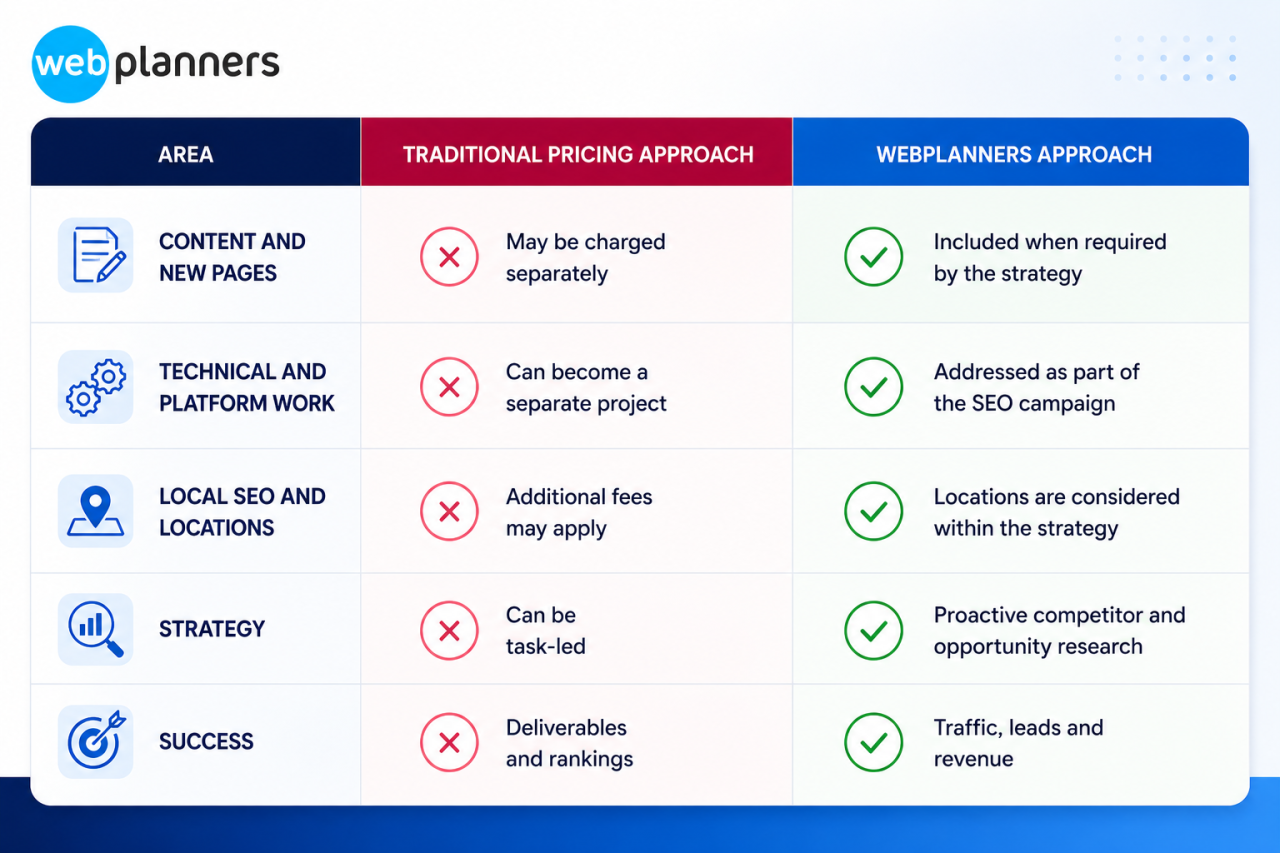
This isn't a claim that every traditional SEO agency follows the same model. Pricing structures differ.
The point is to ask a better question when comparing proposals:
If my website needs something new to compete, is that part of the work or another invoice?
At Webplanners, the emphasis is on completing the work the campaign needs.
If new pages are required, they can form part of the SEO work. If technical improvements are needed, they can be addressed as part of the campaign. If additional local optimisation is required, it is considered within the wider strategy.
At Webplanners, most of our clients receive technical and platform upgrades as part of their SEO package, with no additional charge for new pages, content improvements or additional Google Business Profile optimisation under this model.
That makes the total value of the engagement more important than the headline retainer.
What’s Covered in The Cost?
Pricing should always be tied to scope, but these ranges provide a useful starting point.
1. Around $1,000-$1,500 per month
This can suit a smaller local business with a limited service area and relatively low competition.
The focus may include:
- Foundational technical SEO.
- Local search optimisation.
- Google Business Profile work.
- On-page improvements.
- Targeted content.
- Basic performance monitoring.
The available resources will naturally be more limited than a larger campaign.
2. Around $1,500-$3,000 per month
This is a common range for growing small and mid-sized businesses.
A more active campaign can include:
- Technical SEO.
- Ongoing keyword research.
- Competitor analysis.
- Content creation and optimisation.
- New landing pages.
- Internal linking.
- Local SEO.
- Authority-building activity.
- Conversion-focused improvements.
- Regular strategy and reporting.
Current Australian pricing sources also place many effective small-business campaigns within this range.
3. Around $3,000-$5,000+ per month
This can make sense when competition is stronger, the website is larger or the business has more ambitious growth targets.
The campaign may require greater content production, deeper technical work, broader authority building, multiple locations or more intensive optimisation.
4. Above $5,000 per month
Higher budgets can be appropriate for complex websites, highly competitive industries, large eCommerce operations or campaigns with a much broader scope.
The important point is that higher pricing should correspond with more work or greater complexity.
A bigger invoice by itself doesn't create better SEO.
What Factors Affect SEO Pricing?
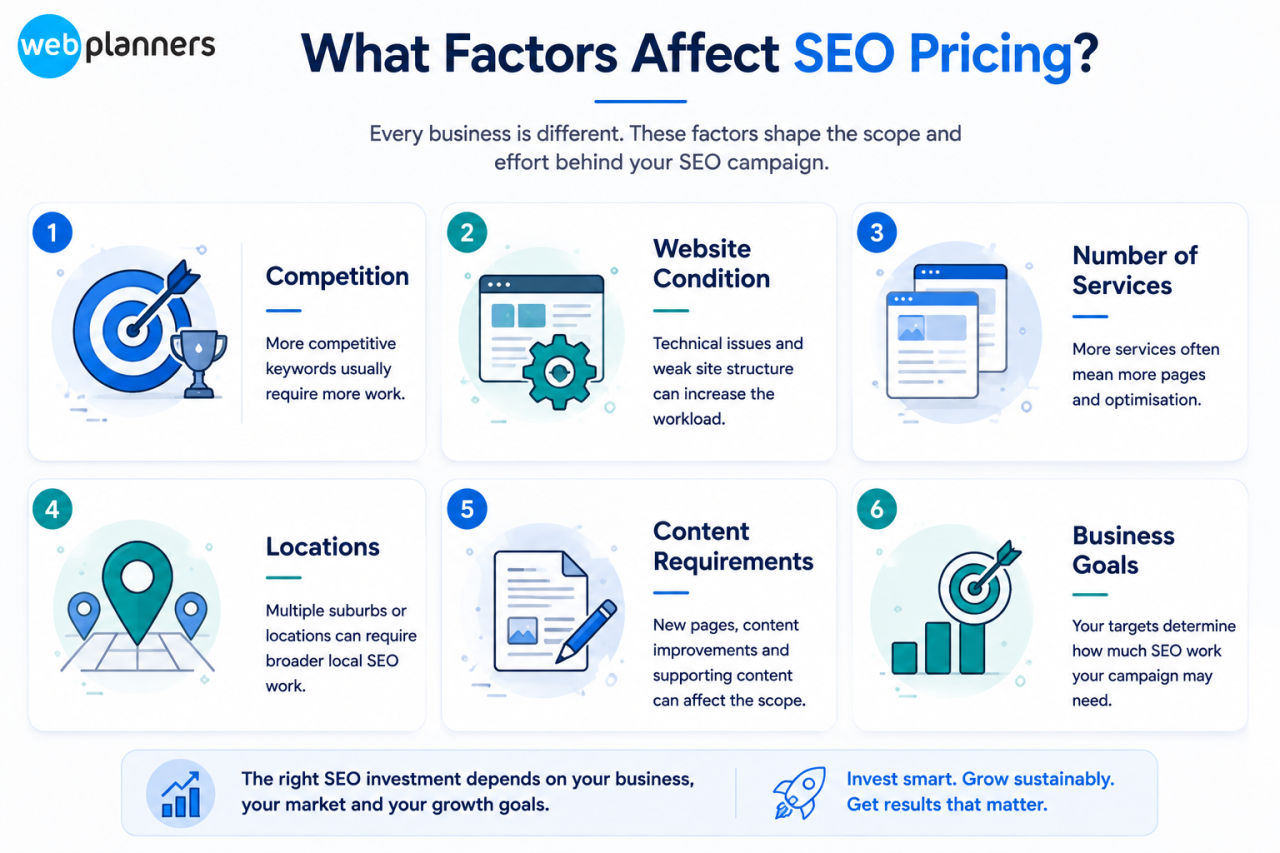
1. Competition
Competition has a major influence on SEO pricing.
Ranking a local business for a niche service can require far less work than competing with established businesses for high-value searches in legal, finance, healthcare, property or other competitive sectors.
2. Website condition
Your starting point matters.
A website with a clear structure, strong pages and healthy technical foundations gives an SEO team a different starting point from one with:
- Indexation problems
- Duplicate content
- Weak internal linking
- Slow pages
- Poor site architecture
- Thin service pages
- Outdated content
- Technical errors
3. Number of services
The more services you offer, the more search opportunities there may be to target.
That can mean additional research, landing pages, supporting content and internal linking.
4. Locations
A business targeting one Melbourne location has a different local search requirement from one serving multiple suburbs or cities.
For businesses that depend heavily on local customers, local SEO should be part of the discussion rather than an afterthought.
5. Content requirements
Some websites already have strong service pages and supporting resources.
Others need substantial work before they can compete.
Content costs are therefore not just about how many words an agency produces. The more important questions are:
- Which pages need improvement?
- Which new pages are needed?
- What search intent do they address?
- What expertise can the business contribute?
- How will those pages support commercial pages?
6. Business goals
A business trying to protect existing visibility has different requirements from one trying to enter a competitive market.
Your SEO investment should reflect the opportunity, not an arbitrary package level.
How Should You Compare SEO Quotes?
When you receive proposals from several SEO companies in Melbourne, don't put the prices into a spreadsheet and choose the lowest number.
Compare the work behind each number.
Ask:
- What is included each month?
- Are new pages included?
- Is content creation included?
- Are technical fixes included?
- Is local SEO included?
- How many locations are covered?
- Who actually works on the campaign?
- How much strategy is involved?
- How is link and authority building handled?
- What reporting will I receive?
- What additional charges could arise?
- How are leads and conversions measured?
A proposal that looks more expensive can sometimes represent better value if it includes significantly more implementation.
Likewise, an expensive proposal isn't automatically good. Scope, expertise and outcomes matter more than the price tag alone.
Is Cheap SEO Worth It?
Not necessarily.
There are legitimate reasons for a small business to start with a smaller SEO budget.
The problem comes when a business expects a comprehensive growth campaign from a budget that only funds a few hours of basic work.
Before choosing a very low-cost SEO package, ask what you are actually buying.
If the provider cannot clearly explain who is doing the work, what gets implemented and how performance will be measured, the low price may not be much of a saving.
A useful rule is:
Don't compare cheap SEO with expensive SEO. Compare the work included in each proposal.
Does AI SEO Cost More in 2026?
It can, but it shouldn't automatically. AI has changed how SEO teams research, analyse data and produce content. It is also changing how Australians find information.
Telsyte's 2026 research found that 12% of Australians now identify AI tools as their primary way of finding information online, up from 5% a year earlier.
The research also found that 81% are aware of AI summaries in search results, while half say they would often rely on an AI summary without clicking through to the source.
That makes AI search relevant to businesses competing for online visibility. But a separate "AI SEO fee" doesn't automatically mean better service.
Google's current guidance is clear: AEO and GEO, or Generative Engine Optimisation, describe work aimed at AI search experiences, but from Google's perspective this remains SEO. Its AI Overviews and AI Mode rely on core Search systems and established SEO practices.
Google specifically recommends strong fundamentals such as:
- Pages that can be crawled and indexed.
- Useful, people-first content.
- Clear internal linking.
- Important information available as text.
- Good page experience.
- Accurate Business Profile information.
- Structured data that matches visible content.
It also says there are no special AI files or special schema required to appear in AI Overviews or AI Mode.
So if an agency offers AI SEO services, ask what additional work you are actually receiving.
What Does AEO and GEO Mean for Your SEO Budget?
Answer Engine Optimisation (AEO) focuses on making information useful and accessible for answer-driven searches.
Generative Engine Optimisation (GEO) focuses on visibility across generative search experiences.
For a business, that can involve work such as:
- Answering important customer questions clearly
- Building stronger topical coverage
- Improving internal linking
- Strengthening entity relationships
- Keeping business information consistent
- Creating genuinely useful supporting content
- Building authority and trust
- Monitoring visibility across changing search experiences
These activities overlap significantly with good SEO.
For businesses that need a more dedicated AI search strategy, Webplanners provides AEO services, GEO services and ChatGPT optimisation services.
The key is to pay for the work and expertise behind the label and not just for the label.
How Webplanners Uses AI Without Removing Human Expertise
AI can make SEO work faster.
It can help with:
- Keyword clustering.
- Search intent analysis.
- Competitor research
- Data processing.
- Content research.
- Entity mapping.
- Identifying content gaps.
- Performance analysis.
But raw AI output is not the finished product.
Webplanners' documented organic traffic case study shows how this works in practice. For a client campaign, AI-assisted research was combined with manual SEO strategy, human content review, search intent analysis, internal linking and content optimisation. The campaign generated a 261% increase in organic traffic within 90 days.
That result matters here because it shows that AI doesn't need to be treated as a replacement for SEO expertise.
The stronger model is:
AI-assisted efficiency + human strategy + real business context + quality control.
Google also states that generative AI can be useful for research and structuring content, but producing many pages without adding value can fall under its scaled content abuse policies.
What Does E-E-A-T Have to Do With SEO Pricing?
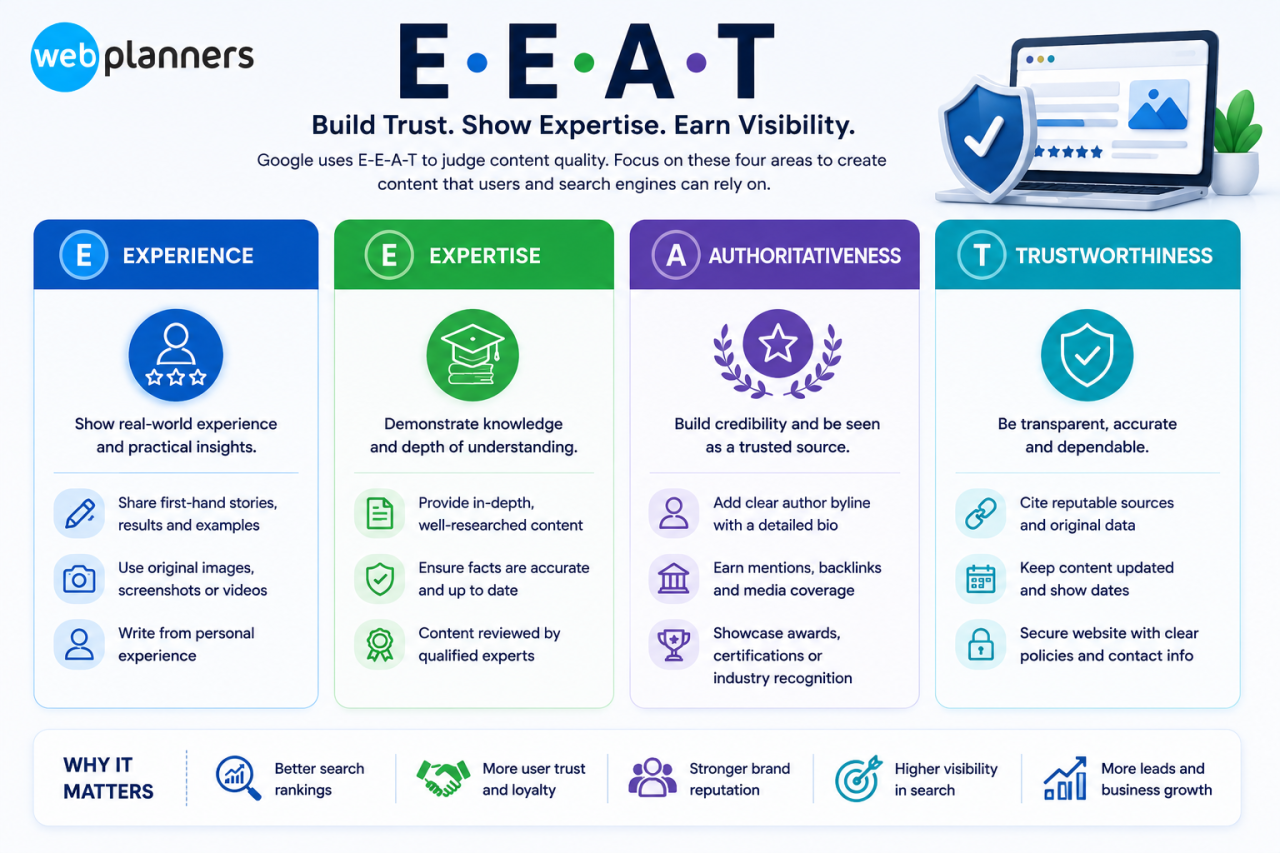
E-E-A-T stands for Experience, Expertise, Authoritativeness and Trustworthiness.
It matters because your SEO budget isn't only paying for technical changes.
You're also paying for the quality of the decisions behind those changes.
For a business choosing an SEO provider, look for evidence of:
- Experience: Has the team worked with businesses facing similar challenges?
- Expertise: Can they explain why a particular strategy makes sense?
- Authority: Can they show genuine results and relevant industry knowledge?
- Trust: Are pricing, deliverables, reporting and expectations clear?
This is why case studies are more useful than generic claims such as "we deliver guaranteed rankings".
For example, our case studies have portrayed specific starting problems, actions taken and measured outcomes. That gives a prospective client something concrete to assess.
How Long Does SEO Take to Produce Results?
SEO isn't usually an immediate channel.
The early stage can involve fixing technical problems, improving existing pages, mapping search intent and building the foundation for stronger visibility.
As the campaign progresses, the focus can shift towards expanding search coverage, strengthening authority, improving conversions and building on performance data.
Be cautious about anyone promising guaranteed Page 1 rankings within a few weeks.
The right question is not:
"How quickly can you guarantee a ranking?"
It is:
"What will you do during the first three, six and twelve months, and how will we measure progress?"
What Should You Expect From an SEO Company in Melbourne?
A good provider should be able to explain your campaign in plain language.
You should understand:
- What the priorities are.
- Why those priorities matter.
- What will be implemented.
- What is included in your fee.
- What could cost extra.
- How performance will be measured.
- Who is responsible for the work.
- How the strategy will change based on results.
If you need broader support beyond traditional search, the provider should also be able to explain how AI search, local search and conversational search fit into the strategy.
Conclusion
For most small and mid-sized businesses, expect to pay around $1,500-$5,000+ per month for ongoing SEO in Melbourne in 2026. Smaller local campaigns may cost less, while highly competitive or complex campaigns can require more.
But the monthly price is only the starting point.
When comparing SEO companies, look at what the investment actually funds.
Does your budget cover the pages your website needs? Are technical improvements part of the work? Is local SEO included? Does the agency proactively identify opportunities? Can the team show evidence of results?
That's where Webplanners take a different approach.
The focus is on doing the work required to improve search visibility, qualified traffic and business growth, rather than turning every new requirement into another charge.
And the results need to support that philosophy.
Webplanners has documented campaigns that are achieved through AI-assisted research combined with human SEO strategy and implementation.
For a business considering the cost of SEO, that's the real question to ask:
Not "Who has the cheapest monthly fee?"
But "Who can give me the right work, expertise and accountability for the investment?"
That is a much better way to assess the value of SEO in Melbourne in 2026.
FAQs
What is the average SEO cost in Melbourne?
There is no official Melbourne-wide average. Current 2026 market sources generally place many small and mid-sized campaigns around $1,500–$3,000 per month, with competitive campaigns moving towards $5,000 or more.
Is $1,500 enough for SEO in Melbourne?
It can be for a focused local campaign, particularly where competition is moderate and the website has a reasonable technical foundation. The available scope will be more limited than a $3,000 or $5,000+ campaign.
Why do some SEO companies charge much more than others?
The difference can come from scope, expertise, team structure, competition, content requirements, technical complexity, authority-building work and the number of locations or services being targeted.
Should I pay monthly for SEO or choose a one-off project?
Monthly SEO is generally more suitable for ongoing organic growth because search performance requires continual analysis and refinement. A one-off project can make sense for a technical audit, website migration, content audit or specific SEO problem.
Should an SEO package include content?
Ask the provider directly. Content is often an important part of SEO, but some agencies charge separately for it. With Webplanners' results-first approach, content and new pages can form part of the SEO work when they are required by the strategy.
Can SEO help my business appear in ChatGPT or Perplexity?
No agency can guarantee that ChatGPT, Perplexity or another AI system will recommend a particular business. SEO can, however, improve the quality, relevance, authority and accessibility of the information available about your business, which can support visibility across different search experiences.
How can I tell if an SEO company is worth the price?
Look at its process and evidence. Ask what gets implemented, who does the work, what is included, how performance is measured and whether the company can show relevant case studies with measurable outcomes.