A customer looking for a skincare product, furniture store, activewear brand, homewares business or local service can now ask an AI platform for recommendations instead of starting with a list of Google results.
A question such as:
“Which Melbourne businesses should I consider for this?”
asks AI to do more than match a keyword. It needs to understand what the businesses offer, who they serve, where they operate, what makes them relevant and what information supports the recommendation.
The same shift is happening in Google. AI Overviews can appear above traditional results for eligible searches, giving users a summary with links to supporting web pages. Google says these AI features build on its existing Search systems, which means strong technical SEO, useful content and clear information still matter.
In this blog, we’ll look at how AI search evaluates businesses, what influences visibility, and what you can do to improve your presence across AI search.
How Modern Search Has Evolved?
Traditional search often starts with a phrase such as:
“women's activewear Melbourne”
The customer then receives a set of results and decides which websites to visit.
An AI search might instead be:
“Which Melbourne activewear businesses are worth considering for comfortable gym clothes?”
Or:
“What Australian activewear brands are suitable for everyday wear?”
The difference is important.
The second type of question contains intent, context and a decision.
The customer is not simply looking for a page about activewear. They want help deciding between options.
AI therefore needs to connect information about:
- The business
- Its products or services
- Its location
- Its customers
- Its areas of expertise
- Its reputation
- The specific need in the question
That is why simply adding more keywords is unlikely to address the whole problem.
Improve How Your Business Appears In AI Search
What Does AI Need to Know About a Business?
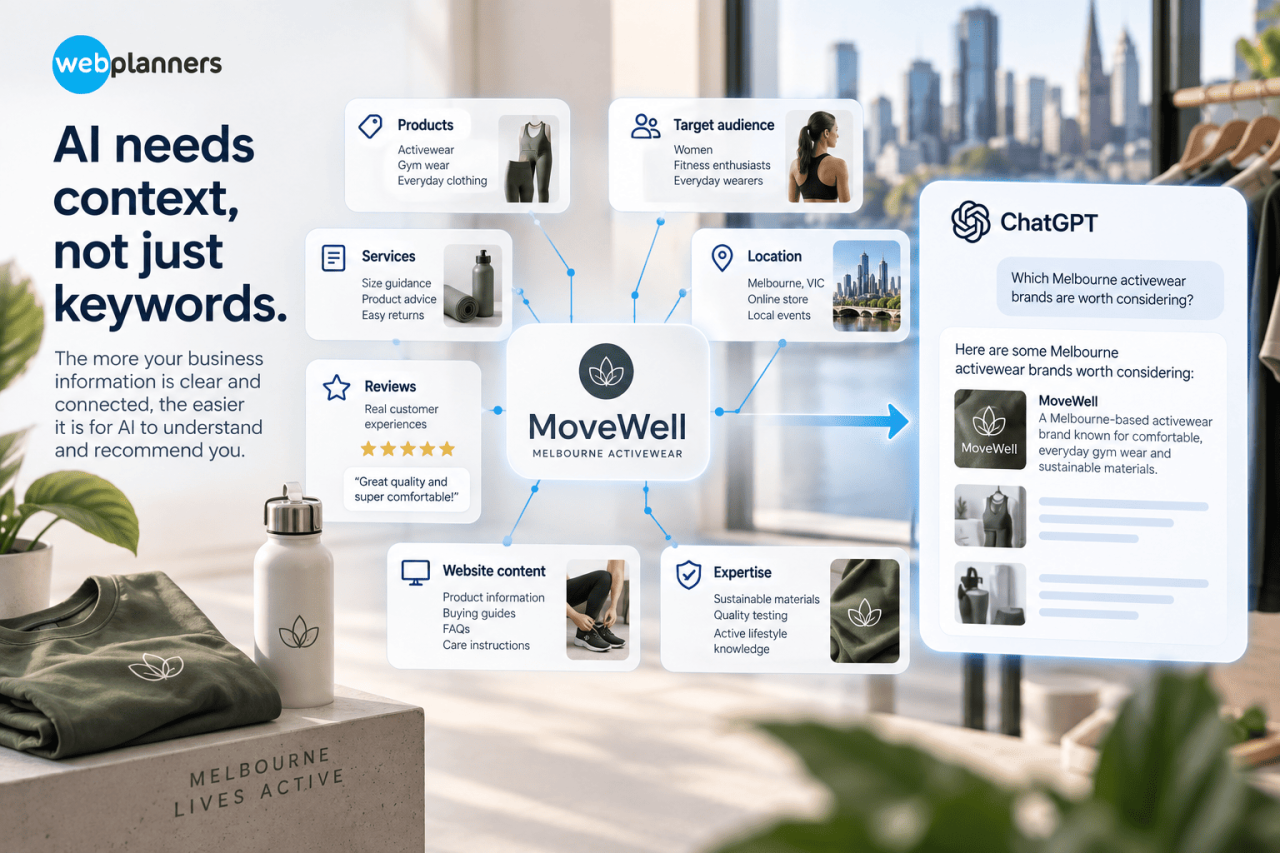
Consider a fictional Melbourne activewear business called MoveWell.
Its website clearly explains its product categories, materials, sizing, intended uses, customer types and Melbourne presence. Its supporting content answers questions about choosing activewear, different fabrics and care requirements.
The information forms a connected picture:
MoveWell → activewear → gym wear → everyday clothing → sustainable materials → Melbourne
Now compare that with a homepage that only says:
“Premium activewear for your active lifestyle.”
The second version may sound polished, but it gives much less useful context.
This is where entity SEO fits naturally into the wider picture. Search systems need to understand the relationship between a business, its products, services, locations and areas of expertise.
For businesses, this means making those relationships clear throughout the website rather than relying on one homepage statement.
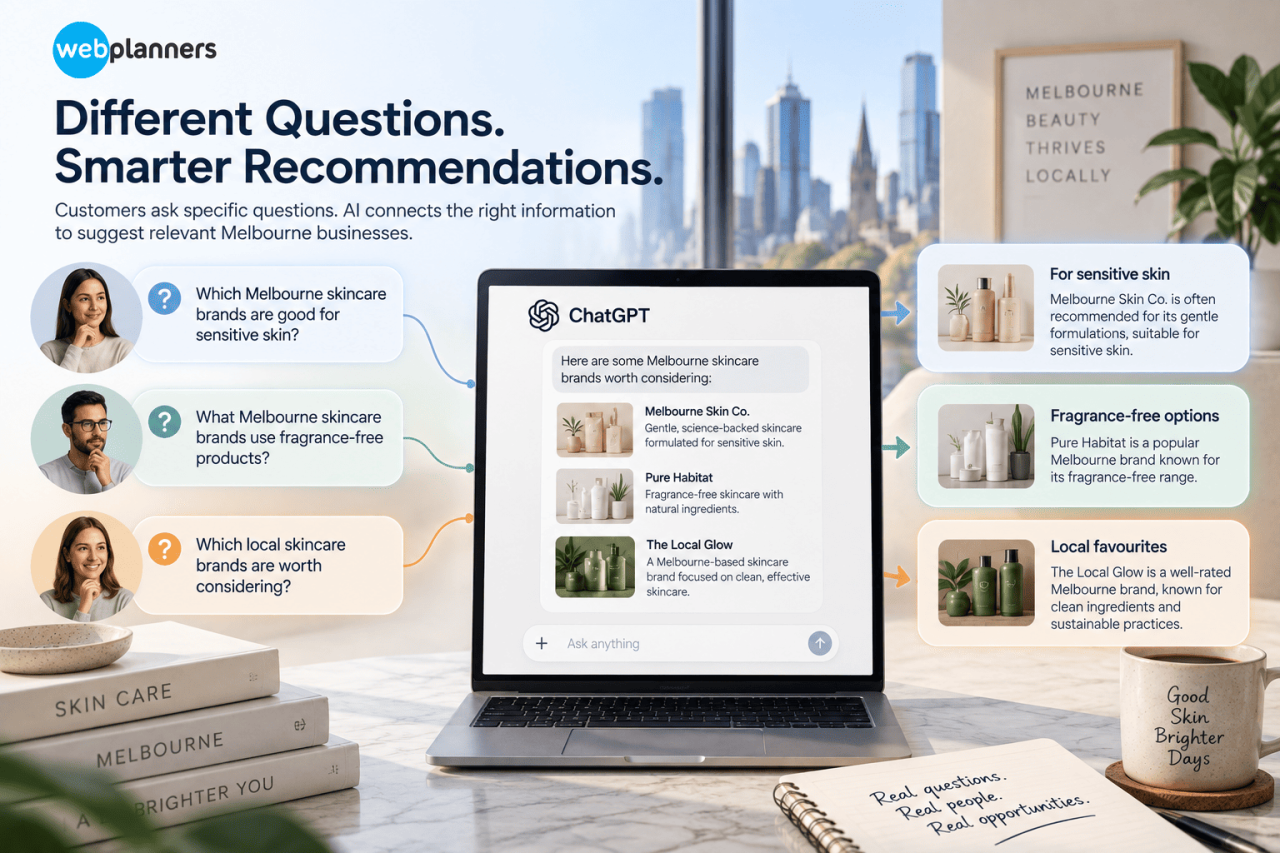
What Happens When the Customer Gets More Specific?
Now change the question.
Instead of:
“Which Melbourne activewear businesses should I consider?”
the customer asks:
“Which Melbourne activewear businesses offer comfortable clothing for everyday wear?”
The answer now depends on more specific information.
The website needs to communicate:
- What products are available
- Who they are designed for
- What makes them suitable
- What materials are used
- How the products differ
- What customers say about them
This is where useful content becomes important.
A product page can provide specifications. A category page can explain the range. Customer reviews can provide experience. A buying resource can answer common questions.
Together, those pages give both customers and search systems more context.
This is also where AEO fits. Instead of creating content around isolated keywords, businesses can answer the questions people ask before making a decision.
Where Do AI Overviews Fit Into This?
The AI search conversation is not limited to ChatGPT.
Google's AI Overviews can provide an AI-generated response within Google Search, with links to web pages that support the information shown. Google says AI Overviews use the same foundational Search systems and can use multiple searches to find relevant information for more complex questions.
That creates another visibility opportunity.
A customer might search:
“What should I look for when choosing a Melbourne furniture store for a small apartment?”
An AI Overview may bring together information from several sources before presenting an answer.
Your business therefore needs to be relevant to the question, not just the keyword.
This is one reason a website with useful buying information, clear product or service pages, supporting evidence and strong technical foundations can have value beyond its traditional ranking positions.
Why Being on Page One is Not the Whole Story?
A business can rank well for:
“sofas Melbourne”
and still have limited visibility when a customer asks:
“Which Melbourne furniture businesses are good for small apartments?”
The first search is largely about finding a product or business.
The second involves evaluation.
The customer wants help understanding which option fits their situation.
This difference is important because AI search can bring together information about a business from multiple sources.
Webplanners has previously looked at this distinction through its work on AI search decline, where traditional Google visibility does not necessarily tell the full story about how a business appears in AI-driven search.
What Information Can Strengthen The Recommendation?
There is no published formula that guarantees an AI platform will recommend a business.
But businesses can make their information more useful and easier to interpret.
For example, a skincare business could provide:
- Detailed product information.
- Ingredient explanations.
- Usage instructions.
- Product comparisons.
- Information about different skin concerns.
- Genuine customer experiences.
- Expert or first-hand commentary.
- Clear information about the business.
A furniture business might need to provide:
- Dimensions.
- Materials.
- Delivery information.
- Assembly details.
- Product suitability.
- Room-size advice.
- Customer reviews.
A professional service business may need:
- Areas of expertise.
- Service information.
- Relevant experience.
- Qualifications.
- Case studies.
- Location details.
- Clear explanations of the process.
The information changes by industry because the customer's decision changes.
That is also why E-E-A-T should be treated as part of the content and trust strategy, rather than as a separate SEO task. Evidence of experience, expertise, authority and trust gives customers more substance when assessing a business.
How Can You Test What AI Says About Your Business?
The simplest approach is to think like a customer.
Do not start with:
“Tell me about my business.”
Ask questions that involve an actual decision.
For a Melbourne homewares business:
“Which Melbourne homewares businesses are worth considering for a first apartment?”
“What should I look for when choosing furniture for a small living room?”
“Which Australian furniture brands offer products suitable for compact homes?”
“What are some Melbourne stores worth considering for modern homewares?”
Then record:
| Check | What to look for |
|---|---|
| Business mentioned | Is your business included? |
| Accuracy | Is the description correct? |
| Products/services | Are the right offerings recognised? |
| Location | Is Melbourne relevance understood? |
| Differentiation | Is your key point of difference visible? |
| Sources | Is your website cited? |
| Competitors | Which alternatives appear? |
Knowing what questions to ask ChatGPT about your own business can help you build a more useful test and see how accurately AI represents your business.
Run the same questions periodically. AI responses can change, so a consistent set of prompts gives you a better comparison than random testing.
What If AI Gets Your Business Wrong?
Start with the specific information that is missing.
If the products or services are incorrect, review the relevant pages.
If your point of difference is missing, make it clearer and support it with evidence.
If your Melbourne presence is unclear, review your local business information.
If competitors appear for questions where your business should be relevant, compare the information available about both businesses.
If AI mentions your business but gives inaccurate details, check for conflicting information across your website and other important online sources.
This process can also reveal gaps that traditional keyword tracking will not show.
For example, you might rank well for your main service but find that AI does not understand your specialist offering. That gives you a much more specific problem to address than simply trying to rank higher.
How AEO, GEO and AI SEO Fit Together
These terms do not need to become separate projects. They describe different parts of the same broader shift.
Think of the three as working across different parts of the search journey: SEO builds search visibility, AEO addresses customer questions, while GEO helps shape how your business is represented in AI-generated responses.
AI SEO brings these areas together with technical accessibility, useful content, entity clarity and ongoing visibility checks.
The practical goal is simple:
Make your business easier for customers and search systems to understand.
That means improving the information that already matters rather than producing content simply to target another AI-related keyword.
What Should You Measure?
AI visibility needs more than a one-time test.
Keep a simple record of:
| Metric | What to monitor |
|---|---|
| Brand mentions | Whether your business appears |
| Accuracy | Whether AI describes it correctly |
| Citations | Whether your website is referenced |
| Competitor mentions | Which alternatives appear |
| Product/service visibility | Whether relevant offerings are recognised |
| Local visibility | Whether your Melbourne connection is recognised |
| Website traffic | Visits from AI-related sources where measurable |
| Conversions | Enquiries or sales associated with that traffic |
Do not treat a single AI response as a ranking position. The value comes from looking for patterns over time.
Help AI Better Understand Your Business
Conclusion
Customers can increasingly ask AI to compare businesses, recommend products and help them make decisions.
That does not replace Google. It adds another layer to how people research before they buy.
For businesses, the priority is not to chase every new AI feature. It is to make the information that matters clear, accurate, useful and supported by genuine experience.
Want to know how AI currently represents your business? Webplanners can assess your entity signals and local visibility, then identify practical opportunities to strengthen your presence across Google and AI search. Get in touch with us to know how we can help you.
FAQs
Can a business appear in AI search without ranking first on Google?
Yes. AI responses are not simply a copy of traditional Google rankings. Different queries, sources and context can affect which businesses and information appear.
Do I need separate pages for every question customers ask?
No. Several related questions can often be answered naturally within a strong product, service, category or supporting content page. The focus should be useful information rather than creating large numbers of pages.
How often should I check how AI represents my business?
A monthly or quarterly check can provide a useful baseline. Use the same customer-focused questions and record mentions, accuracy, citations and competitors so you can identify changes over time.