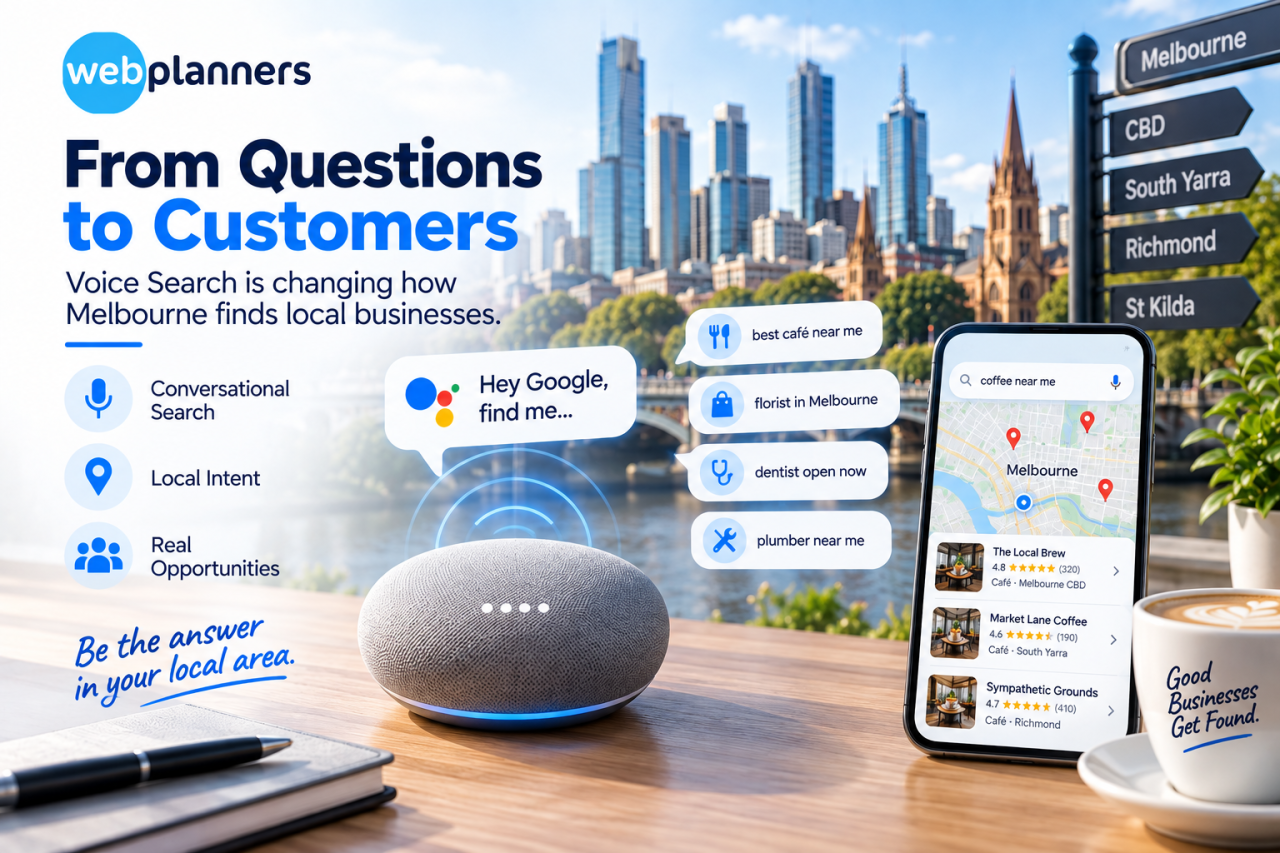
“Hey Google, find me a plumber near me.”
“Where’s the closest dentist that’s open now?”
“Find an Italian restaurant near Melbourne CBD.”
Search is becoming more conversational. Instead of typing short phrases into Google, people can ask complete questions using their phones, smart speakers and other voice-enabled devices.This changes the way customers might search for services, opening hours, nearby businesses and directions for local businesses.
In 2026, however, voice search SEO won’t be about having a separate website for voice assistants. It’s providing enough clarity about your website and business info to answer the questions people are really asking.
Local relevance, useful content, accurate business information and strong SEO foundations still matter.
Keep reading. We’ll discuss the differences between voice searches and traditional searches, why local businesses need to pay attention and what you can do to prepare your website.
Especially for searches that are clearly local or immediate in intent.
People can search by voice for:
- Businesses nearby.
- Opening times.
- How to get there.
- Services.
- Information on the product.
- Short answers to specific questions.
Google suggests that voice assistants can handle local requests, such as finding nearby businesses and checking opening hours.
For Melbourne businesses, the practical takeaway is simple: write for the way people speak, while keeping your website and local business information accurate and easy to understand.
How Is Voice Search Different From Traditional Search?
Traditional searches are often short:
“dentist Melbourne”
A spoken search can be much more specific:
“Can you find a dentist near me that is open Saturday morning?”
The second query contains more context. It tells the search system what the person wants, where they want it and, potentially, when they need it.
This is why conversational search matters.
Your website does not need to copy spoken questions word for word. Instead, your content should naturally answer the questions customers are likely to ask.
For example, a Melbourne dental practice could clearly address:
- Which treatments are available?
- Where is the clinic?
- What are the opening hours?
- Is emergency treatment available?
- Is parking available?
- Which suburbs does the practice serve?
That information can help both people and search engines understand the business.
Prepare Your Business For Voice Search
Local Businesses Have More to Gain From Voice Search
Voice searches often have strong local intent.
Someone who says “find a café near me” is unlikely to want a national list of cafés. They want options they can actually visit.
Google says local results are primarily influenced by relevance, distance and prominence. Complete and accurate Business Profile information helps Google understand what a business does, where it is and when customers can visit.
That makes local SEO particularly relevant to voice-driven searches.
Your website and Google Business Profile should tell a consistent story about:
- Your business category.
- Location.
- Services.
- Opening hours.
- Contact details.
- Service areas.
- Customer reviews and other relevant information.
Google also uses information from your website and other sources when compiling business information for local search.
So voice search should not be treated as an isolated SEO project.
“Near Me” Searches Need More Than a Location Keyword
Adding “Melbourne” to a page does not automatically make it useful for local voice searches.
Consider a person asking:
“Who can repair my air conditioner near me?”
They may care about:
- Whether the business serves their suburb.
- How quickly it can respond.
- Whether it handles their type of system.
- Opening hours.
- Contact details.
- Whether the business has a physical location or service area.
This is why local content should provide useful information rather than simply repeating suburb names.
For businesses serving specific parts of Melbourne, suburb-level intent can also matter. A customer in Brighton may phrase a search differently from someone looking for the same service across Melbourne.
The broader principle is simple: give customers enough local context to make a decision.
Your Google Business Profile Still Matters
Voice search does not remove the importance of your Google Business Profile.
If someone asks for a business nearby, the information available about local businesses needs to be accurate.
Check that your profile has:
- The correct business name.
- Accurate address or service-area information.
- Current opening hours.
- The right business category.
- Relevant services.
- A working website.
- Recent photos where appropriate.
- Genuine customer reviews.
Google states that complete and accurate business information can help businesses appear for relevant local searches.
It is also worth reviewing your profile regularly because Google can combine information from your business, your website, users and other sources.
For businesses reviewing their local presence, the Google Business Profile checklist for Melbourne businesses provides a useful reference.
Does Voice Search Need Special SEO?
There is no separate set of "voice keywords" that replaces standard SEO.
Instead, focus on making your content easy to understand and useful for real customer questions.
Use natural language
Write the way customers speak, particularly in FAQs and service information.
Answer specific questions
A clear answer to a genuine customer question is more useful than a paragraph written around repeated keywords.
Make important information easy to find
Contact details, opening hours, services and location information should not be buried.
Keep your website technically sound
Search engines still need to access and understand your pages.
Strengthen local signals
Your website, Business Profile and other business information should provide consistent details.
This approach also supports broader AEO because the content is structured around questions and useful answers rather than isolated keyword phrases.
What About Voice Search and AI Search?
This is where voice search gets more interesting in 2026.
People can ask increasingly detailed questions through conversational interfaces, rather than using short search phrases.
For example:
“What are some highly rated family dentists near Melbourne's eastern suburbs?”
That type of query combines service, location and user intent.
It is similar to the broader shift towards AI-assisted search, where systems need to understand the meaning behind a question and retrieve relevant information.
This does not mean businesses should rewrite every page specifically for AI.
Instead, clear service information, local context, useful answers and trustworthy business information become increasingly important across different search experiences.
For businesses already working on AI SEO, voice search can be treated as part of the wider move towards conversational search.
How Should Melbourne Businesses Prepare for Voice Search?

You do not need to rebuild your website from scratch. Start with the information customers already need.
1. Review your local information
Verify your business name, address, phone number, hours of opening and service areas.
2. Look at real customer questions
Review calls, enquiries, reviews and sales conversations. These often reveal the questions customers want answered.
3. Improve your service pages
Be clear about what you offer, who your audience is and where you are located.
4. Add useful question-based content
Answer genuine questions rather than creating FAQs simply to add keywords.
5. Strengthen your local presence
Make sure your Google Business Profile is consistent with your website and is up to date.
6. Think beyond typed keywords
Try to imagine someone actually placing an order for your service out loud.
It may be small but it can be meaningful.
Rather than:
“car washing”
A potential customer might say: "
“Suggest me the best car washing services for luxury cars?"
You should be answering the underlying need, not necessarily the shorter phrase.
How Do You Know If Your Website Is Ready?
Ask yourself a few simple questions.
- Can someone quickly understand what your business does?
- Is your location obvious?
- Are your services clearly explained?
- Can customers find your opening hours and contact details?
- Does your content answer the questions people actually ask?
- Is your Google Business Profile accurate?
- Can search engines access your important pages?
If several answers are no, there is work to do before worrying about voice-specific optimisation.
For businesses assessing the wider shift in search, the existing discussion around AI search visibility for Melbourne industries can also provide useful context.
Build A Stronger Voice Search Presence
Conclusion
Voice search is not a reason to abandon traditional SEO or fill your website with awkward conversational phrases.
It is a reminder that search is becoming more natural.
Customers can ask longer questions, include location and timing, and expect useful answers quickly. Melbourne businesses that keep their information clear, accurate and locally relevant are better positioned across these different search behaviours.
The focus should be on making your business easy to understand, whether someone types a few words into Google, asks a question aloud or uses a conversational search experience.
If you want to assess how your website is prepared for voice-driven searches Webplanners can help you. Our voice search SEO services can identify areas for improvement and align your website with the way customers search using voice.
FAQs
1. Can voice search send customers directly to a specific page on my website?
Yes. When a spoken query is clearly defined in its intent, the result could send users to a relevant webpage or business listing. That means the structure of your page is important. Your service page should answer service-related queries and your location pages should answer local intent.
2. Should I create separate pages for every voice-search question?
No. You can get too many thin pages that are redundant. Cluster related questions within useful service or location content and make each page clear in purpose.
3. What types of businesses can benefit from voice search?
Voice search can be relevant to businesses where customers often need quick information, like trades, healthcare, hospitality, professional services and retail. The value depends on how often customers use conversational or instant searches within that industry.
4. Can voice search data be measured separately in Google Analytics?
Not reliably as a standalone channel. Google does not generally provide a simple “voice search” traffic category. Businesses usually need to assess broader search performance, query patterns, local visibility and customer actions to understand changes in search behaviour.
5. How often should businesses review their voice-search strategy?
There is no fixed schedule. A practical approach is to review it when services, locations, opening hours or customer search behaviour change. Search Console data and Business Profile performance can also help identify new query patterns worth addressing.