Everyone has an opinion on this. AI content is spam. AI content is the future. Human content is irreplaceable. Human content does not scale.
The reality? Neither camp is entirely right.
Google does not care who wrote your content. It cares whether the content is helpful, authoritative, and trustworthy. But the execution gap between raw AI output and ranking-worthy content is enormous.
At Webplanners, a professional AI SEO company in Melbourne, we used AI to help our client achieve a 261% increase in organic traffic in 90 days. That result did not come from publishing AI content at volume. It came from a deliberate, human-reviewed AI content strategy that most businesses are not running.
Google doesn't rank content based on who wrote it. It ranks content that earns trust and demonstrates real expertise. In 2026, the approach that actually works is AI assisted and human reviewed. AI handles research, structure, and drafting. Human experts bring original insight, accuracy, and credibility to what gets published. Content built that way quite often outperforms mass AI output that nobody checked before it went live.
What Google's Algorithm Looks for in 2026
Google's Helpful Content system evaluates content on signals that go well beyond authorship. The factors that actually move the needle are the following:
- EEAT: Experience, Expertise, Authoritativeness, and Trustworthiness.
- Depth and accuracy: Does the content cover the topic completely and get the details right?
- Original information: Is there data, perspective, or insight that doesn't exist elsewhere?
- User signals: Do people engage with the content or leave straight away?
- Entity clarity: Is it obvious who wrote this, what they know, and why they are qualified?
Raw AI content quite often falls short on experience, originality, and entity clarity. It produces text that sounds accurate but lacks the specific, first-hand knowledge Google is rewarding more heavily now. That's the real problem with mass AI content generation that skips human oversight entirely.
That is the core problem with mass AI content SEO generation without human oversight.
The Case for Human Reviewed AI Content
The winning model in 2026 is not AI versus human. It is AI assisted, human-reviewed, and verified before publishing.
AI Handles the Heavy Lifting
AI content tools are genuinely useful for:
- Researching competitor content and identifying topical gaps.
- Building content outlines and heading structures aligned with search intent.
- Drafting initial versions of structured sections quickly.
- Suggesting NLP entities and semantic keyword coverage.
- Analysing SERPs for intent signals and featured snippet formats.
These are research and structure tasks. AI does them faster than any human team could at scale.
Human Experts Add What AI Cannot
The parts of content that actually build rankings and trust are the parts AI cannot reliably generate:
- First-hand experience and original case studies.
- Industry-specific accuracy that requires real expertise.
- Brand voice that sounds like a real person, not a generative model.
- Conversion-focused language aligned with your specific audience.
- EEAT AI content signals that come from verified credentials and real author profiles.
This is why generative AI content services that skip human review tend to underperform. The volume is there. The authority is not.

EEAT AI Content: Why This Is the Deciding Factor
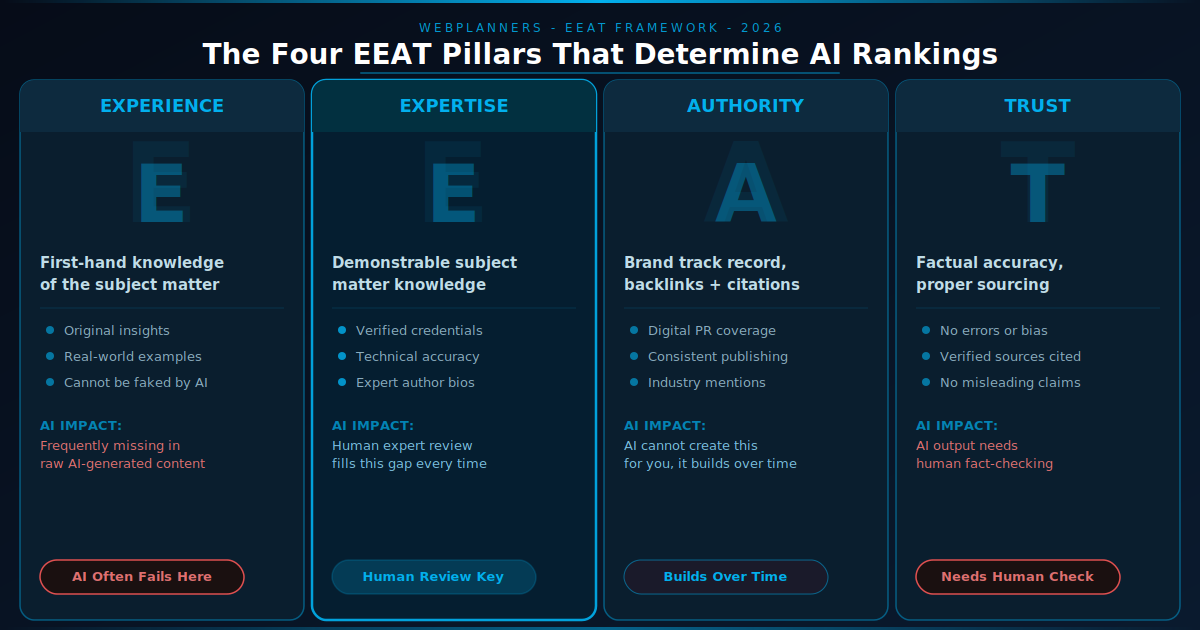
Google's EEAT framework has become the primary quality filter for AI-generated content. The four pillars matter in very specific ways.
1. Experience
First-hand knowledge is the hardest thing for AI to fake and the easiest thing for Google to detect as missing. Generic AI content pulls from sources that already exist and rearranges them. That's not experience. That's synthesis. Google is getting better at telling the difference and rewarding the ones that actually bring something to the table that wasn't there before.
2. Expertise
A qualified expert reviewing AI output before publication changes what the content is capable of. AI can draft a structure quickly. It can cover the obvious ground. What it can't do reliably is verify technical accuracy, add depth that comes from doing the work, or catch the kind of errors that only show up when someone actually knows the subject. Human reviewed AI content has that advantage. Raw output doesn't.
3. Authoritativeness
This one can't be manufactured. Digital PR that earns genuine coverage, backlinks from sources that carry real weight, and a publishing history under verified author profiles all take time and deliberate effort to build. AI produces none of that. It can help you publish more content, but it can't make the rest of the web vouch for you. That part still has to be earned the long way.
4. Trustworthiness
Scale is where trust problems multiply. One piece of unreviewed AI content might be fine. A hundred pieces with no human checking accuracy, sources, or currency of information is a different situation entirely. Errors get through. Outdated claims stay live. The factual reliability that Google uses to assess trustworthiness erodes quietly until something flags it. Human review at every piece is what stops that from happening.
Brands that build EEAT AI content signals into every piece they publish, whether AI assisted or not, are the ones dominating Google in 2026.
AI Content Ranking Factors: What the Data Shows
Based on our work across Australian clients, here is what we have observed about AI content ranking factors:
- Pages with real author bios and credentials outperform anonymous AI content on competitive queries.
- Content with original data, quotes, or case studies earns more backlinks and longer engagement times.
- AI-assisted content creation that has been fully edited for voice and accuracy ranks comparably to pure human content in most niches.
- High-volume AI content with no review consistently underperforms against lower-volume, higher-quality content.
The pattern is clear. Volume without quality is a short-term tactic with long-term consequences.
What Generative AI Content Services Should Actually Look Like
Most agencies offering generative AI content services lead with volume. Fifty articles a month. A hundred. The number goes up and the pitch gets louder. As a generative AI content development company in Melbourne, that's not how we work and not how we think about this.
Publishing at volume without a review process isn't a content strategy. It's a way of accumulating pages that create more problems than they solve over time.
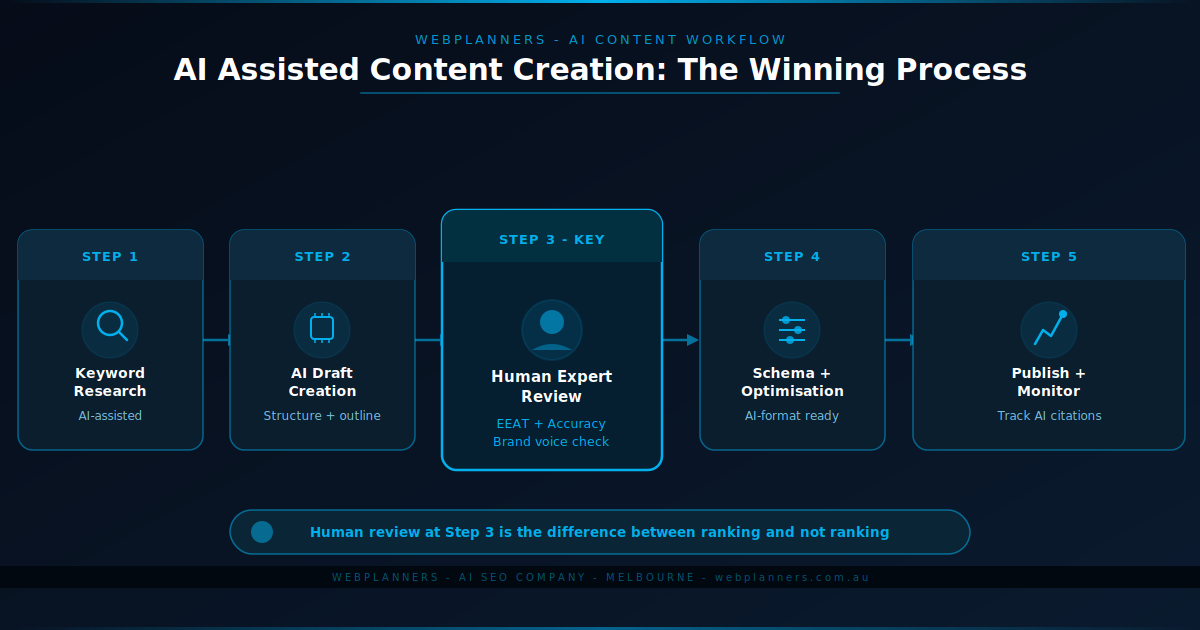
Legitimate generative AI content services involve:
- Keyword and intent research before any content is drafted.
- AI-assisted outlining and structure based on SERP analysis.
- Human expert drafting or review for every published piece.
- EEAT AI content alignment, including author credentials and source citations.
- On-page optimisation for featured snippets and AI citation formats.
- Performance monitoring and content refresh cycles.
This is AI assisted content creation done properly. It scales without sacrificing the quality signals that Google and AI search engines reward.
If you want to see what this approach delivered for one of our clients, read how we used AI to help achieve a 261% increase in organic traffic in 90 days.
Should You Use AI to Scale Your Business Content?
Yes, but with clear guardrails. Businesses that learn how to use AI to scale their business responsibly are gaining a real competitive advantage in Australian search right now.
The ones publishing unreviewed AI output at volume are building a liability, not an asset. AI should accelerate your workflow. Human strategy, human expertise, and human review should sit at the centre of every piece you publish.

Trusted AEO Services and the Content Connection
Answer Engine Optimisation comes down to content quality more than most businesses expect. AI systems reference content that is structured, authoritative, and clearly written by someone who knows the subject. Trusted AEO services from a local SEO agency that understands both the technical and content sides of this puts your brand in position to be that source.
At Webplanners, our GEO services in Melbourne bring content strategy, schema, and digital authority building into one system rather than treating them as separate projects. That's what produces AI search visibility alongside traditional Google rankings rather than one or the other.
Final Thoughts
The AI content vs human content debate is the wrong frame. The real question is whether your content is good enough to rank, regardless of how it was produced.
In 2026, good enough means original, authoritative, well-structured, and written with genuine expertise. AI can assist with most of that process. Only human review and real-world experience can complete it.
Webplanners is a professional AI SEO company in Melbourne that has been helping Australian businesses produce content that ranks, converts, and gets cited in AI-generated answers. We would love to do the same for yours. Get in touch with Webplanners and let us build to generate quality traffic to your business.
FAQs
Does Google penalise AI-generated content?
The short answer is no, but that framing misses the point. Google penalises content that is unhelpful, thin, or untrustworthy. It doesn't ask how the content was made before deciding. AI content SEO works when the output is accurate, properly reviewed, and built with EEAT in mind. What doesn't work is dumping unreviewed output onto a site and expecting Google to treat it like something a real expert wrote and stood behind.
What is human reviewed AI content and why does it matter?
Most people picture AI writing something and a human hitting publish. That's not what this means. Human reviewed AI content uses AI for research, structure, and drafts, then puts a subject matter expert in the room before anything goes live. That expert catches what AI consistently gets wrong. First-hand experience, industry-specific accuracy, and a voice that sounds like a person rather than a language model. Those aren't optional extras. They're what makes the difference between content that earns trust and content that doesn't.
What are the most important AI content ranking factors in 2026?
Start with EEAT and work outward from there. Experience, expertise, authoritativeness, and trustworthiness shape how Google evaluates everything else. Content depth, original information, entity clarity, and author credibility all feed into that assessment. Pages with real author profiles and original data beat high-volume AI content quite consistently. The businesses finding this out the hard way are usually the ones that treated publishing speed as the metric that mattered most.
What should I look for in a generative AI content development company in Melbourne?
A credible Generative AI content development company in Melbourne should offer keyword and intent research before writing, AI-assisted drafting with mandatory human review, EEAT-aligned author attribution, on-page optimisation for featured snippets and AI citations, and ongoing performance monitoring. Volume promises without a review process are a red flag.
How does AI assisted content creation work at Webplanners?
Honestly, the tool is the least interesting part of it. What actually matters is what happens before and after the AI touches anything. Research comes first. We find out what your audience is searching for and where competitors are winning. AI helps with structure and a first draft. Then a human strategist goes through it properly, not a skim but a real review that adds EEAT signals, semantic relevance, and AI citation formatting throughout. What goes live looks quite different from what came out the other end of the tool, etc.
Can AI content be used for AEO and GEO as well as traditional SEO?
Short answer is yes but the how matters more than the yes. Mostly it comes down to building the piece with all three in mind from the start rather than trying to make it work across platforms after the fact. That means structuring for direct answer extraction, getting schema right the first time, and running entity signals through the whole thing consistently. Our trusted AEO services team handles this as standard on every engagement; so it's not something you have to brief separately or follow up on to make sure it actually happened.