SEO Agency Melbourne: How to Actually Compare Quotes Without Getting Burned
Choosing an SEO agency can look simple until three proposals land in your inbox and all three promise better rankings, more traffic and business growth.
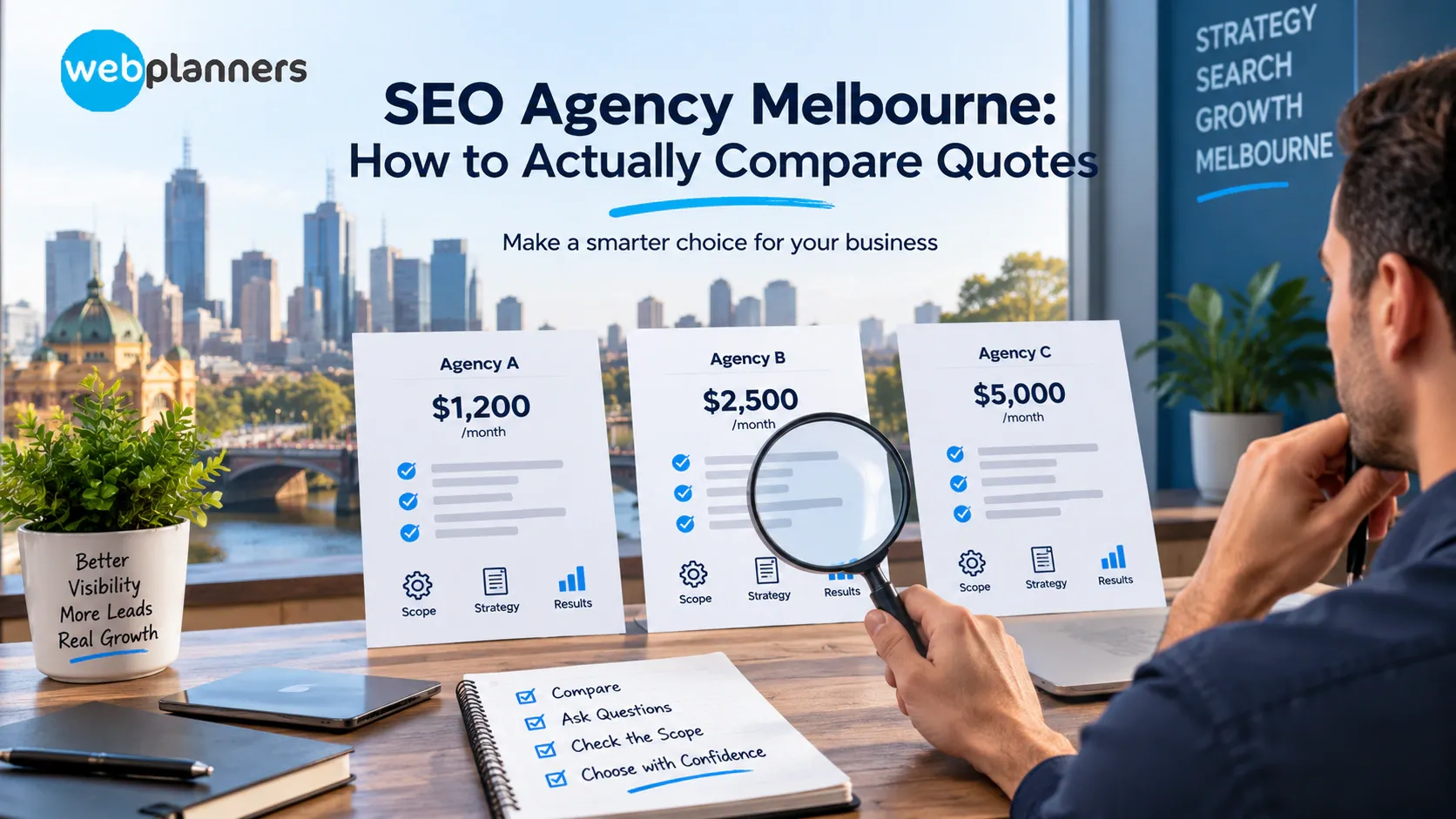
One quote might be $1,200 a month. Another might be $2,500. A third could be $5,000.
Which one is actually better? The cheapest option may not give you enough work to make progress. The most expensive one may include services your business does not need. And two agencies charging a similar amount can have completely different scopes.
The smarter approach is to compare what you are getting, how the work will be done and what business outcome the agency is working towards.
What Should an SEO Quote Actually Include?
An SEO quote should give you enough information to understand where your money is going.
Look beyond a list of generic deliverables such as “SEO optimisation” or “link building”. A useful proposal should explain the work behind those terms.
Depending on your business, the scope may include:
- Technical SEO.
- Keyword and search intent research.
- Existing content optimisation.
- New service or location pages.
- Internal linking.
- Content development.
- Authority and link-building activity.
- Google Business Profile work.
- Local SEO.
- Conversion-focused improvements.
- Reporting and performance analysis.
The right combination depends on the website and its goals.
A local trades business does not necessarily need the same campaign as a national eCommerce brand.
Don’t Compare the Monthly Price Alone
This is where many businesses get caught. Imagine two agencies both quote $2,500 per month.
Agency A includes technical work, content, new pages, internal linking, local optimisation and reporting.
Agency B includes monthly reporting, keyword tracking and a set number of hours, while content and technical changes are charged separately.
The monthly fee looks identical.
The actual value is not.
A current Melbourne SEO pricing benchmark from Webplanners puts many small and mid-sized campaigns around $1,500 to $5,000+ per month, depending on competition, website condition, locations, content requirements and business goals.
That range is only a benchmark. The more important question is what sits inside the quote.
A Better Way to Compare SEO Quotes
| What to compare | What you should ask |
|---|---|
| Strategy | What are you actually trying to improve? |
| Technical SEO | What technical issues will you identify and fix? |
| Keywords | How will you choose and prioritise them? |
| Content | Is content included, and who creates it? |
| New pages | Are new service or location pages included? |
| Internal linking | Will you improve how relevant pages connect? |
| Authority | What type of relevant authority-building work is planned? |
| Local search | Is Google Business Profile and local visibility part of the scope? |
| Reporting | Which metrics will you report and why do they matter? |
| AI search | Where relevant, does the strategy account for newer search behaviour? |
| Additional fees | What work could result in another invoice? |
This comparison usually tells you much more than the headline price.
Ask What Happens When Your Website Needs More Work
SEO rarely stays exactly the same from month one to month twelve.
A technical problem may appear.
An important service page may need to be created.
A competitor may start targeting a valuable search term.
A location may become a new priority.
Ask the agency:
“If the campaign identifies important work that wasn’t obvious at the start, is that included?”
This is particularly important when comparing an SEO company in Melbourne with a more task-based provider.
At Webplanners, our results-first model focuses on the work a campaign needs rather than treating every new requirement as a separate project.
Our current service model includes technical and platform improvements, new pages, content improvements and additional Google Business Profile optimisation within the SEO engagement.
Look at the Strategy
“10 keywords optimised per month” tells you very little.
Ask why those keywords were selected.
A good SEO strategy should connect search demand with:
- Your products or services.
- Your customers.
- Your competitors.
- Search intent.
- Commercial value.
- Existing website content.
- Opportunities the site is currently missing.
For example, ranking for a high-volume informational term may bring thousands of visitors but very few enquiries.
A lower-volume commercial search could produce fewer visitors and considerably more business.
That distinction should appear in the strategy.
Ask About Local SEO If You Serve Melbourne Customers
If your customers search for businesses by location, your proposal should address more than traditional organic rankings.
Local SEO can involve your Google Business Profile, location relevance, reviews, local pages, business information and other signals.
Ask:
- Which suburbs or areas are being targeted?
- Why were those locations selected?
- Will the Google Business Profile be reviewed?
- Are location pages included?
- How will local performance be measured?
A business serving customers in Brighton, Richmond and Carlton may need a different approach from a business targeting all of Australia.
Check Whether They Understand Modern Search

Google remains important, but search behaviour is changing.
Customers can now use AI platforms to ask questions, compare businesses and research products. Google also provides AI-powered search experiences.
That does not mean every SEO quote needs a long list of AI services.
It does mean your agency should understand how these changes affect your business.
For instance, AEO focuses on answer-focused search experiences, while GEO services in Australia address visibility within generative AI responses.
If AI is relevant to your audience, ask the agency how it fits into the wider search strategy rather than accepting an unexplained “AI SEO” add-on.
Ask How They Use AI
AI can make SEO workflows faster, but faster does not automatically mean better.
At Webplanners, we use AI to support research, analysis and repeatable tasks, while human specialists handle strategy, business context, quality checks and final decisions. Our broader generative AI services in Melbourne approach follows the same human-AI workflow.
Ask prospective agencies:
What does AI actually do in your process?
Then ask:
What does a human specialist still review?
A credible answer should be specific.
Don’t Let “AI SEO” Become an Expensive Add-On
An agency may present traditional SEO at one price and then offer AI SEO, AEO or GEO as separate upgrades.
That is not automatically wrong.
The question is whether the additional work has a clear purpose.
For example, if your customers increasingly use AI platforms to research your category, AI SEO services may have a legitimate role.
If your business relies heavily on conversational searches, voice SEO could also be relevant.
The agency should be able to explain what problem the additional service addresses and how its impact will be assessed.
Ask How Results Will Be Measured
Be careful with proposals that focus entirely on rankings.
Rankings matter, but they are not the final business outcome.
Ask whether the agency will monitor:
- Organic traffic.
- Relevant keyword visibility.
- Qualified enquiries.
- Leads.
- Conversion rates.
- Local visibility where applicable.
- Revenue or other agreed business outcomes.
Your reporting should help answer a simple question:
Is the SEO work producing commercially useful progress?
If you want a deeper look at what SEO pricing can include, our SEO cost in Melbourne breakdown covers typical investment levels and what can sit inside different campaign scopes.
Check the Agency Before Signing
The proposal tells you what an agency says it will do.
Its track record tells you more about how it works.
Look for:
- Relevant case studies.
- Measurable results.
- Client examples.
- Evidence of experience in your type of market.
- Clear reporting.
- Transparent communication.
- A defined process.
You can also read our practical checklist on choosing the best SEO company before comparing your shortlist.
Red Flags in an SEO Quote

Some warning signs are easy to spot.
1.Guaranteed rankings
No legitimate agency can control Google’s ranking systems or promise a specific position for every keyword.
2.Huge keyword lists
More keywords do not necessarily mean more business.
3.Vague deliverables
“Optimise website” or “build authority” without explaining the work gives you little to assess.
4.Very cheap packages
A low price can work for a narrowly defined campaign, but check how many hours, pages and actual implementations sit behind it.
5.Large upfront commitments
Be cautious if you are pressured to commit to a long contract before the agency has properly assessed your website and objectives.
6.No business questions
If an agency talks about rankings before asking what you sell, who your customers are and what you want to achieve, that is worth questioning.
What Should You Ask Before Accepting a Quote?
Before signing, ask these eight questions:
- What are the biggest SEO problems on my website right now?
- Which opportunities will you prioritise first?
- What exactly is included in the monthly fee?
- What could cost extra?
- Who will actually do the work?
- How will you measure commercial progress?
- How will the strategy change if the data shows something isn’t working?
- Can you show me relevant results from other clients?
The answers will often tell you more than the price itself.
Conclusion
Comparing SEO quotes is not about finding the lowest monthly number.
It’s about knowing what the agency will do, why that work is important and what you can expect in return.
A strong proposal will tie together technical work, content, search intent, authority, local visibility and business goals and without hiding “important” work behind extra charges.
At Webplanners, we mix experienced specialists with AI-assisted research and workflows, where they add value. We take a results-first approach to SEO. If you are comparing proposals and need a more clear picture of what your business really needs, speak with our team for a detailed conversation.
FAQs
Is a higher SEO quote better?
No. The price should be in line with the scope, complexity and expertise needed. The bigger fee is only justified if the additional investment is in meaningful work and business value.
How long should an SEO contract be?
There is not a one size fits all answer. Constant effort is required for SEO but companies need to understand the commitment, cancellation clauses and expected milestones before signing. Avoid committing simply because an agency says longer contracts are always necessary.
What should an SEO agency do in the first month?
Normally it should establish a clear baseline, analyse the website, research search opportunities, identify priorities and begin solving the biggest issues. The exact work differs by website and campaign goals.
Should SEO quotes include content creation?
Be specific. Some agencies bundle in content, others charge extra. If content is a major part of the strategy, the proposal should describe the quantity of content included, type of content to be created, and who will review it.
Our Recent Blogs

Couldn't be happier with how things have gone since working with Webplanners. The team genuinely cares about getting results and has helped us stay ahead of the competition. Thanks for all the hard work, legends!
Webplanners has been a huge part of our digital growth. Managing multiple websites isn't easy, but they've made the whole process feel effortless. The results have exceeded our expectations.
The team has been great to work with and always keeps us in the loop. We've seen steady improvements over time and the whole process has been straightforward. Very happy with how things are going.