Why Your Google Ads Are Getting Clicks But Not Customers
The report says 400 clicks. Your phone says otherwise. Maybe two enquiries came in, one of them from someone wanting a job. The budget’s disappearing and it’s hard to know who to blame: the ads, the traffic or the website.
Don’t pause anything or throw more money at it just yet. Most of the damage happens between the click and the sale, so that’s where to look first.
A campaign can bring in the right people and still flop. The landing page might be confusing, the offer might be weaker than a competitor’s, or the enquiry form might be a pain to fill out. Below are the usual culprits, how to spot them and what to do.
Where Google Ads Campaigns Lose Potential Customers
- Irrelevant search terms: your ads show up for searches that have nothing to do with what you sell.
- Weak landing pages: people can’t find what the ad promised.
- Poor conversion tracking: real enquiries go missing, or junk actions get counted as wins.
- Unqualified leads: the people enquiring are outside your area, your price range or your market.
- Slow follow-up: someone reaches out, hears nothing for a day and calls your competitor.
Start with search terms, landing pages and conversion data. Those three usually tell you more than fiddling with bids or lifting the daily budget.
Turn More Google Ads Clicks Into Customers
Your Campaign Is Paying For Searches That Will Never Convert
Say a Melbourne bathroom renovator bids on “bathroom ideas”. The clicks roll in. But most of those people are scrolling for inspiration, and they’re nowhere near hiring anyone.
Now compare that to “bathroom renovation quote Melbourne” or “bathroom renovators near me”. Those people are ready to talk. Google doesn’t care which type clicks, though. It bills you for the click either way.
Open your search terms report and read the actual queries that triggered your ads. You’ll probably spot a few that make you wince: research-only searches, a different service entirely, or something that just sounds close to your keyword.
From there, check your match types and add negative keywords. If you only work in Melbourne’s eastern suburbs, make sure your location settings reflect that too.
One warning. Don’t block every broad or research-style search on reflex. Some of those people come back weeks later and buy. How much they’re worth depends on how long your sales cycle runs and what your conversion data shows.
Your Landing Page Does Not Match The Ad
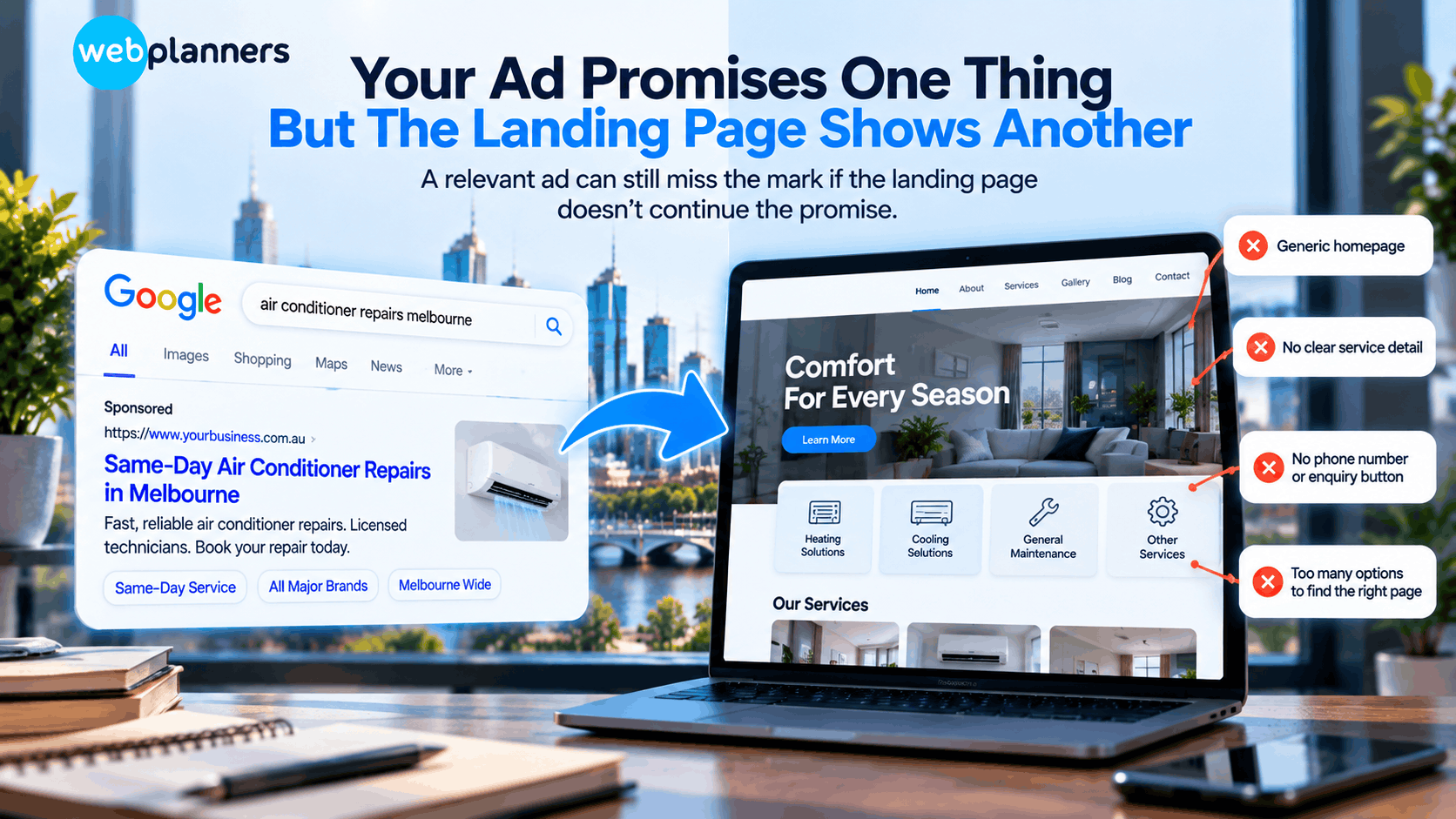
Picture someone clicking an ad for same-day air conditioner repairs. They land on a generic homepage and have to dig through menus to find the repair page, the service area and a phone number. Plenty of them won’t bother.
The landing page should pick up where the ad left off. Whatever the ad promised, the visitor should see it straight away, along with what to do next.
For a service business, the page usually needs:
- the exact service being advertised
- the suburbs or regions you cover
- pricing or quote details, if you can share them
- reviews, licences or other proof that you’re legitimate
- a phone number that’s easy to spot, or a short form
An online store needs the product, price, delivery info and key details front and centre.
This is where good website design in Melbourne pays off for advertising. A clean landing page cuts out pointless steps and lets people decide quickly whether you’re right for them. If the page has a high exit rate, fix the layout and the message before you send it any more paid traffic.
Your Conversion Data Is Giving You The Wrong Picture
Some campaigns report dozens of conversions and not one decent enquiry. It happens when Google Ads treats things like button clicks, form starts or contact page visits as primary conversions.
Those actions can tell you something about behaviour. They just aren’t worth the same as a finished enquiry or a sale.
Run through these questions:
- Are completed forms being recorded properly?
- Are phone calls tracked, if calls matter to you?
- Are duplicate conversions padding the numbers?
- Are low-value actions sitting in your main conversion column?
- Can you link an enquiry to an actual sale?
Here’s an example. A renovation company gets 30 form submissions in a month, but only eight are real, suitable projects. If all 30 count equally, you can’t see how the campaign is actually doing.
Where you can, feed qualified leads or sales back into Google Ads. That gives the system far better information than raw form numbers. Also compare Google Ads against your CRM, call records and website analytics. Small differences between platforms are normal, but a big gap you can’t explain needs a closer look.
More Enquiries Do Not Always Mean Better Leads
A campaign can produce a pile of enquiries and still make you no money.
Take a commercial equipment supplier that advertises across Australia but only delivers in Victoria. Plenty of genuine buyers get in touch, and plenty of them can’t buy. Other businesses run into different versions of the same thing: enquiries for services they don’t offer, budgets that are wildly unrealistic, or people after free advice.
So look at the quality of your leads, not only the count. Ask your sales team which enquiries turned into quotes, appointments and revenue, then trace those back to the search terms, ads and landing pages behind them.
Use what you find to tighten your targeting and messaging. If price is a big filter, putting a realistic starting figure on the page can cut down the wrong enquiries, even if total submissions drop.
If you serve specific suburbs, precise location targeting matters, and it works best alongside a solid local presence. Local SEO services can help nearby customers find you, while Google Ads picks up the paid side.
Your Website May Be Losing Customers After The Click
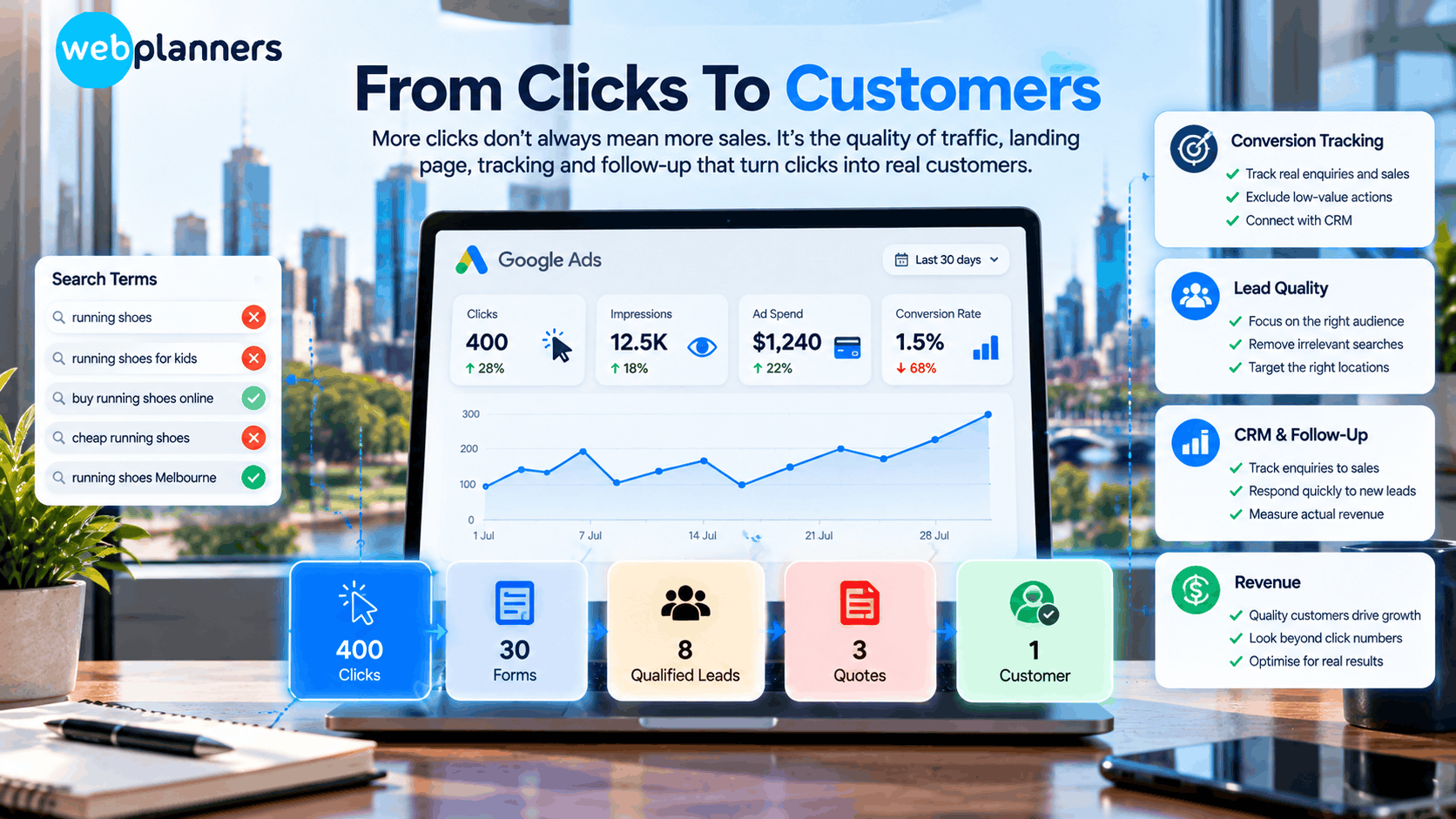
Sometimes the campaign and the landing page are fine, and the problem is the website itself. It works technically, but it’s annoying to use.
Maybe the form is too long. Maybe the phone number is buried on the mobile. Maybe a customer reaches the checkout and gets hit with delivery costs they didn’t expect.
Test the whole journey yourself, ideally on your phone:
- Click the ad or open the landing page.
- Look for the key information.
- Fill in the form or go through checkout.
- Check the confirmation message.
- Make sure the enquiry actually reaches you.
Then look at what real visitors do. Analytics, session recordings and form tracking show where people stall or hit errors.
Our case study on turning thousands of website visitors into bookings shows why traffic numbers alone don’t tell you whether a site is earning its keep.
Paid And Organic Search Should Support Different Needs
Paid and organic search reach people at different moments.
Someone with a burst pipe searches “emergency plumber” and rings the first decent result. Someone else spends a week reading up on heat pumps, comparing prices and installation options before asking for a quote.
Paid campaigns suit the first person. Helpful organic content suits the second, because it answers questions earlier on. A comprehensive and tailored SEO strategy builds visibility over time, and AI SEO helps your information show up in AI-powered search tools as people research and compare providers.
None of that replaces checking how your Google Ads are performing. It just gives you more ways to reach people across a longer buying journey.
What To Fix First When Google Ads Are Underperforming
Resist the urge to change five settings at once. If results move, you won’t know which change did it.
Work through the problems in this order:
| Problem | First action |
|---|---|
| Clicks with almost no enquiries | Review search terms and landing page relevance |
| High landing page exits | Test mobile usability, page speed and message clarity |
| Plenty of forms but few suitable leads | Compare lead quality by campaign and search term |
| Enquiries missing from reports | Audit conversion tracking and attribution |
| Qualified leads but few sales | Review response times, pricing and the sales process |
| Rising cost per lead | Check search intent, competition, conversion rate and lead value |
Give each change enough time and data before judging it, especially if your sales cycle is long or you only get a handful of enquiries a month.
The right yardstick depends on the business, too. An online retailer will care about revenue and return on ad spend. A professional services firm probably cares more about qualified enquiries and what a new client is worth.
Make Your Ad Budget Work More Effectively
Conclusion
Clicks prove your ads get noticed. Customers and sales prove the attention is worth paying for.
Before you touch the budget again, look at search intent, landing page performance, conversion tracking and lead quality.
Webplanners provides PPC services in Melbourne to help businesses find wasted spend, improve campaign results and bring in more relevant enquiries. Talk to Webplanners about improving your Google Ads campaigns.
FAQs
Why Are My Google Ads Clicks Increasing While Conversions Are Falling?
Check whether the campaign is reaching a different audience, picking up new search terms or sending more people to pages that convert worse. Competition, offers, seasonality and tracking changes can all play a part. Break performance down by search term, device, location and landing page to see where things started to slip.
Should I Pause A Google Ads Campaign That Is Not Generating Leads?
Not straight away. Confirm your tracking works, that the campaign has enough relevant traffic and that the results make sense for your sales cycle. If it keeps overspending with nothing valuable to show for it, cutting or pausing the budget while you sort out the cause is reasonable.
What Is A Good Conversion Rate For Google Ads?
It depends. A local emergency service, an online clothing store and a high-value commercial supplier all work differently, so there’s no single number. Industry benchmarks are fine as a rough guide, but your own cost per qualified lead, close rate and customer value matter more.
Our Recent Blogs

Couldn't be happier with how things have gone since working with Webplanners. The team genuinely cares about getting results and has helped us stay ahead of the competition. Thanks for all the hard work, legends!
Webplanners has been a huge part of our digital growth. Managing multiple websites isn't easy, but they've made the whole process feel effortless. The results have exceeded our expectations.
The team has been great to work with and always keeps us in the loop. We've seen steady improvements over time and the whole process has been straightforward. Very happy with how things are going.