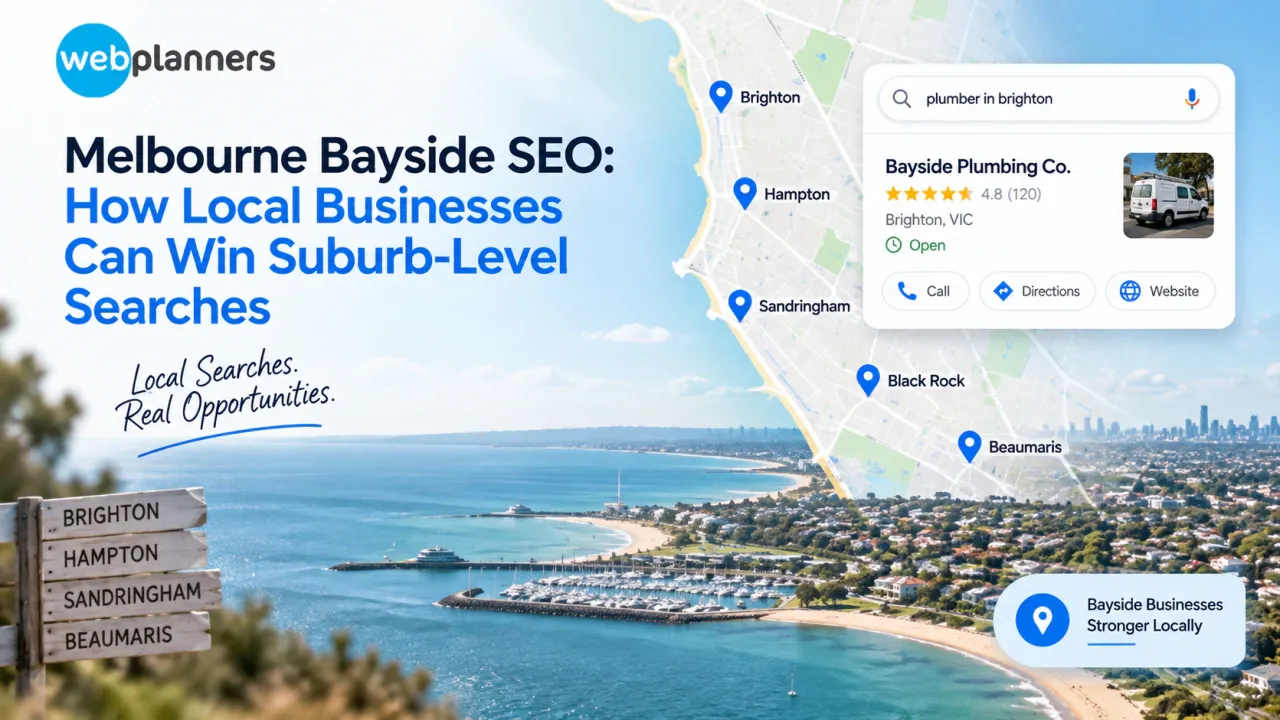
Melbourne Bayside SEO: How Local Businesses Can Win Suburb-Level Searches
A customer searching for a plumber in Brighton is not simply looking for a plumber in Melbourne.
They want someone who serves Brighton, understands the area, can reach them when needed and has enough local credibility to trust.
That small difference in the search query can change which businesses appear.
For businesses operating across Melbourne’s Bayside suburbs, this makes local search more specific than simply trying to rank for “Melbourne”. The opportunity is to build visibility around the places your customers actually live and search.
Why Suburb-Level Search Matters
Local searches often combine a service with a location.
Think:
- Physiotherapist in Hampton.
- Accountant in Sandringham.
- Builder in Beaumaris.
- Café in Brighton.
- Electrician in Black Rock.
The search tells Google something useful: where the customer wants the service.
Bayside businesses can therefore benefit from understanding the suburbs that matter to their actual service area, including Brighton, Brighton East, Hampton, Hampton East, Sandringham, Black Rock, Beaumaris, Highett and Cheltenham.
The important part is not mentioning every suburb on every page. It is showing genuine relevance to the locations the business serves.
Build Stronger Suburb-Level Visibility
What Does Local SEO Mean for a Bayside Business?
Local SEO helps businesses be more relevant for searches tied to their geographic location.
This could be the website, Google Business Profile, reviews, local citations and other signals that help search engines get an understanding of the business.
For example, if a business caters to Hampton and Sandringham, it should clarify:
What services it provides.
- Where it operates.
- How customers can contact it.
- Which locations it genuinely serves.
- What experience it has in those areas.
This is where support from a local SEO company in Melbourne can become valuable, particularly when a business needs to coordinate its website, map presence and wider local signals.
Start With Your Real Service Area
Before creating suburb pages, look at where you actually do business.
A local business may serve:
Brighton → Hampton → Sandringham → Beaumaris
while another may operate across a much wider section of Melbourne.
Those businesses need different strategies.
Creating pages for suburbs you do not serve simply because they have search volume can produce thin, repetitive content. It also gives potential customers little reason to trust the page.
Instead, ask:
- Which locations generate customers?
- Which locations are commercially important?
- Where do we genuinely provide the service?
Those answers should shape the location strategy.
Build Useful Location Pages
A strong suburb page should do more than replace one suburb name with another. Suppose a property maintenance business works across Brighton and Beaumaris.
A Brighton page may talk about the services their clients in Brighton typically ask for, and a Beaumaris page may talk about the services and property types relevant to that area.
The pages can still deliver core business information but each should provide a credible reason for a customer to visit.
Useful location content can include:
- Services available in the area.
- Relevant customer questions.
- Areas or neighbourhoods served.
- Local project experience.
- Practical service information.
- Clear contact options.
This creates a better experience for both the customer and the search engine.
Google Maps Is Part of the Picture
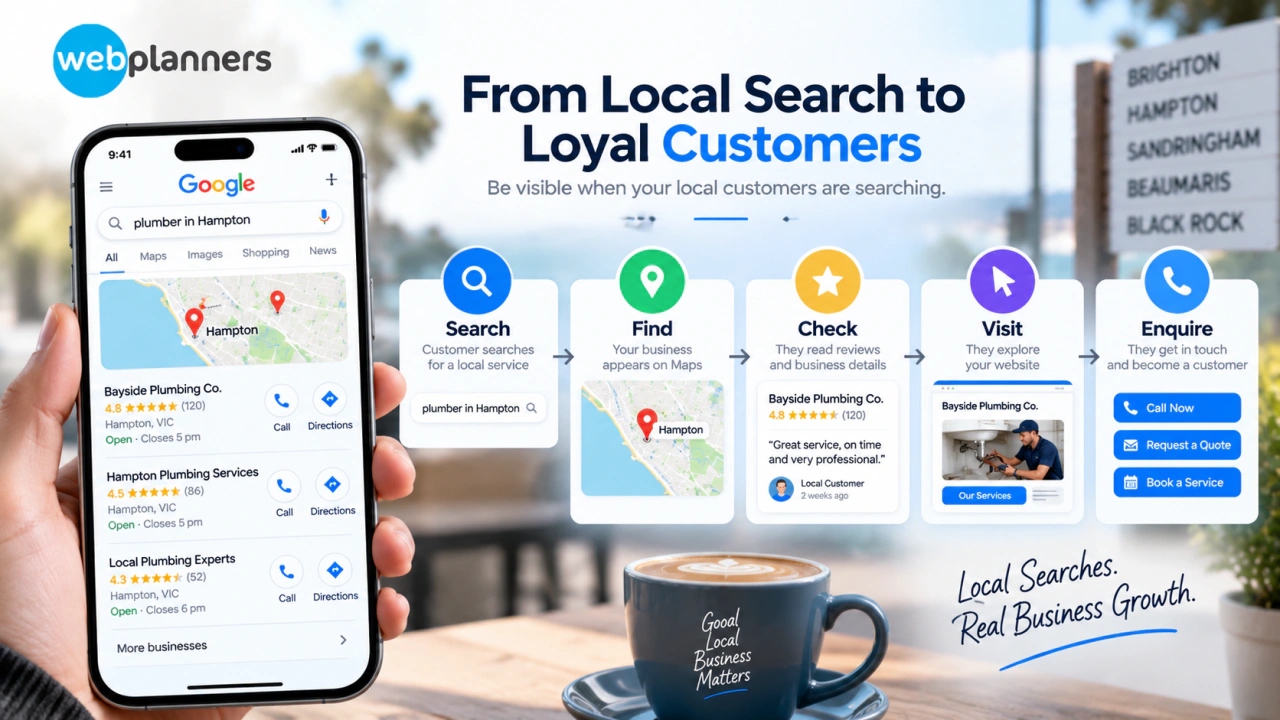
Local search does not stop at the website. A customer may search for a service and immediately see a map pack containing business names, locations, reviews, opening hours and other information.
That makes your Google Business Profile an important part of local visibility. Your business information should be accurate and consistent, including:
- Business name.
- Address or service area.
- Phone number.
- Business category.
- Opening hours.
- Services.
- Photos.
- Reviews.
- Website.
If your website performs well but your business information is incomplete or inconsistent across local listings, you may still miss valuable map-based searches.
We’ve previously looked at the issue, where we discussed why your business may be invisible on Google Maps, including the factors that can affect local map visibility.
Local Signals Should Agree With Each Other
Search engines use information from different places to understand a business.
Imagine your website says your business operates in Hampton, your business profile lists a different service area and several directories contain an old phone number.
That creates an inconsistent picture.
For a Bayside business, it is worth reviewing important local references and checking that the core information matches.
This includes:
- Website details.
- Google Business Profile.
- Relevant directories.
- Industry listings.
- Social profiles.
- Review platforms.
Quality and relevance matter more than trying to appear everywhere.
Don’t Stuff Suburb Names Into Your Content
This is one of the easiest ways to make local content feel unnatural.
A page that repeatedly says:
“Best service in Brighton, Brighton service provider, Brighton services and Brighton business…”
doesn’t become more useful because the location appears more often.
Search engines are better at understanding context than simple repetition suggests.
Instead, use location naturally alongside the service, customer needs and genuine business information. For example:
We offer residential electrical services in Brighton, Hampton and the surrounding Bayside suburbs and can schedule appointments for homeowners and property managers.
That communicates location, service and audience without forcing the keyword into every sentence.
Internal Linking Can Strengthen the Local Structure
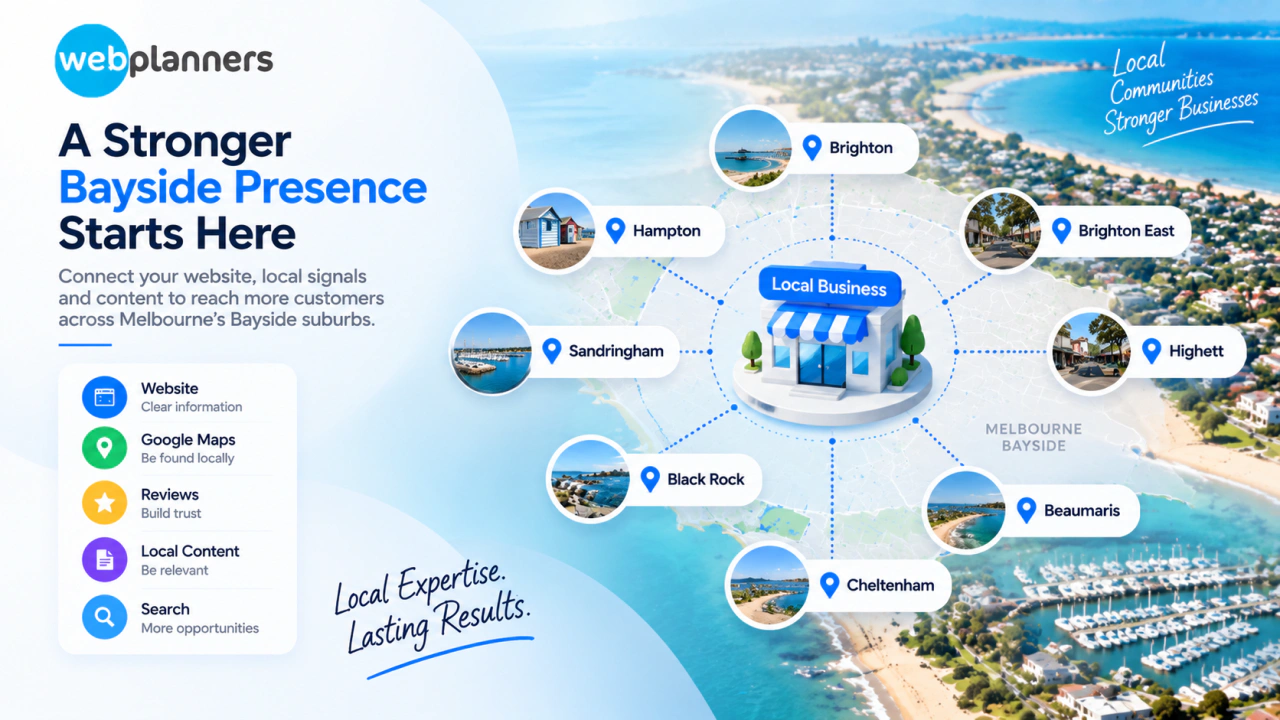
Suburb pages should not sit alone. If your website has a main service page, supporting location pages and useful educational content, contextual internal links can help users move between related information.
For example, a Brighton service page could link to the main service page when discussing the broader offering. A useful local information page could then link back to the relevant service.
This gives visitors a clearer pathway through the website, and helps search engines understand how the pages are related to one another.
Reviews Add Local Context
Reviews are useful because they give potential customers proof from people who have already dealt with the business.
Reviews can also provide natural context around services and customer experiences for local businesses.
For local businesses, reviews can also provide natural context around services and customer experiences.
Local context is more helpful in a review like: “The team arrived at our Brighton property and completed the work quickly” than a generic review like “Great service”
Businesses should avoid creating fake reviews or ask customers to include specific keywords.
The priority should be genuine customer feedback.
What About AI Search and Local Visibility?
Local businesses now have another consideration: people can ask AI systems questions in conversational language.
Instead of searching:
“best landscaper in Brighton”
someone might ask:
“Who provides reliable landscaping services around Brighton for a large residential garden?”
The underlying business information still needs to be clear.
AI-powered search can benefit from information that clearly establishes:
- What the business does.
- Where it operates.
- Who it serves.
- What services it provides.
- Why the business is relevant.
This is one reason we increasingly consider AI alongside established search practices, without treating it as a replacement for the fundamentals.
For instance, AEO can support content designed around clear, answer-focused queries, while GEO addresses visibility within generative AI responses. The underlying local information still needs to be accurate.
AI Overviews and Local Search
Google’s AI-powered search experiences could change how users interact with search results.
Rather than immediately scanning a list of websites, a user might see a summary generated by AI and then choose where to look next.
For a local business, this makes clear and trustworthy information increasingly useful.
That means your website should communicate the basics well:
Service + location + expertise + supporting information.
There is no shortcut that guarantees inclusion in an AI Overview. Strong local foundations still matter, and our AI SEO services keep AI search visibility in mind as part of a broader strategy.
Turn Local Searches Into More Business Opportunities
A Practical Bayside SEO Checklist
Before you add more suburb pages, check out these aspects:
- Service area: Do your pages reflect your actual service area?
- Business profile: Is your Google Business profile up to date?
- Location pages: Does each page have valuable information?
- Reviews: Is the feedback from customers genuine?
- Internal links: Are related service and location pages linked naturally?
- Local references: Are your business information consistent?
- Content: Is your website providing real answers to real customer questions?
- AI Visibility: Is your business information clear enough for modern search engines to understand?
This gives you a better starting point than simply adding more suburb names to the website.
Conclusion
Bayside businesses don’t need to rank for every suburb in Melbourne. They need to be visible where their customers are actually searching.
That means understanding the service area, creating genuinely useful location content, maintaining accurate business information and building a website structure that connects services with the locations they serve.
For a business targeting Brighton, Hampton, Sandringham, Beaumaris, Black Rock or nearby suburbs, the strongest strategy is usually based on relevance rather than repetition.
At Webplanners, we use this principle when developing local SEO strategies: start with the business, understand its customers and locations, then build the search strategy around genuine opportunities. Get in touch with us to know how we can help your business grow online.
FAQs
Do I need separate pages for Brighton, Hampton and Sandringham?
Not automatically. Separate pages make sense when each location represents a meaningful service area and you can provide useful, location-specific information. Otherwise, one strong service-area page may be more appropriate.
Can a service-area business rank in suburbs where it has no physical office?
It can appear for relevant local searches, but local visibility depends on several factors. Businesses should accurately represent their service areas rather than creating the impression that they have physical premises where they do not.
How many Bayside suburbs should a local business target?
There is no useful fixed number. Start with the locations that matter commercially and where the business genuinely provides services. Search demand, competition and actual customer distribution can then help determine priorities.
Should I put suburb names in every page title?
No. Only use location words if they are truly descriptive of the page and relevant to the search intent. Adding every suburb to every title makes pages cluttered and repetitive.
Does local SEO only mean Google Maps?
No. Local SEO can include organic website visibility, Google Business Profile, local content, reviews, citations, location pages and other local signals. Maps are critical, but only one piece of the larger strategy
Our Recent Blogs

Couldn't be happier with how things have gone since working with Webplanners. The team genuinely cares about getting results and has helped us stay ahead of the competition. Thanks for all the hard work, legends!
Webplanners has been a huge part of our digital growth. Managing multiple websites isn't easy, but they've made the whole process feel effortless. The results have exceeded our expectations.
The team has been great to work with and always keeps us in the loop. We've seen steady improvements over time and the whole process has been straightforward. Very happy with how things are going.