Local Landing Pages: When They Help And When They Become Duplicate Content
A business that serves several Melbourne suburbs may see an obvious SEO opportunity: create a page for every location.
Sometimes that is the right move. Sometimes it leaves a website with dozens of pages that provide almost the same information.
The difference comes down to local relevance and user value.
A strong location page gives people useful information about the service, the area and the business. A weak one simply swaps one suburb name for another.
For businesses considering local landing pages, the key question is: what makes this page genuinely useful for someone in this location? In this blog, we will discover how to create effective local landing pages that deliver real SEO value.
Focus: Understanding when local landing pages support local SEO and when similar pages risk creating duplicate content.
Key Considerations: Location relevance, genuine service areas, local customer demand, unique content, and search intent.
SEO Approach: Create location-specific landing pages that provide useful information about services, local experience, customer reviews, and service coverage rather than simply changing suburb names.
Professional Insight: Webplanners believes effective local SEO should prioritise genuinely useful location pages that reflect real business activity and customer needs.
Outcome: A stronger local SEO strategy that improves location relevance, supports search visibility, and avoids unnecessary duplicate landing pages.
What Is A Local Landing Page?
A local landing page targets a specific geographic area where a business genuinely operates or provides services.
For example:
- A dental practice with clinics in Brighton and Caulfield could have separate location pages for each clinic.
- A trades business serving Melbourne’s Bayside suburbs could create pages for its most important service areas.
- A company with offices in Melbourne, Geelong and Ballarat could provide location-specific information for each branch.
The page should reflect the business’s actual presence in that area.
This is an important part of local SEO services in Melbourne, where location relevance sits alongside website content, business information, reviews and other local search signals.
Build Better Local Landing Pages
When Local Landing Pages Make Sense
A location page has a stronger case when the business has something useful and specific to say about that area.
You Actually Serve The Location
Start with locations where you have real customers or regularly provide services.
If a business receives regular enquiries from Brighton, Hampton and Sandringham, those suburbs may warrant dedicated pages.
A suburb where the business has little activity, no meaningful customer base and limited service availability may not need its own URL.
You Have Genuine Local Experience
Local experience gives a page useful detail.
Depending on the business, this could include:
- Completed projects in the area.
- Testimonials from local customers.
- Services available to customers in that suburb.
- Common local customer requirements.
- Relevant project photos.
- Local appointment or service information.
- Case studies from the area.
These details help a visitor understand the business’s relevance to their location.
The Location Has Commercial Value
Search volume should not be the only factor behind a location page.
Consider:
- Existing customers in the area.
- Search demand for the service.
- Local competition.
- Average customer value.
- Service availability.
- Existing brand awareness.
- Your ability to provide useful local information.
Five strong location pages can be more valuable than 50 pages that provide little additional information.
When Local Pages Become Duplicate Content
Consider a website with these pages:
- SEO Melbourne.
- SEO Richmond.
- SEO Hawthorn.
- SEO South Yarra.
- SEO Carlton.
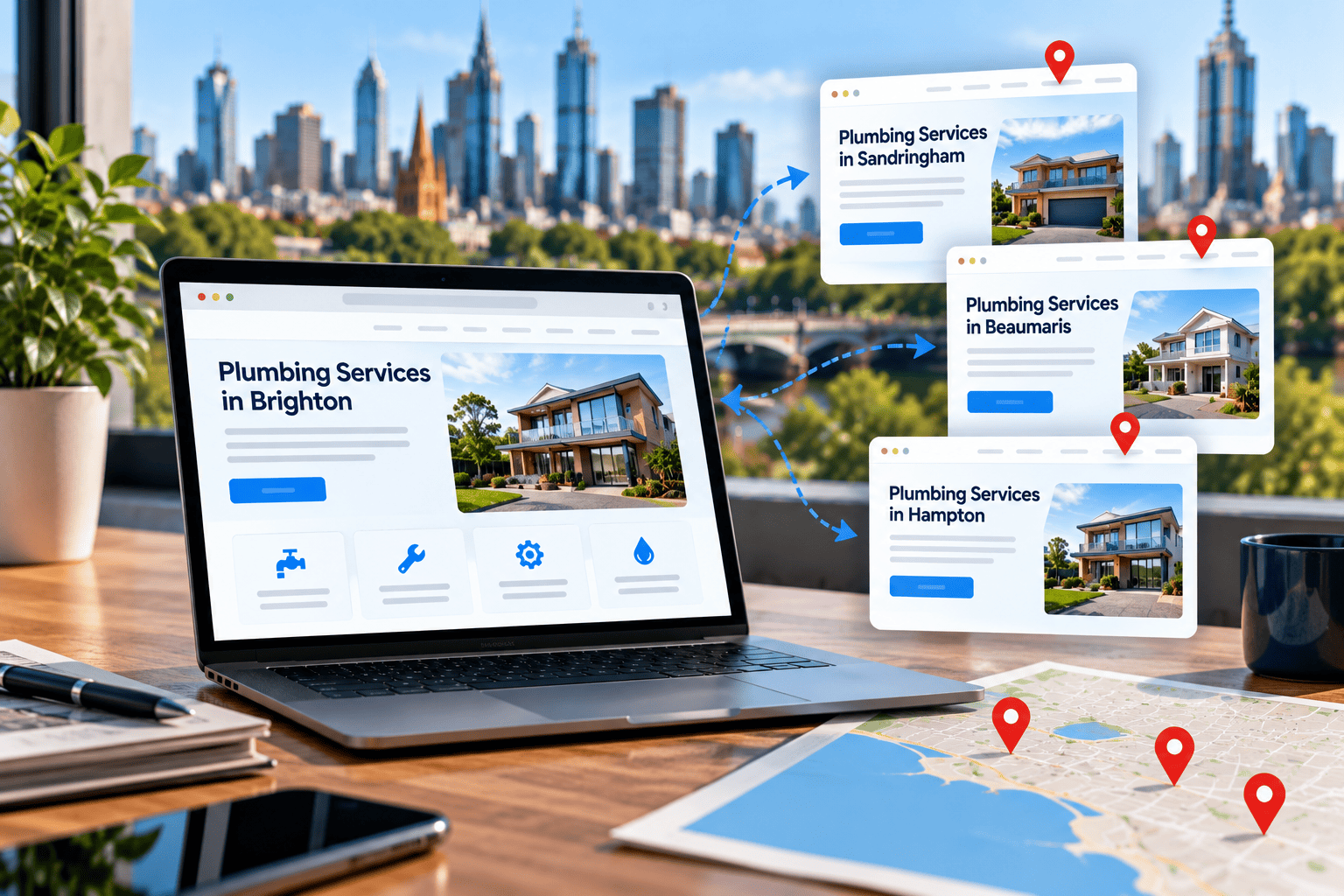
If every page contains the same introduction, services, FAQs, images, testimonials and calls to action, changing the suburb name does little for the customer.
Google explains that when multiple pages contain duplicate or very similar content, it can select one representative canonical URL from that group. Google also states that some duplicate content is normal and does not, by itself, violate its spam policies.
There is a separate concern when businesses create substantially similar pages specifically to target different cities or regions without adding enough value. Google’s spam policies classify this type of doorway abuse as a search spam practice.
So the issue is not simply having similar information across a website. The bigger concern is creating location pages that offer little reason to exist as separate pages.
What Should A Strong Local Landing Page Include?
A useful location page should answer the questions a customer is likely to have before making contact.
Consider including:
- A location-specific introduction.
- Services available in that area.
- Genuine local examples.
- Relevant customer reviews.
- Local questions and answers.
- Service coverage information.
- Clear contact details.
- Relevant internal links.
- Useful images from local work.
- Evidence of experience in the area.
The information should feel relevant to the location rather than copied from another suburb page.
For businesses working across several markets, the website structure also needs to keep each location clearly connected to its relevant services. This becomes particularly important when planning multi-location SEO for Melbourne businesses.
Do You Need A Page For Every Melbourne Suburb?
There is no SEO requirement to create a page for every suburb.
Instead, assess each location against actual business activity and customer demand.
Ask:
- Do we provide services in this location?
- Do we have customers here?
- Is there meaningful search demand?
- Is the location commercially important?
- Can we provide information that is genuinely specific to this area?
- Does the location have a distinct customer need?
- Is another page already targeting the same search intent?
For example, a business focused on Melbourne’s Bayside area may have stronger opportunities in selected suburbs than across every suburb in metropolitan Melbourne.
Search behaviour can also vary between nearby suburbs, which makes understanding Melbourne Bayside SEO searches useful when deciding where location-specific content deserves attention.
Local Landing Pages And Google Maps
Your website is only one part of local search visibility.
Google Business Profile information, customer reviews, business details and website content all contribute to the information customers see when they search for a local business.
For example, inaccurate opening hours or outdated business details can create a poor customer experience even when the website itself is well optimised.
Keeping business information consistent also matters when building a broader Google Business Profile optimisation strategy.
Google Maps deserves separate attention as well. A business can have useful website content and still receive limited visibility in local map results, which is why Google Maps SEO in Melbourne should form part of a wider local search strategy.
Local Landing Pages And AI Overviews
Local search is also becoming part of Google’s AI-powered search experiences.
Google says its AI features, including AI Overviews and AI Mode, are built on its existing Search systems. Google recommends continuing to follow its established SEO practices, rather than relying on special techniques created specifically for AI features.
That makes the quality of your local pages particularly important.
A location page should make it easy to understand:
- What the business does.
- Which services it provides.
- Where it operates.
- What experience it has.
- What makes the business relevant to that customer.
- Where customers can find further supporting information.
Google also says there are no additional technical requirements or special schema required specifically for AI Overviews or AI Mode.
For businesses working on their local search strategy, this means the fundamentals still matter: useful content, accessible pages, clear website structure and accurate business information.
These principles also sit behind the growing role of AI for local SEO, particularly as customers use more conversational searches to find nearby services.
Turn Local Searches Into Leads
How To Decide Whether A Location Page Is Worth Keeping
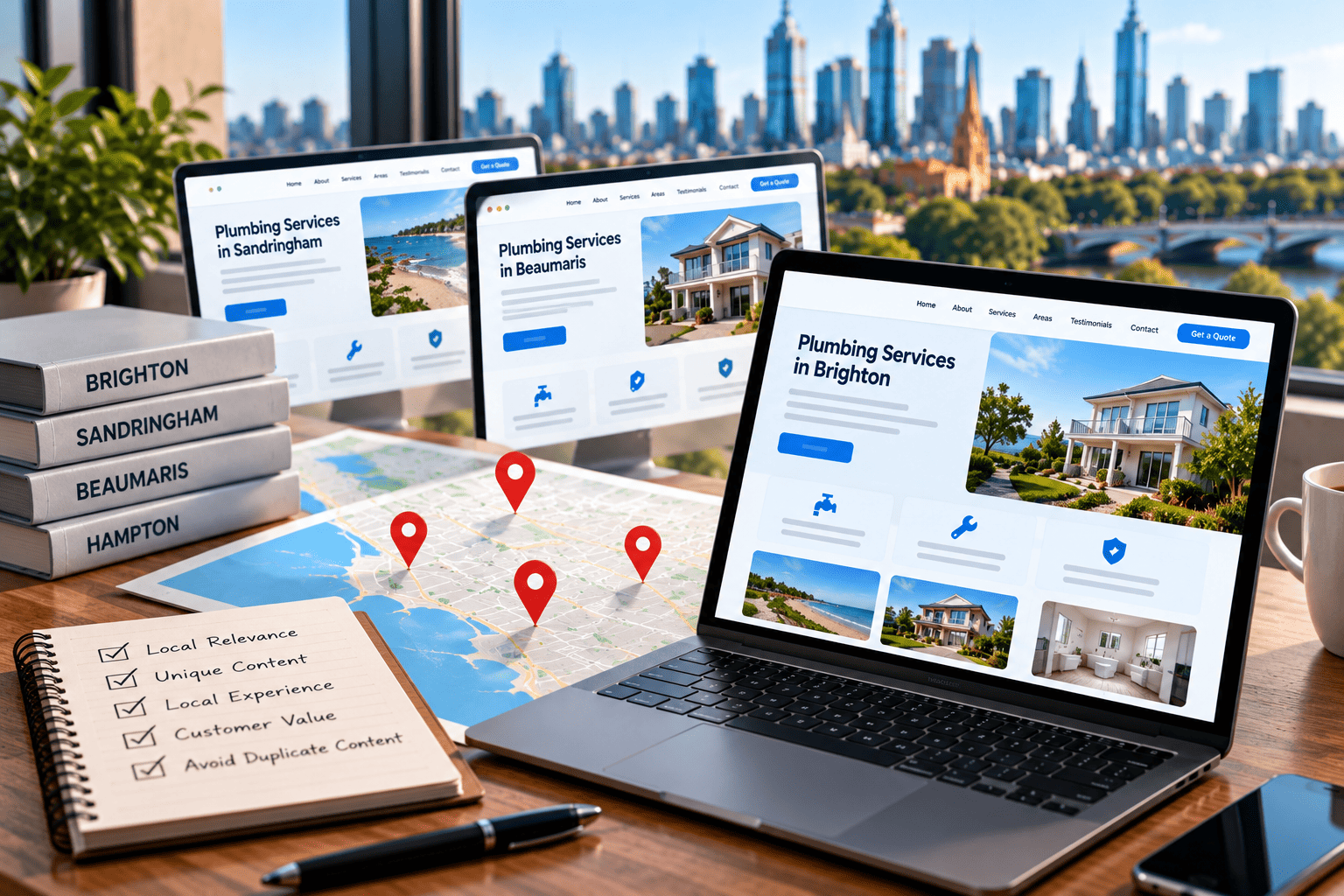
Before publishing or retaining a local landing page, ask:
- Does this page serve a genuine location?
- Does the business actually operate there?
- Does the page contain information specific to that location?
- Do we have local experience or customer evidence?
- Does the page answer useful questions?
- Does it target a distinct search intent?
- Does it add something that another page does not?
- Would a customer find it useful even without considering SEO?
If the page exists mainly because a suburb keyword has been added to the URL, title and headings, it probably needs more work.
Conclusion
Local landing pages can play an important role in an SEO strategy when they reflect genuine service areas, local experience and customer needs.
The strongest approach is to select locations based on real business activity and give each page a clear purpose. A website does not need hundreds of suburb pages to demonstrate local relevance.
For Melbourne businesses, the right structure depends on where you operate, who you serve and the useful information you can provide for each market.
Planning local landing pages for your business? Talk to WebPlanners about our SEO services in Melbourne and find out which locations deserve dedicated pages within your website.
FAQs
Should Every Service Area Have Its Own Landing Page?
No. A dedicated page makes sense when the location has genuine business relevance and there is enough useful information to make the page worthwhile. Businesses should consider service availability, customer demand, competition and the amount of location-specific information they can provide.
How Different Should Local Landing Pages Be?
There is no fixed percentage or word count that makes a page sufficiently different. The important consideration is whether each page provides meaningful information for its intended audience. Google can group pages with duplicate or highly similar content and select a representative canonical URL.
Can Duplicate Location Pages Hurt SEO?
Duplicate content does not automatically result in a Google penalty. However, highly similar pages can create indexing and canonicalisation issues and may provide little value to users. Google also has spam policies covering substantially similar regional pages created primarily to manipulate search visibility.
Should A Business Delete Similar Location Pages?
Not automatically. Review the purpose, quality and performance of each page first. Some pages may need stronger local information, while others may be better consolidated when they target the same intent and offer little additional value.
Can Local Landing Pages Appear In AI Overviews?
A local landing page can be eligible for Google’s AI search features when it meets Google’s normal Search requirements. Google states that its AI features use existing Search systems and that there are no special technical requirements specifically for AI Overviews or AI Mode.
Is Local Schema Required For AI Overviews?
No special schema is required for AI Overviews or AI Mode. Structured data can help Google understand page content when it is supported for the relevant Search feature and accurately reflects information visible on the page.
Our Recent Blogs

Couldn't be happier with how things have gone since working with Webplanners. The team genuinely cares about getting results and has helped us stay ahead of the competition. Thanks for all the hard work, legends!
Webplanners has been a huge part of our digital growth. Managing multiple websites isn't easy, but they've made the whole process feel effortless. The results have exceeded our expectations.
The team has been great to work with and always keeps us in the loop. We've seen steady improvements over time and the whole process has been straightforward. Very happy with how things are going.