10 Questions to Ask ChatGPT About Your Own Business, And What the Answers Reveal
Your business may look very different from the way an AI system understands it.
That difference matters. A potential customer can now ask ChatGPT about a business, its services, competitors, reputation or suitability for a particular need. The answer they receive may influence what they consider next.
So instead of asking only, “Does my website rank?”, there is another useful question:
“What does AI actually understand about my business?”
You can get a surprisingly useful first look by asking ChatGPT these 10 questions. The answers are not a formal ranking report, but they can reveal gaps in your online presence, content, positioning and business information. Keep reading to see what each question can reveal about your business.
Top Questions to Ask ChatGPT About Your Business
1. “What does my business do?”
Start with the simplest question. Ask ChatGPT to describe your business using only publicly available information.
- What the answer can reveal.
- Whether your core service is clear.
- Whether your industry is correctly understood.
- Whether your positioning is specific or generic.
- Whether important services are missing.
- Whether outdated information is influencing the response.
If ChatGPT gives you a wrong description of your business, it’s not immediately obvious that the AI is to blame. Look up your website and other trusted sources to see what information is out there about your business.
For example, a solar installation professional may be referred to as just an “electrical contractor”. That could be a sign that the business has not clearly positioned its solar expertise across its digital presence.
Find Out How AI Understands Your Business
2. “What services does [business name] offer?”
This question is to test the clarity of your service offering. Ideally, the response should identify the services that matter to customers.
If it lists old services, misses major offerings or confuses one service with another, review the related pages and business information.
This can also tell you if your site has enough depth around important commercial topics.
3. “Who would you recommend this business for?”
This is more than just basic business info. You are asking AI to read your audience and positioning.
Consider to look:
- The kind of customer it connects with your business.
- The problems it thinks you solve.
- Whether your target market is correct.
- If your positioning is different from competitors.
For instance, a high-end furniture retailer may want to target consumers seeking custom, made-to-order pieces. If the response is making it sound like it is a budget furniture store, then there is a messaging problem that should be looked into.
4. “What are the main reasons someone would choose this business?”
This is one of the most telling questions. AI could highlight strengths based on what data it can find about your business such as experience, specialist services, customer reviews, certifications, locations or specific areas of expertise.
If your answer sounds like something that could be said about 10 other companies in the same industry, then your digital presence may not have unique information.
This is closely tied to E-E-A-T where first-hand experience, expertise, authority and trust help to build why a business should be considered credible.
5. “What questions would customers ask before choosing this business?”
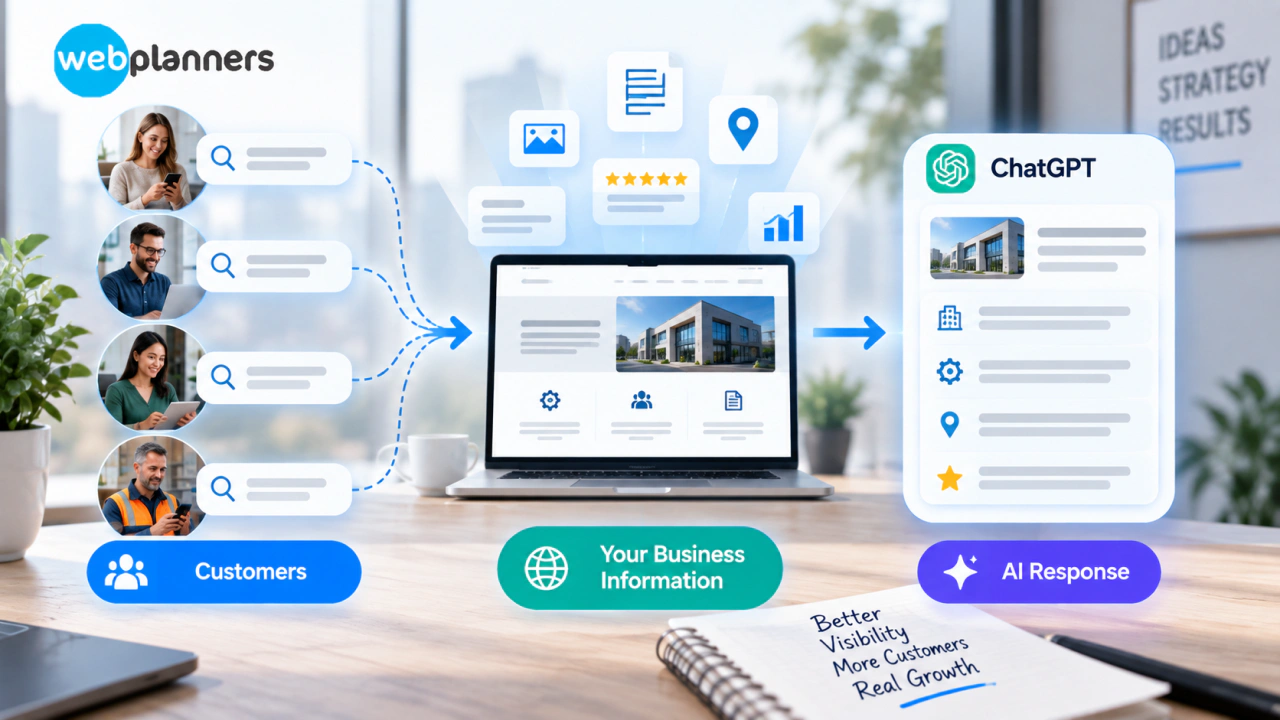
Now you’re looking at customer intent.
The response can surface questions around:
- Pricing.
- Suitability.
- Service areas.
- Experience.
- Products or services.
- Comparisons.
- Timing.
- Guarantees or policies.
These questions can provide useful ideas for website content. They can also support AEO because answer-focused content starts with understanding the questions customers actually ask.
The goal is not to publish all the questions that AI produces. Choose the questions that will be of real value to your audience.
6. “Would you recommend this business to someone in [suburb/city]?”
This is particularly useful for businesses that rely on local customers. Try several locations where you genuinely operate.
What the answer may reveal
- Whether your location is associated with the business.
- Whether your service area is clear.
- Whether competitors appear instead.
- Whether the business is being positioned as relevant to that location.
This could be another way to look at local SEO for a Melbourne business.
It shouldn’t replace a proper local search audit, but it is useful in pointing out questions that are worth investigating.
7. “What sources did you use to answer this?”
This question is especially useful when you are testing how your business is being represented by AI.
Look at the sources it identifies.
Are they:
- Your official website?
- Industry publications?
- Business directories?
- News websites?
- Review platforms?
- Outdated pages?
- Competitor websites?
If credible sources repeatedly support your business information, that can strengthen the overall picture AI has available.
If important information comes from outdated or weak sources, you have a reason to review your wider digital presence.
8. “What information about this business seems to be missing?”
This question makes the conversation a content gap exercise.
AI may uncover missing details on services, expertise, locations, products, customer segments, or other critical aspects.
You should then verify those gaps against your actual business.
For example, a specialist accounting firm may have strong pages about tax services but very little information demonstrating experience with the industries it serves.
That missing context could matter to both customers and AI systems.
9. “Who are the main competitors of this business?”
Don’t treat the response as a definitive competitor report.
Instead, look at who AI associates with your business.
Are the competitors:
- Similar in size?
- Targeting the same customers?
- Offering comparable services?
- More visible online?
- Being mentioned for reasons your business does not communicate?
This can give you another starting point for competitor research.
An experienced SEO consultant can then combine those observations with real search data, competitor analysis and website performance rather than rely solely on AI output.
10. What would make you less likely to recommend this business?
This might be the most awkward question, but it can be one of the most helpful.
Employ AI to identify possible problems from publicly available data.
It could mention :
- Limited information.
- Details of service are not clear.
- Signs of limited expertise.
- Contradictory business information.
- Limited credible references.
- Badly explained offerings.
- No recent information.
Don’t treat every response as fact. Instead, use it as a prompt to check what customers, search engines and AI systems can actually see.
What These 10 Questions Tell You
Taken together, the answers can show whether your business has a clear and consistent digital identity.
| What you test | What you may learn |
|---|---|
| Business description | Entity and brand clarity |
| Services | Content and information gaps |
| Target customers | Positioning |
| Reasons to choose you | Differentiation and expertise |
| Customer questions | Search intent |
| Location recommendations | Local relevance |
| Sources | Authority and credibility |
| Missing information | Content opportunities |
| Competitors | Market positioning |
| Reasons not to recommend | Trust and information gaps |
The important point is that one ChatGPT conversation is not a visibility score.
AI responses can change based on the wording of the question, available sources, location, current information and the system being used.
What matters is the pattern.
What Should You Do With the Answers?
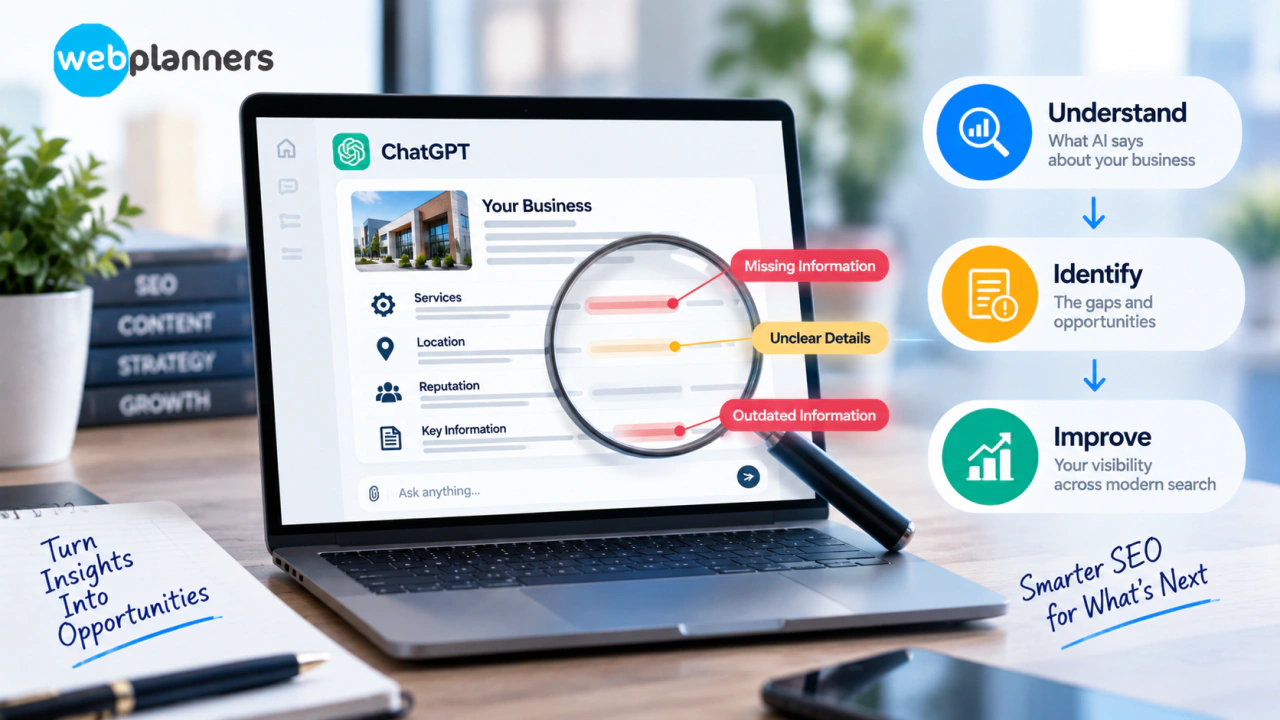
Don’t jump straight to writing your entire website over. First, the findings are grouped.
1. If the business description is incorrect
Review your primary business and service pages. Determine your expertise, audience and what you offer.
2. If important services are lacking
Check your existing content out whether those include useful, well-crafted information and required details.
3. Competitors are shown more often
Look at what information is getting them noticed. They might be better at covering topics, they might have better positioning, they might be better at citing references.
4. Where local guidance is poor
Check your location details, Google Business Profile, reviews and broader local signals.
5. If AI is unable to find sufficient useful information
This could be a sign of a bigger problem with your content or authority, not just needing more blog posts.
Where AI Fits Into Our SEO Process
At Webplanners, we see AI as useful for analysing large amounts of information and identifying patterns, but the final strategy still needs human judgement.
Our approach to generative AI services combines AI-assisted workflows with human review, business context and editorial oversight. That matters because AI can identify a possible gap, but it cannot decide whether that gap actually matters to your customers without understanding the business.
The same principle applies when assessing visibility in generative search. Generative engine optimisation focuses on how a business is represented and referenced within generative AI responses, so understanding what AI currently says about your brand can be a useful starting point.
And if ChatGPT is important to your audience, asking these questions gives you a practical starting point for ChatGPT optimisation, particularly when you compare the answers with the information actually available across your digital presence.
Turn AI Visibility Gaps Into Growth Opportunities
Conclusion
You don’t need to wait for a customer to tell you what AI says about your business. The answers can reveal how clearly your business is understood, what information is missing, which competitors are associated with your category and whether your online presence gives AI enough reliable context to represent you accurately.
The most useful response is not necessarily a flattering one. If you find gaps, treat them as opportunities to improve how your business is represented online.
If you need help turning those findings into a practical strategy, our team at Webplanners can assess your website, search visibility and AI presence. As an experienced AI SEO company in Melbourne y, we combine AI-assisted analysis with human expertise to identify where your business can improve its visibility across modern search.
Get in touch with us to discuss where your business could improve its visibility across modern search.
FAQs
Can I use ChatGPT to check whether my business ranks?
Not reliably. ChatGPT can tell you what your business looks like in an AI response but it’s not a substitute for search ranking data, analytics or a proper SEO audit.
Do I ask the same questions on different AI platforms?
Yes, if you want to compare how your business is listed. Use the same questions. Write down the answers so you can see patterns instead of considering inputs from a single platform.
What if ChatGPT provides me with wrong information about my business?
First, verify the information it appears to be relying on. Check your website, business listings and other trusted third-party references. Cleaning up old or inconsistent information in those sources will help you build a cleaner digital identity.
Can these questions replace an SEO audit?
No. They are a useful diagnostic exercise, not a complete technical or search performance assessment. An SEO audit can examine areas that a conversational AI response cannot reliably assess, including crawlability, indexation, technical issues, rankings and organic traffic.
Our Recent Blogs

Couldn't be happier with how things have gone since working with Webplanners. The team genuinely cares about getting results and has helped us stay ahead of the competition. Thanks for all the hard work, legends!
Webplanners has been a huge part of our digital growth. Managing multiple websites isn't easy, but they've made the whole process feel effortless. The results have exceeded our expectations.
The team has been great to work with and always keeps us in the loop. We've seen steady improvements over time and the whole process has been straightforward. Very happy with how things are going.