
A website can have strong products, industry knowledge and a clear market, yet still remain difficult to find in organic search.
That was the position of one of our RTO resources clients.
The business had a relevant offering, but there was room to capture more of the searches its audience was already making. Instead of treating the campaign as a simple ranking exercise, we looked at the website from several angles: keyword opportunities, content quality, search intent, internal linking and authority.
The result was a 658% increase in organic traffic.
More importantly, the campaign shows what can happen when SEO activities work together instead of being handled as disconnected monthly tasks.
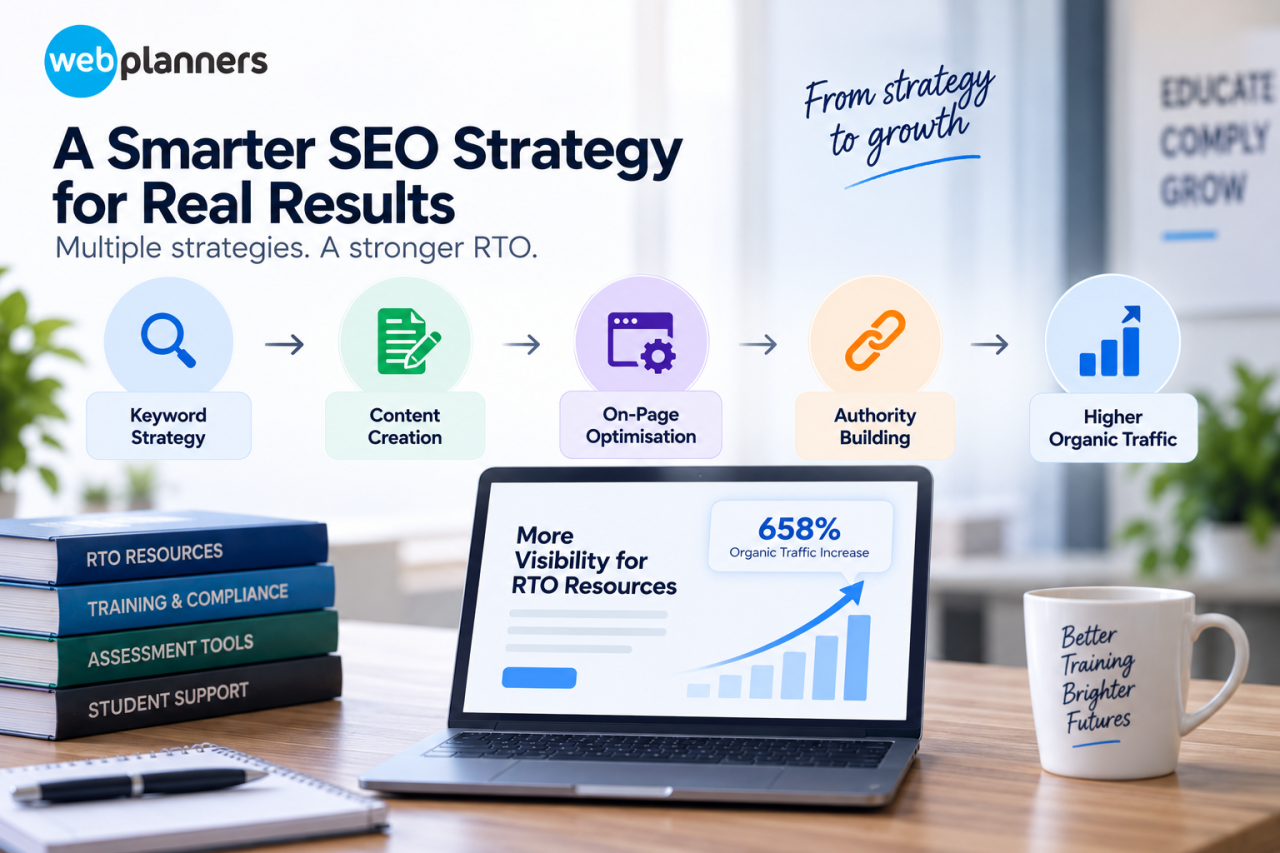
Webplanners increased organic traffic for an RTO resources client by combining targeted keyword research, useful content, stronger internal linking and relevant link building. Rather than relying on one SEO tactic, we connected these activities to improve the website's search visibility and attract more relevant organic traffic.
Key strategy: Keyword targeting → Content → On-page optimisation → Internal linking → Authority building → Organic growth.Where the Campaign Started
The client operates in the RTO resources and vocational education space. Search behaviour in this market can be highly specific.
Potential customers may search for a particular resource, training requirement, documentation or solution rather than a broad industry term.
At first, our review highlighted a number of areas for improvement on the website:
- Some pages were not well aligned to search intent.
- There was not full use of content opportunities.
- The site had opportunities to increase its authority.
- Relevance of organic traffic needed to be assessed.
- The navigation between related pages could be improved.
- The search terms that mattered weren’t being targeted well.
This gave us a clear goal: to identify the right search opportunities, build useful content around them and strengthen the ability of the website to compete.
Turn Search Visibility Into Business Growth
The SEO Strategy We Used
1. Advanced Keyword Strategy
So we began with keyword research, but it wasn’t just about finding terms with a high search volume.
We looked at:
- Search intent.
- Relevant long-tail searches.
- Commercial opportunities.
- Related search terms.
- Competitor keyword gaps.
- Existing pages that could be improved.
- New topics that needed dedicated content.
This helped us create a stronger connection between the search query, the user's intent and the most appropriate page.
For an RTO resources provider, that distinction matters. A highly relevant search from someone looking for a specific resource can be more valuable than a broad term that attracts visitors with no commercial connection to the business.
This is also the foundation of our SEO services in Melbourne, where we assess the actual search opportunity before deciding what work should be prioritised.
2. We Built Content Around Actual Search Demand
Once the keyword opportunities were identified, we looked at the content needed to address them.
The objective wasn't to publish content simply to increase the number of pages on the website.
Each piece needed to have a reason to exist.
We focused on content that:
- Added useful context.
- Backed up key commercial pages.
- Expanded coverage of relevant topics.
- Matched the intent behind relevant searches.
- Answered actual questions and information needs.
Knowledge gained from first-hand experience can be a real game-changer for specialist businesses . Generic content rarely replicates the industry experience and knowledge that an RTO resources provider has.
Our approach to content strategy follows the same principle: content should serve the audience while supporting the wider organic search strategy.
3. We Improved the Relationship Between Pages
Creating useful content is only part of the work.
We also considered how pages connected with one another.Someone early in their research may like an information page. That resource or solution might be found on another page. Logical internal linking can connect those stages and provide clearer signals to search engines on the relationship of related content.
We worked on :
- Internal links in context.
- Relevant anchor text.
- Reduce isolated content.
- Connections between supporting and commercial pages.
- Upgrading important pages with relevant supporting content.
This helped turn individual pages into a more cohesive website rather than a collection of individual URLs.
4. We Strengthened Website Authority
Content is king, but authority also matters too as it connects to improving organic visibility. We acquired quality links that were relevant to help support the authority of the website.
It was not about building up a ton of links from anywhere and everywhere. We considered relevance, quality and context.
This was part of a wider campaign that included keyword optimisation and content development rather than doing link building as a stand alone activity.
5. We Measured Growth Through Business Relevance
The headline result was a 658% increase in organic traffic.
But we didn't treat the traffic figure as the entire definition of success. For an RTO resources provider, attracting people who are genuinely interested in the products and resources matters more than generating visits from unrelated searches.
So the strategy considered whether organic visibility was moving towards relevant search demand and the client's commercial objectives.
This is an important distinction. More traffic can look impressive. Relevant traffic is what gives that growth business value.
What Changed as a Result?
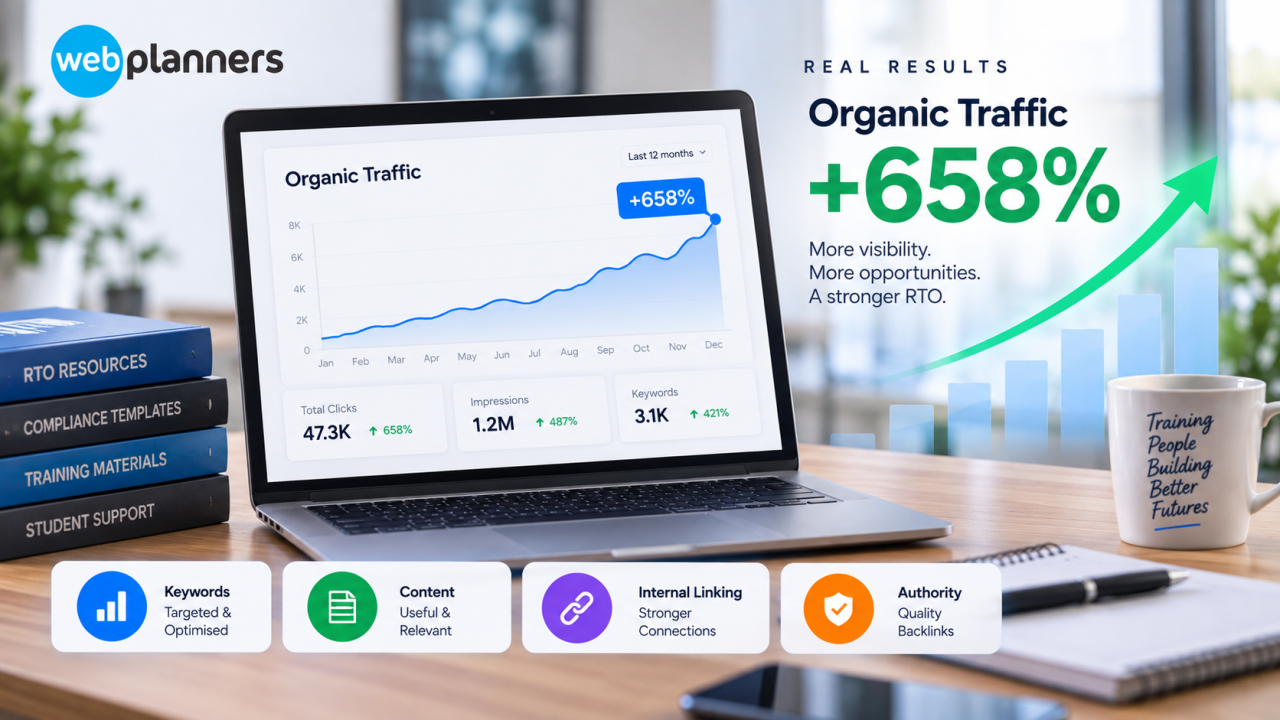
The campaign brought several SEO activities together:
| Area | What we focused on |
|---|---|
| Keyword research | Identifying relevant searches and search intent. |
| Content | Creating useful coverage around priority topics. |
| Internal linking | Building stronger connections between related pages. |
| Authority | Developing relevant, quality links. |
| SEO strategy | Keeping the work connected to business objectives. |
The result was a 658% increase in organic traffic for the RTO resources provider.
We have also seen substantial organic growth across other industries through different SEO strategies.
Our published case studies include businesses in areas such as retail, automotive, professional services and education, showing why we don't apply exactly the same campaign structure to every client.
What Other RTOs Can Learn From This
The strategy behind this campaign isn't a formula that every RTO should copy word for word.
The more useful lesson is how we approached the problem.
Start with real search behaviour
Understand the terminology customers actually use, including specific and long-tail searches.
Give important searches the right destination
A specific search should lead to a page that genuinely addresses the need behind that search.
Use your industry knowledge
RTOs have specialist knowledge, processes and experience. Bringing that into website content can make it more useful and distinctive.
Connect supporting content with commercial pages
A blog or resource page shouldn't exist in isolation. Relevant internal links can help users move towards the information or solution they need.
Look beyond rankings
Rankings are important, but they should be considered in relation to organic traffic, relevant visitors, enquiries and other business outcomes.
How Modern Search Fits Into the Picture
SEO has also evolved past the standard blue link results. Search engines now have more direct answers and AI search experiences. Conversational systems can also provide suggestions and information to users.
That doesn't mean traditional SEO is irrelevant. Strong technical foundations, useful content, clear site structure and relevant authority remain important.
We also consider newer search experiences where they make sense for a business. For example, Answer Engine Optimisation focuses on structuring useful information for answer-focused search experiences.
Separately, Generative Engine Optimisation addresses visibility within generative AI responses.
And for businesses looking at the wider use of AI within their search strategy, our generative AI services combine AI-assisted workflows with human review and strategic input.
These areas can support a modern SEO strategy, but they don't replace the fundamentals that helped drive this RTO campaign.
Why We Don't Use the Same SEO Strategy for Every Business
An RTO resources provider has a very different search market from a retailer, local service business or professional firm.
The starting point changes.
So do the competitors, search behaviour, content requirements and commercial priorities.
That's why we begin by asking:
- What does the business sell?
- Who is searching for it?
- What are they searching for?
- Where is the website currently visible?
- Where are competitors gaining ground?
From there, we decide where the effort should go.
That could involve technical SEO, content, keyword research, internal linking, authority building or other work.
What Role Does AI Play in Our SEO Process?
We use AI to improve parts of the research and production workflow, but we don't treat AI output as a finished SEO strategy.
AI can assist with areas such as:
- Keyword clustering.
- Topic research.
- Content gap analysis.
- Competitor research.
- Content briefs.
- Large-scale data analysis.
Our team then reviews the information, checks relevance and applies the business context.
That human-AI workflow is important because search strategy still requires judgement. AI can process information quickly, but it doesn't automatically understand a client's products, customers, competitive position or commercial priorities.
Build An SEO Strategy Around Real Search Demand
Conclusion
The 658% organic traffic increase was not the result of one shortcut. We combined keyword research, content, internal linking and authority building around the client's actual search market. That is the bigger lesson from this campaign.
Good SEO starts with understanding the business and its customers, then deciding what the website actually needs.
If your RTO website isn't attracting the organic visibility it should, get in touch with Webplanners.
As a leading SEO company in Melbourne, we will assess your current search performance and identify the opportunities that could have the greatest value for your business.
FAQs
Can an RTO increase organic visibility without publishing dozens of blogs?
Yes. More content isn't always best. Better search intent alignment, on-page optimisation, internal linking and stronger topical coverage can offer significant opportunities within existing service and resource pages.
Should an RTO target broad education keywords?
Not always. Broad terms can be very competitive and may not indicate strong buying or enquiry intent. Commercial value can be found in specific searches for resources, solutions or information that an audience of RTOs requires.
How important are internal links for an RTO website?
This can be particularly useful when a site has many related resources and informational pages. Contextual links placed well help users move between related information and can give search engines a clearer understanding of how pages relate.
Can content produced by AI improve RTO’s SEO?
While AI may assist with research and content workflows, publishing AI-generated text alone doesn’t generate expertise or authority. RTO content must be accurate, relevant and business-specific and must be appropriately human-reviewed.
Should RTOs invest in local SEO as well?
That depends on your business model. Local SEO could be part of the broader strategy if the RTO caters for specific locations or depends on local searches. A national resource provider might have different priorities.