
Search is no longer limited to a list of blue links.People are increasingly using complete questions in their search and expect to get a direct answer. They might say “Hey Google” or use a voice assistant or newer AI-powered search experiences.
This has resulted in the increased relevance of Answer Engine Optimisation (AEO), in modern SEO.
But what is AEO, and does your business really need it? Keep reading as we explore in more detail.
- Answer Engine Optimisation is about providing people with clear answers to the questions they are searching for.
- Featured snippets and other answer-focused search features offer common AEO opportunities.
- The heart of AEO is the need for content structure that is clear, compatible with a search intent and that provides useful information.
- Voice search SEO and conversational queries overlap, but they are not the same as AEO.
- AEO is not a substitute for SEO. Good technical SEO and useful content still count.
What is AEO?
Answer Engine Optimisation is about organising useful information on a website in a way that search systems can understand and potentially surface it as a direct answer.
An easy example is an online furniture retailer.
Customer searches:
“What size dining table do I need for 6 people?
Rather than forcing the customer to read an entire buying page, the website could provide a short answer under an appropriate heading, with useful information about room size, table shape and seating.
The content first answers the question, then provides helpful context.
That is the basic thinking behind AEO.
Why is AEO Important?
People don't always search with short keywords anymore.
They ask questions like:
- “How often do I need to replace my running shoes?”
- “What is the best sunscreen for sensitive skin?”
- “How much food should I feed my puppy?”
- “What size air conditioner do I need for a 3-bedroom house?
These searches show search intent better than just one keyword.This is a chance for businesses to answer questions customers ask before they buy.
AEO can also help visibility in search features like featured snippets, where Google can show a direct answer from a webpage. Google says featured snippets are selected by an algorithm when its systems determine that a page has an answer that is helpful for search queries.
What Makes Content Suitable for AEO?
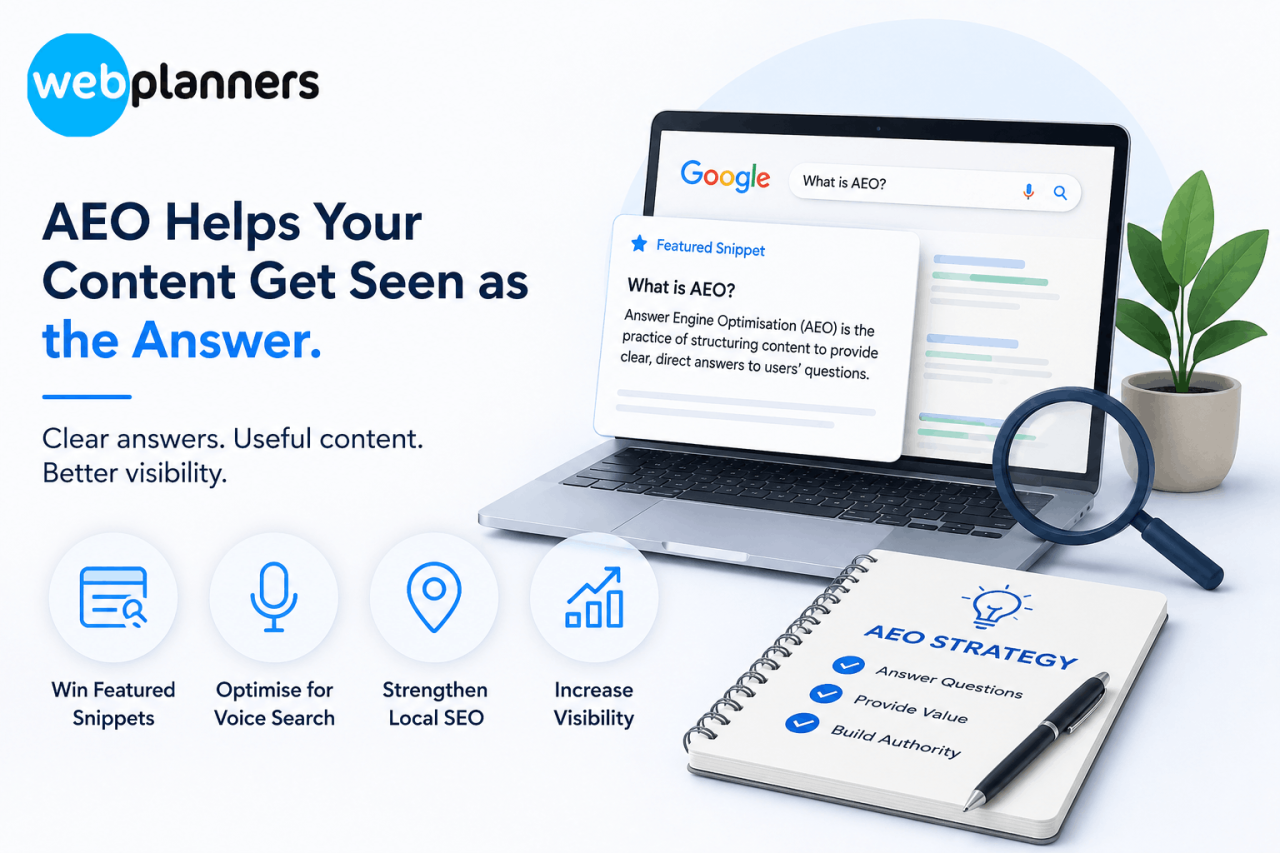
There is no single AEO formula.
The strongest approach starts with good SEO fundamentals and then makes important information easy to understand.
Answer Real Customer Questions
Start with questions customers actually ask.
An online pet store could create useful content around:
- How often should I feed my puppy?
- What food is suitable for senior dogs?
- How do I change my dog's food safely?
- How much exercise does my dog need?
These questions are much more valuable than creating pages simply because they contain a keyword.
Give The Answer Early (H3)
If someone asks a question, answer it near the relevant heading.
You can then add supporting information, examples and expert context.
Match the Content to Intent
Someone searching “how to clean white sneakers” wants instructions.
Someone searching “best white sneakers for walking” is probably comparing products.
The page should reflect that difference.
Build Topical Depth
A strong website should cover the important questions around its products or services rather than creating disconnected pages for individual keywords.
This is where semantic SEO, topic relationships and internal linking become useful.
Google's current documentation also recommends clear site structure, crawlable internal links and accessible text content for AI search features.
What Role Does Voice Search SEO Play?
Voice searches often sound like conversations.
Someone might type:
"best family restaurant in Melbourne"
but say:
“Best family restaurants near me that serves vegan food options”
And this is where voice search SEO comes in.
Businesses can be ready for conversational searches by providing clear answers to natural questions and keeping important business information accurate.
A Melbourne physiotherapy clinic, for instance, can clearly explain its services, treatment areas, hours of operation, location and frequently asked patient questions.
Voice search SEO and AEO can work together but they are not the same. Voice search is about voice interface searches, while AEO is about providing content that can be used as direct answers.
Where Does Local SEO Come In?
Location changes the type of answer a customer needs.
Consider someone searching:
“Where can I get a wedding dress altered in Melbourne?”
The search isn't only looking for information about dress alterations. It also needs relevant local businesses.
This is where local SEO matters.
A local business should provide accurate information about:
- Location
- Service areas
- Opening hours
- Services
- Contact details
- Business profile information
- Customer reviews
AEO can help answer informational questions, while local SEO supports visibility when the search has a geographic intent.
What Is GEO?
Generative Engine Optimisation (GEO) relates to visibility within generative AI responses.
For example, a consumer could ask an AI platform:
“What are some good Australian skincare brands for sensitive skin?”
The response may mention several businesses and draw information from different sources.
GEO focuses on the signals that can help a business be represented and cited accurately within those generated responses.
This can involve:
- Topical authority
- Brand and entity information
- Credible third-party references
- Useful original content
- Consistent business information
- Strong website structure
GEO is therefore a separate area from AEO, even though both sit within the broader shift towards conversational search and AI-powered information discovery.
Businesses interested specifically in this area can consider GEO services.
ChatGPT optimisation fits within this broader generative AI focus. It involves improving the quality, clarity and availability of a brand's information so that ChatGPT can better understand the business when generating answers or recommendations.
For example, someone might ask:
“Which Australian brands sell environmentally friendly cleaning products?”
For a business to be represented accurately, its website and wider online presence need clear information about its products, expertise, positioning and supporting evidence.
This is different from simply adding a keyword to a webpage.
Webplanners provides ChatGPT optimisation as part of its broader AI search services.
How Can a Business Improve AEO?
A practical starting point is to use information you already have.
1. Gather Customer Questions
Check:
- Sales enquiries
- Support messages from customers.
- Search console query.
- Customer reviews.
- Web site search results.
- Questions from Staff.
2. Cluster Questions by Intent
Looking for:
- Questions of information.
- How to search.
- Comparisons between products.
- Buying questions.
- Local search.
- Problem-solving queries.
3. Give Clear Answers
Respond to each important question in a helpful way. Don’t create pages to increase the number of indexed URLs.
4. Provide Support for Expertise
Use practical examples, original information, expert input, evidence and relevant sources where appropriate.
5. Power Up The Website
Review technical SEO, internal linking, page structure, mobile usability and structured data.
6. Measure Business Results
Don't just look at rankings. Monitor organic traffic, relevant queries, leads, sales, and conversions.
An experienced SEO consultant can help identify which question-based opportunities are worth prioritising.
Does AEO Replace SEO?
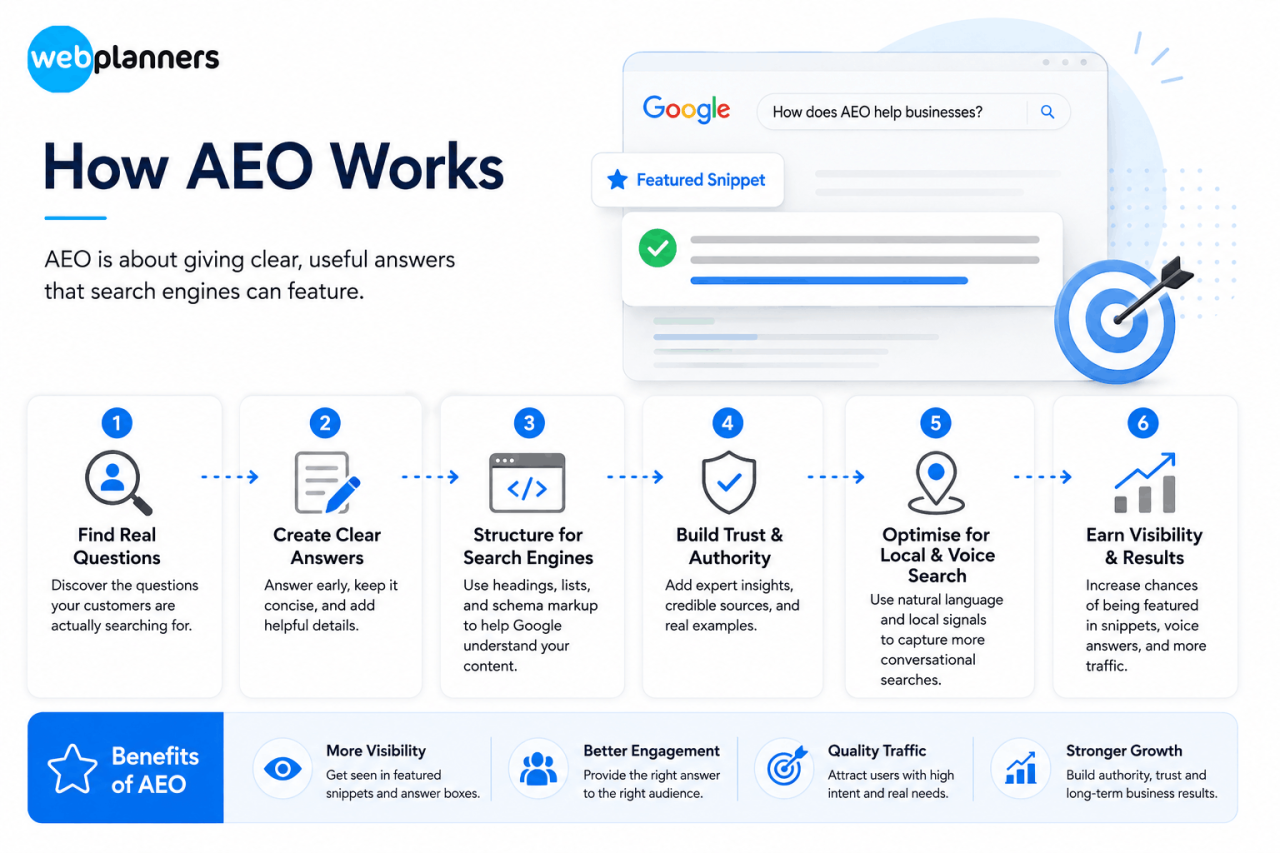
AEO works best as part of a wider organic search strategy.
Your website still needs strong technical foundations, useful content, relevant internal links, good page experience and a clear information structure.
For Melbourne businesses, that broader strategy can consider support from an SEO company in Melbourne.
The goal is simple: make your website useful for people and easy for search systems to understand.
Conclusion
Answer Engine Optimisation is about making useful information easier to understand and extract when people search for answers.
It works best when it forms part of a broader SEO strategy rather than sitting separately from it.
If your business operates in Melbourne and you want to assess where your website can improve across organic search, conversational queries and answer-focused search experiences, Webplanners can help with the wider strategy.
FAQs
Is AEO exclusive to Google?
No. AEO is a more generic industry term for optimising content for answer-focused search experiences. Which exact search feature or system is used depends on the platform and the query.
Can AEO assist local businesses?
Yes. Location-based questions are not enough with useful answers; they often need good business information. This is where local SEO comes into play as an important part of the wider strategy.
Does AEO mean writing lots of FAQs?
No. FAQs can be useful when they answer real customer questions, but AEO is beyond FAQ content. Structure of the page, intent, quality of the content, technical SEO and clear answers all count.
Will an AEO strategy work with voice search?
Yes. Voice queries are usually natural, conversational questions so clear question and answer content can help support voice search SEO as part of a wider SEO strategy.