
A page can rank well, attract organic traffic and generate enquiries, yet still have little presence when customers turn to AI search.
That is because traditional SEO performance and AI search visibility are related, but they are not the same thing. A page that performs strongly for a specific keyword may not contain the depth, context, evidence or direct answers needed when an AI system builds a response from multiple sources.
Google itself states that its generative AI search features continue to rely on core Search ranking and quality systems, while also advising site owners to focus on clear technical structure and unique, useful content.
Keep reading, as we’ll look at why strong SEO pages can be overlooked in AI search and what businesses should assess across their existing content.
Your highest-traffic SEO page is not automatically your strongest AI search asset.
A page may perform well because it targets a valuable keyword, has strong backlinks, matches search intent and has built authority over time. AI systems have a broader task when generating an answer: they need to understand the subject, identify relevant information, connect concepts and select useful sources for a particular question.
That means businesses should assess more than rankings and traffic.
Look at:
- Whether the page answers specific customer questions
- Whether the information is detailed enough to provide useful context
- Whether expertise and first-hand knowledge are visible
- Whether the page clearly relates to the business and its core entities
- Whether supporting pages strengthen the topic
- Whether important information exists as accessible page content
- Whether the page remains useful when a customer asks a more specific question
Google's advice also makes an important point: there is no separate technical shortcut that guarantees visibility in generative AI features. Strong SEO fundamentals remain central.
A Page Can Win Google Traffic Without Answering the Bigger Question
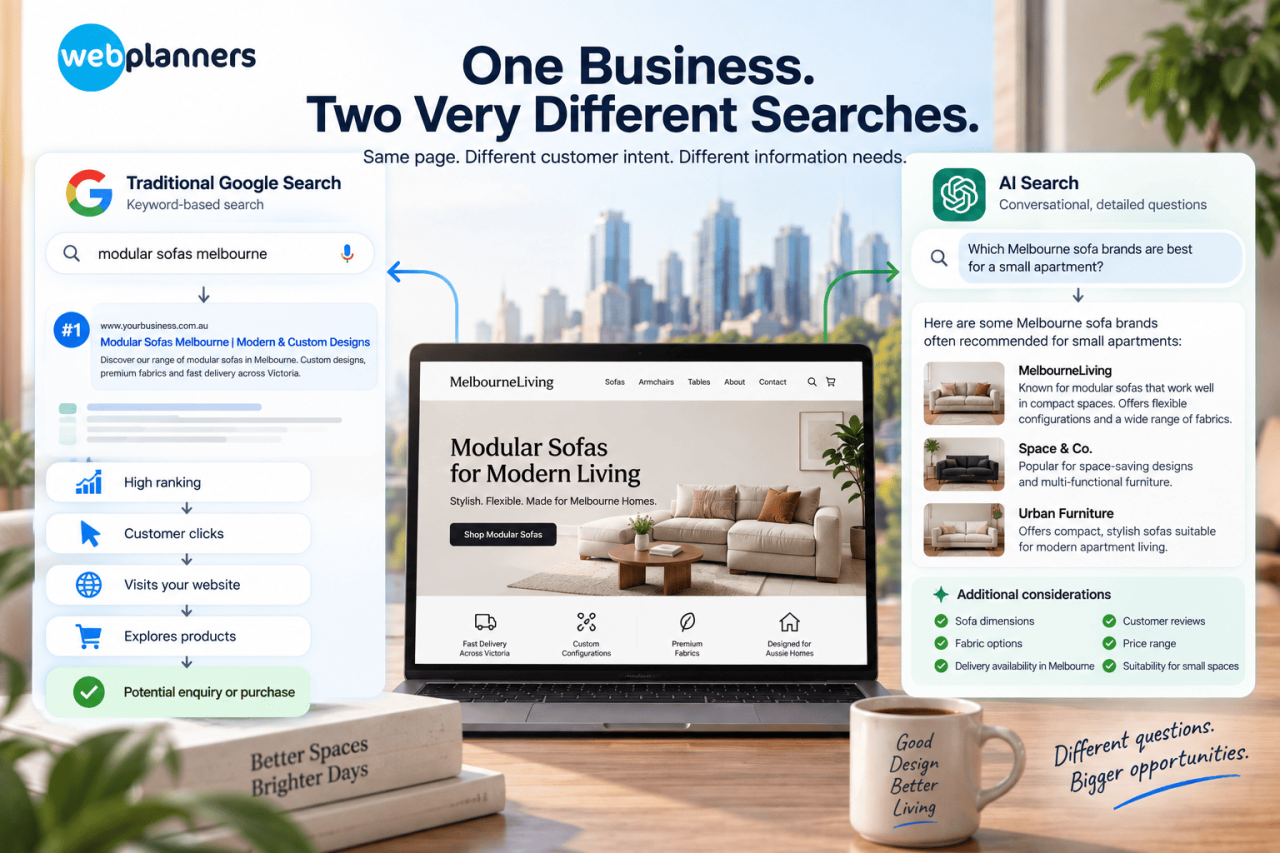
Consider an online furniture business with a page targeting:
“modular sofas Melbourne”
The page ranks well and receives steady organic traffic.
It might contain:
- A product range
- Pricing information
- Product specifications
- Delivery details
- Strong internal links
- Optimised title and headings
From a traditional SEO perspective, that page may perform very well.
But a customer could ask an AI platform:
“Which modular sofas are best for a small Melbourne apartment?”
That question introduces several additional considerations:
- Space requirements
- Sofa dimensions
- Configuration options
- Fabric suitability
- Delivery availability
- Apartment access
- Price range
- Customer reviews
- Product comparisons
The original page may rank for the broad search while providing little information that directly addresses the more specific question.
This is one reason AI SEO requires businesses to look beyond individual keyword positions and consider the information customers need throughout the decision process.
Why AI Search Changes What Makes a Page Useful
Traditional search often starts with a keyword.
AI search can start with a complete question.
That difference matters.
Someone searching:
“Melbourne activewear”
has a relatively broad intent.
Someone asking:
“Which Melbourne activewear brands make durable leggings for regular gym training?”
has already supplied context, preferences and a potential buying requirement.
The AI system has to interpret that request and identify information that helps answer it.
This is where a page's information depth becomes important.
A strong page does not need to contain every possible question. It should, however, provide enough useful information for its main subject to be understood clearly.
Google's current generative AI guidance recommends unique, useful content aimed at people rather than content produced simply to target different variations of search queries.
That distinction is important. Businesses should not create dozens of near-identical pages just because AI search can generate many variations of a question. Instead, strengthen the pages that genuinely deserve to exist.
Strengthen Your Website For AI Search
Traffic Tells You What People Visit But No What AI Needs
Organic traffic is still an important SEO measurement.
So are:
- Rankings
- Click-through rate
- Conversions
- Engagement
- Revenue
- Leads
But these metrics answer a different question:
How is this page performing in traditional search and business outcomes?
AI search introduces another question:
Does this page contain information that can support an answer to a customer's more detailed query?
A page receiving 10,000 monthly visits may have strong commercial value. Another page receiving 500 visits may contain far more specific information about your products, processes or expertise.
Neither traffic figure tells you which page an AI system may use for a particular response.
This is why AI search analysis should sit alongside your existing SEO reporting rather than replace it.
What Can Make a Strong SEO Page More Useful for AI Search?
1. Clear Answers to Real Customer Questions
Important information should be easy to locate and easy to read on a page.
In an activewear business that could be:
- Which fabrics are good for high-intensity training?
- What is the fit of leggings?
- What is the difference between compression and everyday activewear?
- How should customers care for technical fabrics?
- What products do you have for different training styles?
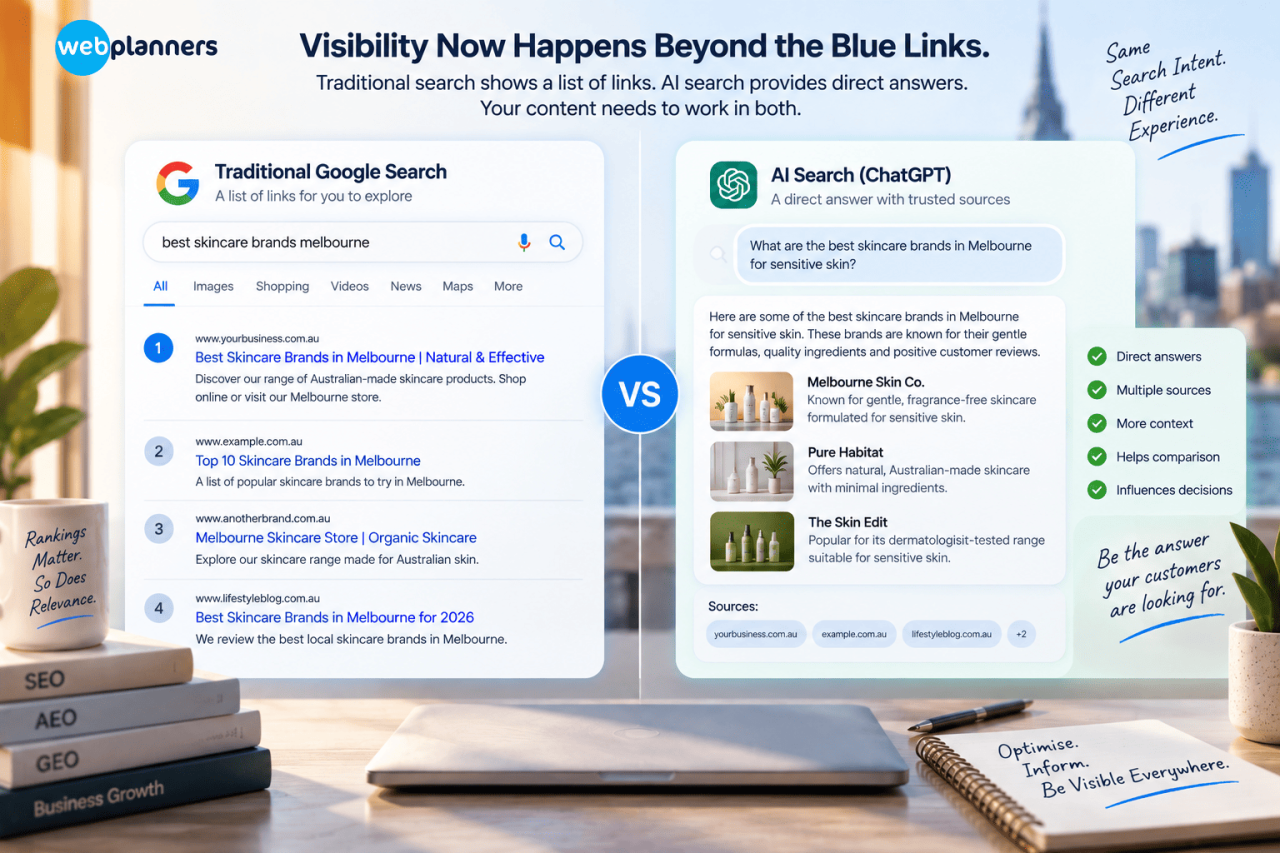
The questions can be about ingredients, skin types, product use, routines and product combinations for a skincare brand.
This is where AEO and GEO become relevant. Answer-focused content can make important information clearer for both users and search systems.
The goal is not to turn every page into a long FAQ. It is to answer the questions that genuinely belong to the page.
2. Evidence of Experience and Expertise
AI systems can draw from many sources. Generic statements provide little differentiation.
Compare:
“We sell high-quality activewear.”
with:
“Our running tights use a four-way stretch fabric tested through repeated training sessions, with a higher waistband designed to stay in place during movement.”
The second statement provides specific information.
It tells the reader:
- What the product does
- How it is designed
- What experience informs the claim
- Why the feature matters
This is where E-E-A-T becomes useful. Experience, expertise, authority and trust are not simply boxes to tick. They should appear through the actual information a business publishes.
Author information, first-hand observations, product testing, original research, useful comparisons and evidence can all add substance where they genuinely apply.
3. Strong Connections Between Pages
AI search does not only depend on one isolated page.
Your website should make the relationship between important topics clear.
For example, a skincare website might have:
Skincare:
→ Sensitive Skin
→ Fragrance-Free Products
→ Moisturisers
→ Ingredients
→ Product Guides
Each page serves a different purpose while contributing to a broader understanding of the business.
This is also where Entity SEO matters. Your website should make it clear what your business is, what you sell, which services or products belong to you, who you serve and how different parts of your offering relate to each other.
A well-structured site gives search systems more context than a collection of unrelated pages targeting individual keywords.
4. Information that goes beyond generic descriptions
One of the biggest problems with AI search content is sameness.
If ten websites publish almost identical explanations of a topic, there is little reason for an AI system to rely heavily on one particular page.
Businesses have an opportunity to add information that comes from their own experience.
That could include:
- Original research
- Product testing
- Customer insights
- First-hand observations
- Local knowledge
- Industry-specific examples
- Detailed comparisons
- Proprietary data
- Case studies
The Webplanners material on generative AI content also highlights comprehensive topic coverage, question-and-answer formats, original research, case studies and useful comparisons as content formats that can provide stronger source value.
The key point is simple: give people something useful that cannot be produced by swapping a few words in an existing page.
What Should You Check on Your Highest-Performing Pages?
Start with your top organic pages rather than creating new content immediately.
For each page, ask:
Does the page answer the obvious next question?
If someone reads the page, what would they ask next?
Add useful information where there is a genuine gap.
Is the page specific enough?
Replace broad claims with concrete information wherever possible.
Is your expertise visible?
Show relevant experience, evidence, examples and supporting information instead of relying on promotional statements.
Does the page explain the business clearly?
Make your products, services, audience, location and areas of expertise clear.
Does the page connect to related content?
Use relevant internal links to help users and search systems understand the wider subject.
Does the page still make sense outside its target keyword?
Remove the keyword and read the page as a customer would.
If the content becomes vague without the keyword, it probably needs stronger substance.
Build Content That Supports AI Search Visibility
Don't Rewrite Every High-performing Page for AI
This is where many businesses can waste time.
A page that already performs well does not automatically need a complete rewrite.
Start by identifying what is missing.
For example:
| Existing strength | Possible gap |
|---|---|
| Strong organic rankings | Limited answers to detailed questions |
| High traffic | Little first-hand information |
| Good backlinks | Weak connection to related topics |
| Strong product descriptions | Few comparison points |
| Clear service information | Limited evidence of expertise |
| Good local rankings | Weak supporting information about location |
| Strong commercial intent | Little information for earlier research stages |
The right response may be a targeted content improvement, stronger internal linking, clearer page structure or additional evidence. It does not have to mean starting again.
Google's own guidance supports this approach: its recommendations for generative AI search continue to emphasise sound SEO fundamentals, useful content and clear technical structure rather than separate AI-only tricks.
Conclusion
Your best SEO page and your best AI search page may be the same page.
But they may also be completely different.
Rankings and traffic show where your website performs in traditional search. AI search adds another layer: whether your content contains clear, useful and trustworthy information that can support more detailed customer questions.
The answer is not to abandon SEO or create a separate set of pages for every AI query. Strengthen the pages that already matter, add genuine expertise and useful detail, connect related topics, and measure how your visibility changes across both traditional and AI search.
Want to know whether your existing SEO strategy is ready for AI search? Talk to the Webplanners team for a practical assessment of your website, content and search visibility.
FAQs
Can a page with low organic traffic still be valuable for AI search?
Yes. Traffic counts visits, not the overall utility of information on a page. A page with a modest amount of organic traffic may have very specific information that helps support detailed customer questions, comparisons or recommendations.
How often should I review pages that perform well in SEO?
Not necessarily. It creates needless duplication to make large numbers of pages for minor variations on the same question. When it truly belongs on an existing relevant page, it is generally more useful to strengthen that page. Google’s guidance today also cautions against creating content at scale to primarily manipulate Search or generative AI visibility.
How often should I review pages that perform well in SEO?
There’s no set review period that works for all websites. Important pages to review: When customer needs change Products / services change Search behaviour changes Organic performance and conversions change For AI search, also verify that the information continues to accurately represent the business and addresses current customer questions.