
We ran a 12-month internal experiment on our own SEO workflow. The results were better than we expected, and the failures were more instructive.
At Webplanners, we do not advise clients on an AI SEO workflow without testing it ourselves first. So instead of publishing a think piece about what AI might do for SEO, we quietly replaced around 40% of our own internal processes with AI-assisted tools and tracked exactly what happened.
Every process we tested ran on live client work, real briefs, and actual deliverables. The outcomes were tracked against our existing benchmarks, not a controlled environment designed to make AI look good.
Here is what changed:
- Keyword research time dropped by 55%: What took a senior strategist most of a day now takes under an hour.
- Content brief production dropped by 60%: Less rebuilding from scratch. More time on strategy.
- On-page audit turnaround dropped by 50%: More thorough output in half the time.
But the numbers are only half the story. This post covers all of it. What we handed to AI, what we refused to, what improved, what broke, and what it means if you are considering using AI for SEO inside your own business.
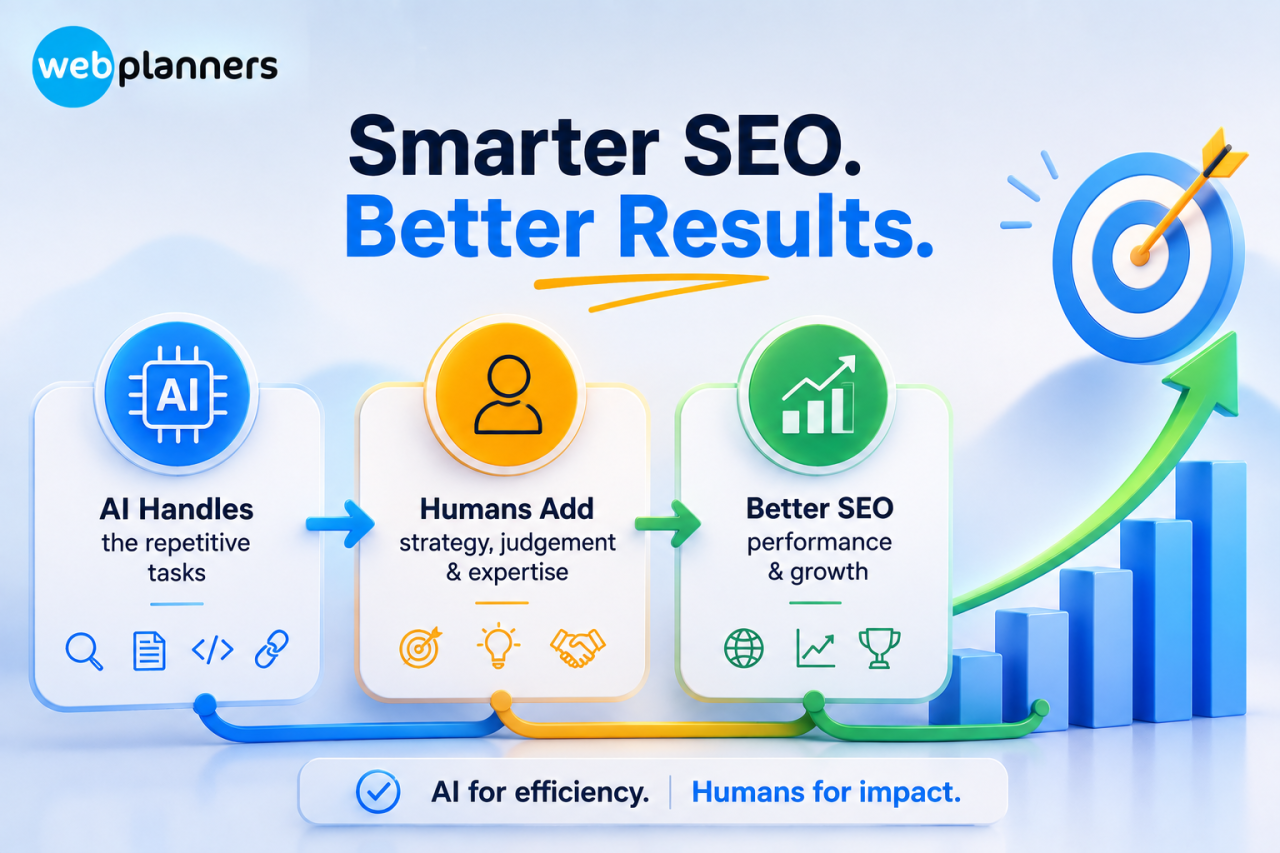
Replacing part of an SEO workflow with AI tools can significantly reduce time spent on repeatable tasks such as keyword research, content brief creation, on-page auditing, and schema markup drafting. However, tasks that require commercial judgement, client-specific expertise, and performance interpretation still depend on experienced human strategists. The most effective AI SEO workflows maintain clear boundaries between what AI handles and what humans decide, using AI to improve speed and consistency while keeping strategic oversight firmly with the team.
What Prompted the Change
Our team was spending significant time on tasks that were valuable but did not require the kind of strategic thinking our clients actually pay for. Content documentation that took hours. Briefs rebuilt from scratch every time. Competitor analysis that was thorough but slow.
We had a benchmark as well. Having helped one client grow organic traffic by 261% in 90 days with AI-assisted SEO, we then set out to understand precisely what had made that success possible. We broke down the progress, step by step, so we could replicate it consistently across every client campaign.
The goal was not to reduce headcount or cut corners. The goal was to free our strategists to focus on the work that actually moves the needle: analysis, strategy, and client-specific decision-making.
Part of that move was to get beyond just ad hoc AI usage and actually build structured systems. We built client and use case specific AI environments, documented workflows and repeatable processes that allowed us to scale our AI SEO services without compromising quality or consistency.
The 40% We Handed to AI
1. Keyword Research and Clustering
AI is now aiding initial keyword discovery, search intent classification, and topical cluster mapping. We also feed the AI with manually researched seed keywords, competitor insights, and client-specific information to uncover missed opportunities and expand topical coverage. What once took a senior strategist four to six hours now takes less than an hour. Then our SEO specialists check each suggestion for commercial value, search intent, and accordance with the client’s business goals before proceeding.
2. Content Brief Creation
AI writes the first draft of each content brief, using our structured briefing framework. It analyses the client information, target keywords, search intent, competitor pages, NLP entities, internal linking opportunities, and content gaps and then generates a detailed outline. Instead of starting from a blank page, our strategists review, develop and strengthen every brief with commercial insights, conversion opportunities and client-specific context.
3. On-page SEO Auditing
Most of the standard on-page checks (title tags, meta descriptions, heading structure, keyword cannibalisation, image optimisation, content coverage etc.) are completed using AI-engineered processes. We’ve built our own SEO audit frameworks and checklists into these AI processes to identify problems that are often missed in manual audits. Then our experts prioritise recommendations based on business impact and implement the most important fixes.
4. Schema Markup Drafting
AI produces the first draft of schema markup for service pages, blog posts, local business pages and other structured data opportunities based on predefined templates and SEO best practices. Each implementation is then manually reviewed, changes are made and validated before going live. Schema mistakes can look small, but the consequences can be huge. That’s why human review is still important.
5. Internal Link Mapping
AI analyses the entire website to find internal linking opportunities, topical relationships, orphan pages and content clusters that should be linked. It recommends relevant link placements and possible anchor text based on the context of the page. Before making any changes, our SEO specialists identify which links actually contribute to user experience, topical authority and conversion paths.
6. First Drafts of Structured Content
For repeatable content formats (FAQs, comparison pages, service content, landing pages, how-to guides) AI creates the first draft based on our structured prompts and client knowledge base. Then, human editors rewrite, fact check, strengthen the messaging, refine the tone of voice and optimise the content for conversions before publishing.
7. Client-specific AI Environments
We do not rely on generic AI tools, but instead create tailored AI environments for every client. For every client, we create custom GPTs, Claude Projects, prompt libraries and knowledge bases that are built around the client’s brand, services, target audience, tone of voice and SEO strategy. Context is the starting point for all AI interactions, resulting in more powerful, consistent first drafts.
8. AI Workflows That Can be Repeated
Once those AI environments are built, we then utilize our custom made AI workflows and dedicated Claude skills for tasks like content creation, SEO analysis , Google Ads copy, website copy, competitor research and reporting along with the traditional relevant practices that still work today. The AI does the repetitive production work while our specialists review, refine and approve each output to ensure it is accurate, commercially relevant and meets the client’s objectives.
The 60% We Kept Human
This is the part most discussions about AI SEO automation skip over. Not everything improved when we handed it to AI.
1. Strategy and Commercial Prioritisation
AI can find keyword opportunities, content gaps, and authority weaknesses. It cannot tell which opportunities best align with a client’s revenue objectives, target audience, service priorities, or growth strategy over the long term. Here is why experienced SEO consultants come in. They decide what gets attention first, and more importantly what doesn't.
2. Client-specific Content
The AI produces organised first drafts, but each one goes through a human process before publishing. Our writers polish the messaging, strip out generic AI language, integrate client feedback, industry expertise and real-world examples, and mould the content to the client’s unique brand voice. That process continues to evolve as we learn more about each business as time goes by.
3. Technical SEO Diagnosis
AI is excellent at identifying technical SEO issues but diagnosing what’s behind them requires experience. Our technical specialists will crawl anomalies, indexation issues, rendering issues, JavaScript conflicts, redirect chains to complex site architecture issues, looking into context, prioritising fixes and recommending the right solution rather than relying on automated suggestions.
4. Relationship and Outreach Work
Human expertise still matters when it comes to building authority. Identifying high-quality, relevant websites, securing valuable backlinks, earning media mentions, and developing digital PR opportunities require research, communication, and genuine relationships. AI can aid in prospecting, but trust and authority are earned through human expertise and strategic outreach.
5. Performance Interpretation
AI is great at generating dashboards and highlighting changes, but it doesn’t know why those changes in performance matter to a particular business. Our specialists interpret search behaviour, competitor shifts, seasonal trends, conversion data and commercial outcomes to understand what’s driving results and when a strategy needs to pivot. Data is only useful if somebody knows what to do with it.
See How AI Can Work Inside Your SEO Operation
What Actually Improved
The speed gains were real and significant. But the more interesting improvement was quality consistency.
When AI handles the structured, repeatable parts of the workflow, the output is more consistent than when different team members do the same task differently on different days.
This is a benefit that most discussions about AI workflow do not emphasise enough. AI does not just save time. It reduces the variance in output quality across a team.
We also noticed improvements in our ability to handle scale. Tasks that previously required us to limit how many clients we could serve at a given level of depth became more manageable. That directly contributed to the kind of results we have been able to deliver, including the work we have done around AI SEO for local businesses across Melbourne and other suburbs.
One area that benefitted particularly well from AI-assisted structuring was answer-engine optimisation. When you are working to get content cited in AI-generated answers, the formatting and entity signals need to be precise and consistent across every page.
Our AEO services in Melbourne improved in delivery quality once AI was handling the structural groundwork, freeing our specialists to focus on the authority-building layer.
What Did Not Work
Honesty matters here. A few things we tried either failed outright or required so much remediation that the time-saving evaporated.
1. Fully AI-generated Client-facing Copy
We tested publishing AI-generated content that had only light human reviews. Performance was measurably worse than copy that went through full human editing. Engagement metrics dropped. Conversion rates dropped. We pulled it back within eight weeks. The lesson: AI drafts need real editing, not a quick proofread.
2. AI-led technical SEO Recommendations Without Human Validation
On two occasions, AI tools flagged what looked like significant technical issues. Both turned out to be false positives caused by unusual site configurations. Acting on those recommendations without a human validation step cost time and led to one page being incorrectly indexed. Human sign-off on technical changes is now mandatory before anything is implemented.
3. Over-relying on AI for Competitive Analysis Context
AI tools are excellent at surfacing what competitors are doing on-page. They are poor at interpreting why a competitor has a particular strategy or whether it is actually working for them. We found ourselves making recommendations based on competitor tactics that turned out to be legacy decisions the competitor had already abandoned.
What This Means for Your Business
If you are thinking about building an AI SEO workflow for your own business, the lesson from our experience is straightforward.
AI performs best when it is handling structured, repeatable, data-heavy tasks. It performs poorly when it is expected to replace commercial judgement, creative expertise, or contextual knowledge.
- The 40% we replaced were tasks where the input is defined, the process is consistent, and the output can be verified by a human in less time than it would take to do from scratch.
- The 60% we kept were tasks where the value comes from understanding the client, the market, and the specific context.
The businesses winning with AI SEO automation right now are not the ones that handed everything to a tool. They are the ones that redesigned their workflow with clear boundaries between what AI does and what humans decide.
This same logic applies directly to generative engine optimisation. Structuring content for AI search platforms like Gemini and Perplexity requires precision that AI tools can assist with, but the strategic layer is firmly human work. Our GEO services in Melbourne are built on exactly this division.
AI is transforming SEO in Australia at a pace that is outrunning most businesses' ability to adapt. The window for building a genuine workflow advantage is now, before these approaches become standard across the industry.
Build an SEO Workflow That Scales With Your Business
Final Thoughts
Replacing 40% of our AI SEO workflow with AI tools was one of the most valuable operational decisions we have made as an agency. It made us faster, more consistent, and more capable of delivering depth at scale.
It also clarified something important. The value of an experienced SEO team is not in doing the tasks that AI can now handle. It is in knowing what to do with what AI surfaces and making the strategic calls that no tool can make for you.
One place where that human and AI balance consistently produces strong results is in generative AI services, where the content architecture has to be precise enough for large language models to interpret reliably, but the strategy behind it requires genuine commercial understanding of the client's market.
If you want to understand how using AI for SEO could work for your business and what the real boundaries of AI-assisted SEO look like in practice, Webplanners is the team to talk to. We have lived it. We can build it for you too.
FAQs
How do you decide which SEO tasks to hand to AI and which to keep human?
The clearest test is whether the task has a defined input, a consistent process, and an output that a human can verify quickly. Keyword clustering, schema drafting, and on-page auditing meet that test. Strategy, client-specific content, and performance interpretation do not. The boundary is not about capability. It is about where judgement and context create value that AI cannot replicate.
Does using AI in an SEO workflow affect how long it takes to see results?
In our experience, yes, positively. Faster brief production and audit cycles mean optimisation work gets implemented sooner. That said, the fundamentals of SEO, authority, relevance, and technical health still take time to compound regardless of how efficiently the work is produced.
What should a business look for when evaluating whether an agency is using AI responsibly?
Ask which tasks are AI-assisted and what the human review process looks like for each one. A straight answer to that question is a reasonable thing to expect. An agency using AI properly should be able to walk you through where the tool is involved, where a human makes the call, and how quality gets checked before anything goes to a client. If the answer is vague or defensive, that tells you something worth knowing before you sign anything.
Can the same AI workflow approach work across different types of SEO?
Yes, though the split looks different depending on the discipline. In local SEO, AI handles citation auditing and schema drafting while humans manage GBP strategy and review responses. In technical SEO, AI finds the issues while humans work out what is actually causing them. In content, AI produces structured drafts while human experts check accuracy and voice before anything goes live. The underlying principle stays the same across all of them; however, the specific tasks on each side of the line change quite a bit depending on what kind of SEO work is being done.