
For years, eCommerce SEO has focused heavily on product rankings, category visibility, technical performance and commercial keywords. Those fundamentals still matter. What has changed is how people search, compare products and decide what to buy.
A shopper might now ask Google or an AI search tool, “What are the best running shoes for someone who walks and runs several times a week?” rather than simply searching for “running shoes Melbourne”. They may ask which sofa suits a small apartment, which skincare product is better for dry skin, or which laptop offers the best battery life for university.
That changes what an eCommerce website needs to communicate. Keep reading as this blog looks at what online stores need to change across product pages, category architecture, structured data and content.
AI has not replaced eCommerce SEO. It has changed the amount and type of information a store needs to communicate.
Product pages need more than a product name, price and short description. Category pages need a clear purpose. Product variants, availability, reviews and other commercial details need to be presented accurately. Content should answer genuine shopping questions rather than repeat generic keywords.
AEO and GEO can be useful ways to think about visibility in conversational and generative search, but they should sit alongside solid SEO rather than replace it. Google states that there are no special requirements or separate schema types needed just to appear in AI Overviews or AI Mode.
1. Product Pages Need to Answer Real Buying Questions
A traditional product page might contain:
- Product name.
- Price.
- A few images.
- Short description.
- Add-to-cart button.
- Basic specifications.
That can be enough for a customer who already knows exactly what they want. It is less useful for someone still comparing options.
AI-driven search can involve much more specific questions.
For example, someone shopping for a dining table might ask:
- Is this table suitable for a six-person dining room?
- What material is it made from?
- Is it easy to clean?
- How much assembly is required?
- What chairs work well with it?
- Is it suitable for a small apartment?
- What are the delivery options?
Your product page does not need to turn into a huge block of text. It needs to provide the information a shopper genuinely needs at the point of consideration.
Google's current AI search guidance places particular emphasis on useful, unique content that offers information beyond generic material repeated across the web.
Prepare Your Online Store For AI Search
2. Product Descriptions Should Provide Context
Changing a product description from:
“Women's black running shoes. Lightweight running shoes for women. Buy women's running shoes online.”
to a longer version stuffed with variations of “women's running shoes” does not solve the underlying problem.
Instead, explain what makes the product useful.
For example:
Lightweight road running shoes for everyday training
Then provide information about:
- Cushioning
- Fit
- Weight
- Intended running surface
- Distance suitability
- Materials
- Available sizes
- Care instructions
- Warranty
- Delivery and returns
This gives search systems and shoppers more meaningful information to work with.
3. Category Pages Need a Clearer Role
One common eCommerce problem is treating category pages as simple collections of product links.
A well-structured category page can do much more.
Take an online furniture store:
Living Room Furniture
→ Sofas
→ Modular Sofas
→ Sofa Beds
→ Armchairs
→ Coffee Tables
→ TV Units
The category page should explain what the category contains, help shoppers compare relevant options and connect naturally to important subcategories.
This creates a clearer relationship between the store's products and topics.
The same principle applies to fashion, electronics, homewares, beauty, sporting goods and almost any other eCommerce sector.
4. Product Data Needs to be Technically Clear
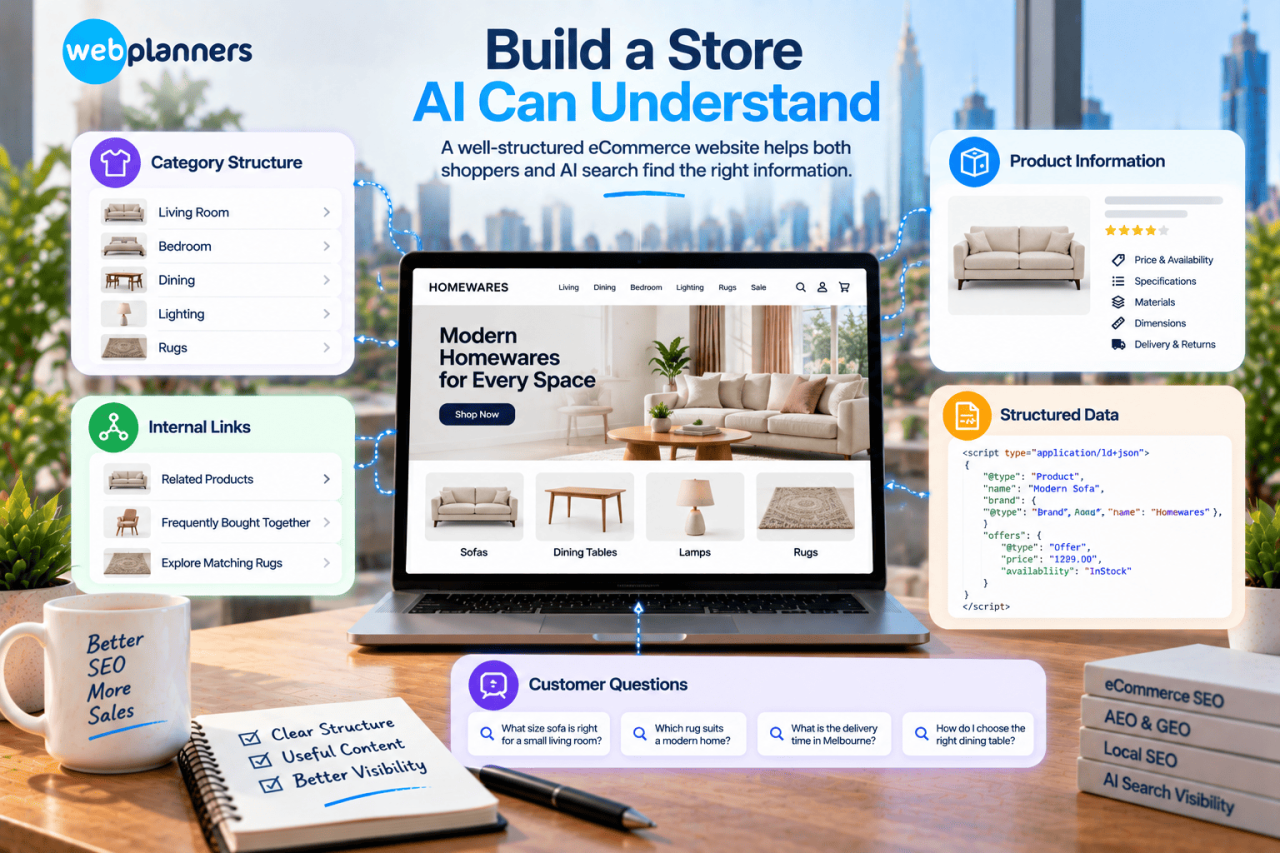
AI search does not remove the need for technical SEO. In fact, large online stores have even more information that needs to be presented accurately.
Google supports Product structured data for information such as product details, offers, reviews, ratings and availability. Merchant listing experiences can also use information such as price, shipping and returns.
For stores selling products with multiple versions, variant information matters too.
A clothing retailer might sell one jacket in:
- Black
- Navy
- Green
- Small
- Medium
- Large
Google provides ProductGroup and Product structured data specifically for product variants such as different sizes, colours and materials.
The important point is that structured data should reflect what shoppers can actually see and buy. It is not a shortcut to AI visibility.
Google explicitly says there is no special schema markup required for AI Overviews or AI Mode. Structured data remains useful as part of broader SEO and search appearance work.
5. AEO Matters When Shoppers Ask Questions
AEO, or Answer Engine Optimisation, is useful as a way of thinking about question-based search.
For an eCommerce store, that means considering the questions people ask before they buy.
A furniture retailer could answer:
What size sofa is suitable for a small living room?
A skincare retailer could answer:
What should I look for in a moisturiser for dry skin?
An activewear store could answer:
What should I wear for running in cold weather?
These questions can sit within category content, buying resources, product comparisons or relevant product pages.
The goal is not to turn every page into an FAQ. It is to provide genuinely useful answers where they help someone make a purchase decision.
6. GEO Should Support the Wider SEO Strategy
GEO, or Generative Engine Optimisation, is another term businesses increasingly encounter when discussing AI search.
For an online store, the practical question is not simply, “How do we optimise for GEO?”
It is:
Does our website contain useful, reliable information that an AI system can understand and reference when someone asks a relevant shopping question?
That means looking at:
- Product information
- Category relationships
- Buying advice
- Comparisons
- Reviews
- Brand information
- Delivery and returns
- Original expertise
- Relevant local information
Google's current AI search guidance specifically warns against chasing supposed AEO or GEO shortcuts. It recommends continuing with strong SEO foundations and useful, non-commodity content.
7. Local SEO Still Matters for E-commerce
Selling online does not automatically make location irrelevant.
Many eCommerce businesses have:
- Melbourne showrooms
- Physical retail stores
- Click-and-collect locations
- Local delivery areas
- Warehouses
- Installation services
- Service teams
- Melbourne-specific offers
A shopper might search for:
“Where can I buy a sofa in Melbourne?”
or:
“Best furniture store near Richmond with delivery?”
The website needs to communicate its location and services clearly.
This is where local SEO services can complement eCommerce SEO. Local business information, location pages, Google Business Profile information and relevant website content all contribute to a clearer local presence.
8. Strategy Plays An Important Role
AI tools can speed up parts of eCommerce SEO.
They can help teams:
- Group large keyword datasets.
- Identify recurring customer questions.
- Compare product attributes.
- Find gaps between categories.
- Create content briefs.
- Analyse internal linking opportunities.
- Summarise large inventories.
- Assist with initial product copy.
But publishing thousands of automatically generated product descriptions creates a different problem.
If 1,000 products receive almost identical AI-written descriptions with only the product name and colour changed, the store has not created 1,000 useful pieces of information.
Generative AI can assist with content creation, but mass-produced pages that add little value can fall under its scaled content abuse policies.
Human review still matters, particularly for product specifications, claims, comparisons and buying advice.
9. Measure Visibility Beyond Traditional Rankings
A strong eCommerce SEO strategy should not rely on one number.
Look at:
- Organic revenue.
- Product page traffic.
- Category page performance.
- Non-brand search traffic.
- Conversion rates.
- Assisted conversions.
- Product visibility.
- Search Console performance.
- AI search visibility where measurable.
- Queries generating commercial traffic.
That matters for eCommerce because shopping behaviour is becoming increasingly visual as well as conversational.
A product can be relevant to a customer even when that customer does not begin with a traditional ten-word Google query.
Build A Stronger SEO Strategy For Your Store
Conclusion
AI has not created a completely separate version of SEO for online stores. It has made the quality and clarity of existing information more important.
A product page should help someone understand a product. A category page should help someone understand their options. Structured data should accurately describe the information already present. Internal links should connect related areas of the store. Content should answer genuine questions. Local information should be clear when location influences the purchase.
That is where AI SEO becomes practical. It is not about filling a website with AI-generated text or chasing a new technical trick. It is about making the store useful and understandable across the different ways people now search.
For an online retailer, working with an experienced eCommerce SEO company in Melbourne can help bring these areas together across technical SEO, content, product architecture and search visibility.
Ready to strengthen your eCommerce search presence? Talk to Webplanners today and let’s discuss how we can help your online store attract more qualified customers.
FAQs
Should an eCommerce website have different content for AI search?
Not necessarily. Google says there are no specific content requirements for AI Overviews or AI Mode. Existing SEO basics still count, with useful, people-first content at the core.
Should every product page have a long description?
No. The length of the page should be defined by what the shopper needs to know. There’s no set word count for a product page, just enough accurate information to help your customers make their purchasing decision. There is no ideal page length for generative AI search.
Can AI write all my product descriptions?
AI can assist in the process, especially for large inventories, but human review and original product information is still important. Creating lots of low-quality pages automatically can lead to spam and quality problems.